As of November 2026. Prices, rankings and acquisitions checked on 9 November 2026.
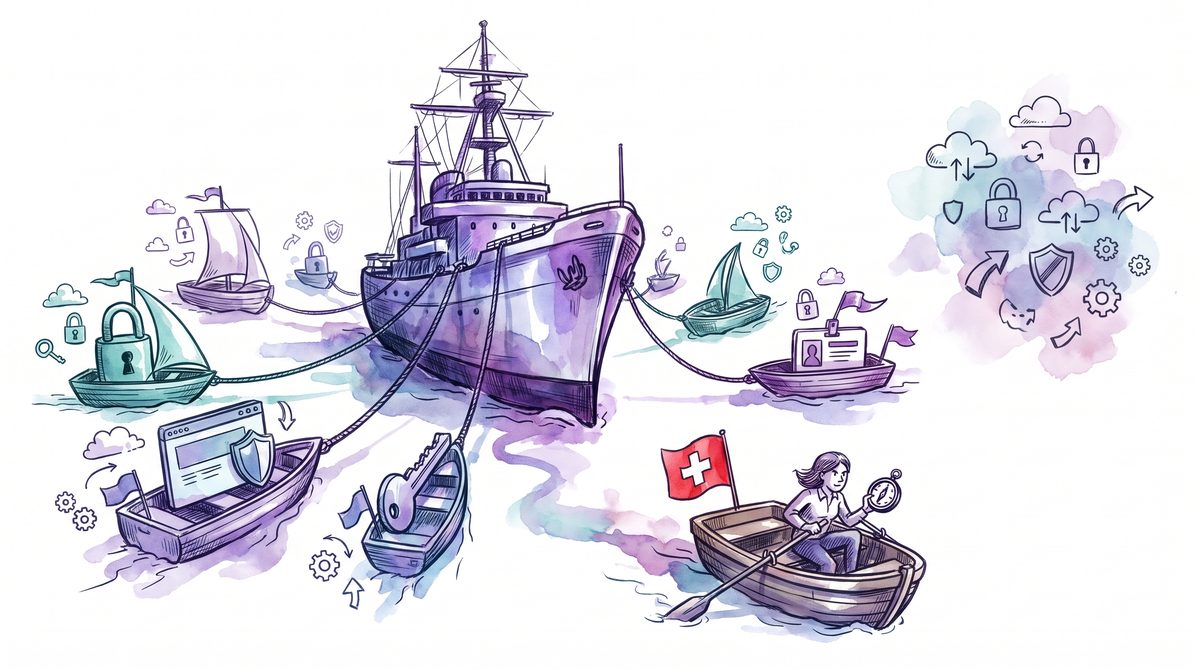
Between August 2025 and November 2026, the big security vendors bought a dozen specialist companies: for identity, privileged access, browser protection, machine identities and cloud security. That leaves fewer vendors to choose from. For a Swiss SME this means two things. Every new contract ties you more closely to one platform. And a large part of what these platforms sell is already included in the Microsoft or Google subscription you pay for today.
If you first want to clarify what Zero Trust is and what it is not, start there. This post is about the market: who bought whom, where the vendors are heading, what it costs and which questions you ask before every signature.
Three terms that make the vendor list readable
Vendors almost never sell "Zero Trust". They sell building blocks with three abbreviations:
- ZTNA (Zero Trust Network Access): access to a single application instead of VPN access to the whole network. Whoever signs in only sees the app they are cleared for.
- SSE (Security Service Edge): ZTNA plus web filtering plus control over cloud apps, all delivered as a cloud service.
- SASE (Secure Access Service Edge): SSE plus the company network itself (SD-WAN), from one source.
The further down this list, the more you buy from one vendor, and the more expensive it gets to switch.
Who bought whom in 2025 and 2026

On top of that, Netskope went public in September 2025, and in early November 2026 several media outlets reported that Palo Alto was negotiating to buy Clutch Security, a specialist for machine identities. We read three patterns from the deals. SASE vendors buy identity, browser and detection. Endpoint vendors such as CrowdStrike buy identity and browser. Identity vendors such as Okta buy privileged access and agent control. They all want to be the one platform every access runs through.
For you, this has a sober consequence. The specialist product you bought in 2024 for its independence may today belong to a group whose platform you never wanted. If you use CyberArk for privileged access, you will negotiate the next renewal with Palo Alto.
Which Zero Trust vendors lead in 2026?
According to Gartner's Magic Quadrant for SASE platforms from July 2026, Netskope, Cato Networks, Palo Alto Networks and, new this year, Zscaler are the Leaders. Fortinet dropped out of the Leaders, and Cloudflare is the only Visionary. In Security Service Edge, Zscaler, Netskope and Palo Alto lead. The reports themselves are paid; the placements come from the SDxCentral summary and the vendors' announcements.
In Forrester's evaluation of "Zero Trust platforms" from Q3 2025 (we did not find a newer edition), Check Point, Microsoft and Palo Alto are Leaders. In microsegmentation (Q3 2026) they are Illumio, Akamai, ColorTokens and Cisco.
Two things stand out. First, analysts evaluate platforms, not a product called "Zero Trust". Second, the top moved within one year: Fortinet out, Zscaler in, Palo Alto no longer in first place. A ranking is a snapshot. Anyone who signs a five-year contract today because of a Leader placement is betting that the list stays still. From 2025 to 2026, it did not.
Five directions the vendors are taking
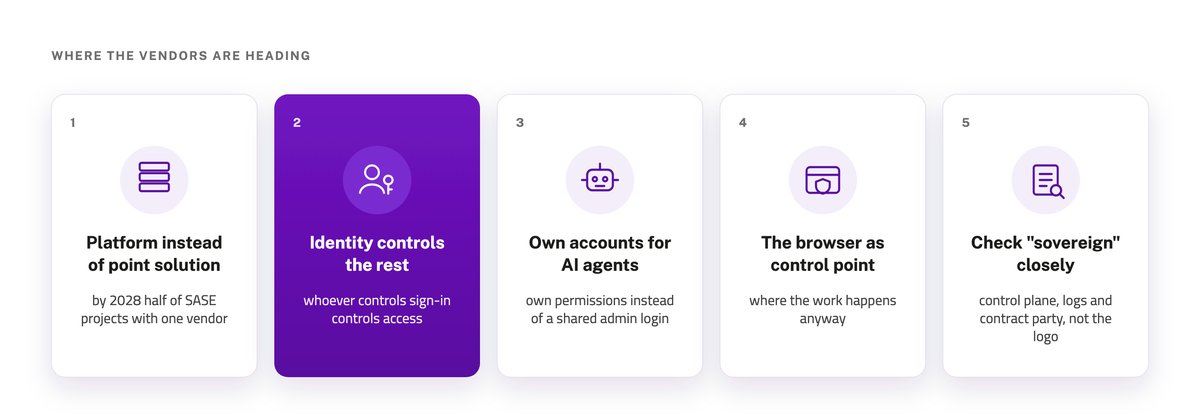
1. Platform instead of point solution. Gartner expects that by 2028 half of new SASE projects will go to a single vendor, up from 30% in 2025 (Gartner Strategic Roadmap for SASE Convergence, June 2025, published by Palo Alto). Fewer interfaces are an advantage, as we explained in fewer tools, more protection. The price is a vendor without which nothing runs anymore.
2. Identity becomes the control layer. Palo Alto with CyberArk, CrowdStrike with SGNL, Okta with Axiom: whoever decides who may sign in also decides the rest. For most SMEs this layer sits in Microsoft Entra or Google Workspace today, whether they chose that consciously or not.
3. AI agents get their own identities. Microsoft Entra Agent ID and Okta for AI Agents have been generally available since 2026. An agent that reads emails or prepares invoices needs its own account with its own permissions, not a shared admin login. Which rules belong to that is covered in our post on governing AI agents. For the next audit, this is the question that comes after MFA: which machines and agents have access in your company, and who approved them?
4. The browser becomes the control point. Zscaler, CrowdStrike and Akamai bought browser technology. Gartner expects that by 2028 a quarter of organizations will use a secure enterprise browser, up from under 10% in 2025 (Gartner, 29.04.2025). For an SME with a lot of SaaS and little network of its own, this is interesting, because the browser is where the work happens anyway.
5. "Sovereign" often means: a US vendor on European infrastructure. Since the end of July 2026, Zscaler has run a SASE offering on STACKIT, the cloud of the Schwarz Group. Versa says it offers control and logs in the EU. That can be enough. But do not ask about the logo on the slide, ask about three things: where does the control plane run? Where are the logs stored? Which legal entity do you sign the contract with? More on the trade-offs in digital sovereignty for Swiss companies.
What Zero Trust costs: list prices compared
List prices per person and month, excluding VAT, for Microsoft, Google, Okta and Twingate on annual plans, as of 9 November 2026. Microsoft and Google show franc prices on their Swiss pages; the other vendors only show dollars. Partners and resellers charge different prices, and the lists change without notice. Check the amount on the vendor's page before you decide.
| Offering | List price | What is included |
|---|---|---|
| Microsoft 365 Business Premium | CHF 17.82 | Office, identity with MFA and access policies (Entra ID P1), device management (Intune), antivirus with EDR; up to 300 people |
| Microsoft Entra Private Access | CHF 4.00 | Per-app access (ZTNA) instead of VPN |
| Microsoft Entra Suite | CHF 9.70 | Private and Internet Access, identity protection, identity governance |
| Google Workspace Business Plus | CHF 22 | Office suite with account and device management |
| Chrome Enterprise Premium | USD 6 | Browser as control point, data loss protection |
| Okta Workforce Starter | from USD 6 | Sign-in (SSO), MFA, directory; minimum contract USD 1,500 per year |
| Cisco Duo | USD 3 / 6 / 9 | MFA and SSO, plus protection against identity attacks, plus ZTNA and full device check |
| Cloudflare Zero Trust | free up to 50 people, otherwise USD 7 | ZTNA, web filtering, SaaS control |
| Twingate Business | USD 10 | ZTNA instead of VPN, quick to set up |
The math for a Microsoft SME: Business Premium plus Entra Private Access comes to CHF 21.82 per person and month for identity, devices, antivirus and per-app access. For 80 people that is just under CHF 21,000 a year at list price, and many companies already pay the larger part of it today. To be honest, that is only the licence part. Setup, testing and the exceptions for the two applications that do not play along cost more time than money, in our experience. The Leaders from the SASE ranking do not publish list prices. Their suites come through partners and are designed for larger environments.
Identity from the office subscription, ZTNA from a specialist where needed: for many SMEs this combination is cheaper than a full suite. You plan the exit at the same time.
ZTNA vendors in Switzerland and Europe
If you do not want to hand control and data entirely to US companies, the choice in Switzerland is limited. This list is a selection, not a recommendation.
- Swisscom beem: a security service in the Swisscom network for SMEs and large companies. Devices, people and sites go to the internet through Swisscom's gateway beemNet, operated in data centres in Switzerland; according to Versa, the technology behind it is Versa's Sovereign SASE. Access to company applications under Zero Trust rules is available from the Essential edition; a complete SASE with company network only together with Swisscom Enterprise Connect. User licence from CHF 7 per device and month, with a mobile subscription from CHF 55 (minimum term 24 months). The Standard and Plus editions cost from CHF 90 and CHF 170 per month respectively for up to three people and one site and run for at least 12 months.
- Open Systems: managed SASE from Zurich (SD-WAN, firewall, web filtering, ZTNA, 24/7 operations), owned by Swiss Post since October 2024. No public prices.
- Airlock (Ergon Informatik, Zurich): protection and access control for your own web applications and APIs (gateway plus IAM). It does not replace a VPN for the whole network, but it is a Swiss answer if your customer portals or business applications are the core.
- Zscaler on STACKIT and Versa with European operations: US technology, infrastructure in Germany and the EU respectively.
Swiss cloud providers such as Infomaniak or Exoscale host your systems; we did not find a ZTNA or SASE product from them. Where your servers are and who controls access to them are two separate decisions.
Before you buy: use what you already pay for
In our experience, most SMEs have unused features before they need a new product. Business Premium includes Entra ID P1 with access policies (Conditional Access), Intune and Defender for Business. Often only part of it is switched on and properly configured. What a clean baseline looks like is described in Microsoft 365 hardening.
The check takes half an hour. In the Microsoft 365 admin center, look under Billing to see which licences you have. Then open the Conditional Access policies in the Entra admin center and count the active ones. If there are none, or only one for admins, you are paying for access policies that are not running. The same goes for Intune: how many of your devices are enrolled there, and how many of them count as compliant? If the answers are "none" and "we don't know", that is your first Zero Trust project, and it costs no additional franc in licences.
| Need | You may already have | Open source |
|---|---|---|
| Strong sign-in | Entra ID P1 (in Business Premium and E3) | Keycloak, authentik |
| Per-app access | Cloudflare Zero Trust (free up to 50), Entra Private Access (CHF 4) | NetBird, Pomerium, OpenZiti |
| Device management | Intune (in Business Premium and E3) | Fleet (osquery) |
| Secrets for machines | Azure Key Vault | OpenBao |
| Logs and detection | Entra sign-in logs, Defender | Wazuh |
Open source is not free. Operations, updates and the know-how cost hours, and in an SME these are often the hours of the same two people.
At an industrial company with around 1,600 employees, we steered a Zero Trust programme across the entire IT. It covered identity and access, endpoints, the lifecycle of user accounts, privileged access, inventory, awareness, contingency planning and detection. At the end there was a shared target picture with aligned concepts instead of isolated solutions, and management could see the progress. With 80 people the programme is smaller, but the order stays the same: first clarify the areas and who is responsible for them, then check what the existing tools can already do, and only then buy for a gap.
Five questions for every vendor
Feature lists look the same for all Leaders. These five questions separate them better:
- Do you cover all identities? Employees, external partners, customers, service accounts and AI agents, without an add-on product?
- How deep is the integration? Does the enforcement point use identity and device signals in real time, and can it revoke access in the middle of a session?
- Do you deliver your own signals? Do we get telemetry we would not otherwise have, or the same data a second time?
- Are there interfaces? If the standard feature is not enough, can we automate via API?
- Where are you heading? Does your roadmap for the next three to five years fit ours, and what happens to our contract if you get acquired?
Two years ago the fifth question was a formality; after this year's acquisitions we ask it first.
Three points belong in every contract: data export in a readable format, a term of no more than three years, and logs that are stored with you and not only with the vendor. An SME does not always get a termination right on a change of ownership. Asking costs nothing. We describe the best moment for all of this in consolidating security tools: the renewal.
The order for 2026 and 2027
- Start with the identity you already pay for. Microsoft, Google and Okta come with MFA and access policies. Phishing-resistant sign-in and clean access policies achieve more than a new product, in our experience.
- Replace VPN with ZTNA as the second step. Ask for a price per person and settle the exit.
- Consolidate, but with an exit. Fewer vendors yes, a single one without a way out no.
- Inventory machines and agents. Service accounts, API keys and AI agents are the next question in every audit.
- Collect evidence from the start. Customers and cyber insurers ask about MFA, backup and remote access. Neither the ISG nor NIS2 requires "Zero Trust". What they require is access control, strong authentication and supply chain security, and the Zero Trust controls are your evidence for that.
If you stick to this order, you may buy a single new product in 2027. Maybe none. If you want to know which gap remains in your company once everything you pay for is switched on, we clarify that in a Security Assessment, measured against the risk and not against a vendor's catalogue.
Frequently asked questions
Which Zero Trust vendors are there in Switzerland?
Swiss options are Swisscom beem (a security service in the Swisscom network with Versa technology, operated in Switzerland), Open Systems (managed SASE, owned by Swiss Post) and Airlock by Ergon (access protection for web applications). Most global vendors such as Microsoft, Zscaler, Netskope, Palo Alto or Cloudflare sell in Switzerland through partners. As of November 2026.
What does Zero Trust cost for an SME?
For a Microsoft SME, most of it is included in the Business Premium subscription (list price CHF 17.82 per person and month). Per-app access instead of VPN costs CHF 4 per person and month with Entra Private Access (list price, November 2026). Cloudflare Zero Trust is free up to 50 people. Complete SASE suites from the large vendors have no public list prices.
What is the difference between ZTNA, SSE and SASE?
ZTNA gives access to individual applications instead of the whole network and replaces the VPN. SSE bundles ZTNA with web filtering and control over cloud apps as a cloud service. SASE adds the company network (SD-WAN) to SSE. The more of it comes from one vendor, the simpler the operation and the more expensive the switch.
Do I need a new vendor for Zero Trust?
Usually not as a first step. Strong sign-in, access policies and device management are already part of the existing Microsoft or Google subscription for many SMEs. A new vendor pays off when a clear gap remains afterwards, typically replacing the VPN with per-app access.