What free AI tools carry in daily operations
Free AI tools almost never fail because of missing features. They fail because nobody decided which work they are supposed to take over. The list of ten tools that went around the group chat in spring sits unused three weeks later, and the conclusion becomes that AI is not ready for this company. Usually it was just the wrong question.
Anyone searching for free AI tools wants a start that costs nothing and breaks nothing. That start exists. We publish free AI tools to copy, with no login and no email address, because part of the work really is done with them. Pulling twenty pages down to half a page. A counterpart for a decision you would otherwise go through twice on your own. The hours that disappear are real hours, and they cost you nothing.
That kind of work stops at some point. And the line where it stops is sharper than the price difference suggests.
Are free AI tools enough for a company?
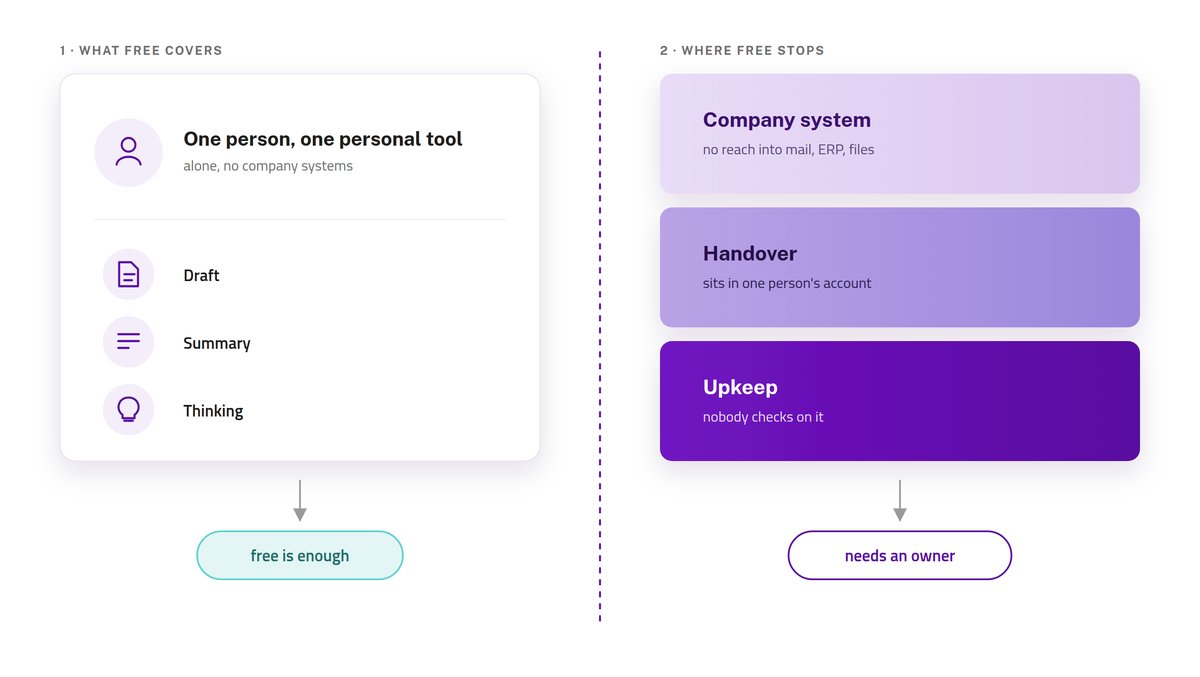
For work one person does alone in their own tool, they are enough. Drafts, summaries, templates, thinking. They stop being enough the moment a task touches a company system, another person depends on the result, or the whole thing has to keep running for months. Then access, handover and upkeep are missing, and none of the three is solved by a better free tier.
The line is not about price
This is how we draw it in our own work: free covers everything one person can do alone in their own tool. The moment something touches company systems, involves other people, or has to stay alive, free stops.
At that point three things appear that a chat window does not bring with it: access to the data, a handover to other people, and someone who still maintains the thing in six months. Each of them costs money or time, usually both.
The useful part of the line is that you can apply it before you try anything. Three questions per task are enough. Does it touch a company system, a mailbox, an ERP, a file store? Does another person depend on the result, someone who is not in the same chat window? And does it still have to run in six months, even when the person who built it is on holiday?
Three times no means: take a free tool and start today. One yes does not mean you have to buy something. It means a decision is due before the choice of tool matters at all.
First sign: the tool cannot reach the data
The clearest example comes from Microsoft's own documentation. On the included tier of Copilot it says: "Copilot Chat (Basic) and Microsoft 365 Copilot (Basic) can't use organizational data via Microsoft Graph when interacting with Copilot Chat. You must upload the content with your prompt" (learn.microsoft.com, as of 17.11.2026).
In plain words: this tier does not see your mail, files and meetings. It can work with them if you carry them in, but it does not fetch them itself. Strictly speaking Copilot Chat is not free, it is included in eligible Microsoft 365 plans. For you it costs nothing extra, and that is exactly how it gets treated in daily work.
For a one-off task this is no problem. You upload the three files and you are done. With recurring work it tips over: whoever collects the numbers from two systems every week and copies them into the chat window is the interface. The tool is free, the transport is not. And the transport is the part that repeats every week.
The sign to watch for: as soon as the instructions for a task contain the sentence "then you export" or "then you paste it in", a person has become part of the automation.
There is also a limit you only notice once something runs regularly. On the same page Microsoft states that for the included tier some features are subject to "fair use limits", and points to a separate overview for them. That means nothing for occasional use and becomes relevant exactly when somebody does the same task there every day. Free tiers are built for trying things out, not for operations. Expect that as soon as a task turns into a habit.
Second sign: the account belongs to a person, not to the company
A free tier hangs on a personal account, even when the email address belongs to the company. That sounds like a formality and it is the reason for two things that hurt in daily operations.
The first: what is created in that account cannot be handed over. The good working instruction that took five attempts sits in one person's history. The colleague who takes over the task next quarter starts at attempt one. Nobody notices, because nothing breaks; it is simply learned a second time. You can only hand over what sits outside a head and outside a personal chat history, as a file several people can open.
The second: a personal account comes with consumer terms. That is no scandal, it is the deal. You are not paying with money.
Google states it plainly on the privacy page for the Gemini apps. Some chats are read by people, "Reviewed chats are retained for up to three years", and those reviewed chats are not deleted when you delete your history. The sentence that goes with it: "Please don't enter confidential information that you wouldn't want a reviewer to see" (support.google.com, as of 24.11.2026).
OpenAI puts it just as clearly in the privacy policy that explicitly covers Switzerland: "we may use Content you provide us to improve our Services, for example to train the models that power ChatGPT." The same policy explicitly does not apply to the business products; there the customer agreements govern what happens to the content (openai.com, as of 24.08.2026).
What you do with that is sorting, not panic. The draft of a job advertisement belongs there. The payroll list, the customer list and the quote that goes out next week belong in a place with a company account and a contract. What may land in which tool is written up in which company data may go into ChatGPT.
The practical part is unspectacular: in almost every SME we see, this is decided by the account people are signed in with. You can check that today, and it costs nothing.
Third sign: nobody keeps it alive
The third sign shows up last, and it is the expensive one.
A good working instruction for a chat window is a small piece of operating knowledge. It sits in one person's notes app. If that person goes on holiday, the task sits still. If they change jobs, the instruction goes with them. The form in the source system gets a new field, and the result quietly turns wrong, because nobody noticed that the instruction no longer fits.
In our experience this is where free tools in SMEs most often end. They end quietly. At some point somebody does it by hand again, and nobody quite knows when that started.
What helps here is an owner: a name on the task, a place where the instruction lives, and a date when somebody checks it. A bigger model changes nothing about that. The date is the part almost everyone leaves out. Without a date nobody checks, and half a year is a long time in this technology. As long as this upkeep belongs to nobody, nobody does it. What it costs today can be worked out beforehand, and it should be before anyone talks about tools.
What a free tier can do for you this week
The line is no reason to avoid free AI tools. It only tells you what for.
Three things work immediately and without budget. First: solve the same real task twice, once without context and once after explaining to the tool in ten sentences what the company does and for whom. The difference between the two answers tells you more about AI in your own operations than any demo, and it costs you twenty minutes.
Second: a company profile and a description of your own working style, written down as a file. These files work in every tool, they survive a model change, and they belong to you. The templates for them are in our toolbox.
Third: the list of recurring work that bothers you, with a rough number next to it. How often per month, how long each time. You cannot collect that number later, and it is the only way to know afterwards whether anything got better.
What comes after that is a rebuild: one workflow is rethought from the result backwards, two or three systems are connected, and in the end it runs without your people. That is exactly what one less process is.
Where the line does not help
Two cases where this sorting brings nothing.
If you work alone or in a team of three, the free tier is often the whole answer. There is no handover, you are the access to the systems, and upkeep happens on the side because you are the only user. Paid is then a question of convenience, not of structure.
And if recurring work is not the bottleneck, no tool changes anything. Honestly, we say this in conversations more often than we would like: if two positions are vacant or decisions keep piling up, that is not an AI topic. You sort that out first, otherwise you automate a queue.
The task you typed into the same window twice
Free tools are better than their reputation. They just do not tell you where they stop. You have to see that yourself, and the three signs above are the cheapest way to get there.
If you want to go through the list with a second pair of eyes, that is what the free first conversation is for. We sort it into two columns, on the left what one person handles alone, on the right what needs access, handover and upkeep. Book a slot.
And until then, a question we find useful ourselves: which task did you type into the same chat window for the second time last week?
Frequently asked questions
Are free AI tools enough for a company?
For work one person does alone in their own tool they are enough: drafts, summaries, templates, thinking. They stop being enough the moment a task touches a company system, another person depends on the result, or the whole thing has to keep running for months. Then access, handover and upkeep are missing.
Why can a free AI tool not reach company data?
Because the free tier is not built for it. Microsoft states for the included tier that Copilot Chat (Basic) cannot use organizational data via Microsoft Graph and that you must upload the content with your prompt. Whoever carries the data in by hand every week has become the interface themselves.
Can I put company data into a free AI tool?
A free tier hangs on a personal account, and consumer terms apply to it. Google explicitly asks users not to enter confidential information, and OpenAI reserves the right in the policy that also covers Switzerland to use content for training. Company data belongs in a company account with a contract.