What artificial intelligence in a company takes away first
When a system takes over the recurring work, it usually hits the middle first. A department head carries a lot of work that moves information from one place to the next: asking for status, chasing two missing numbers, dropping them into the same template, forwarding, following up two days later. That part can be taken over by a system that reaches the data and knows the operation. How this gets built and run in an SME is on our overview of artificial intelligence in the company.
The common reading is that a management layer disappears. We see no basis for that in Swiss SMEs. What we do see is less comfortable: as soon as the collecting stops, the question is what that role actually decides. In many companies the answer is written down nowhere.
We see it in our own operation. Mail, calendar, invoicing, projects and the website hang off a system that knows the operation, and the blog goes out in two languages without anyone being awake in the morning. The collecting is gone. The decisions stayed, and they became more visible.
The collecting stops, the deciding does not
Take a department head in your company and look at their recurring tasks. In our experience, most of them fall into two groups.
The first group moves information. Someone collects the weekly status because it sits in three heads and two systems. The department head asks about the deviation because it shows up nowhere on its own. And they write the minutes themselves so the management has something to read at the start of the week. None of these tasks needs a judgement about the business. They need access, diligence and a template.
The second group decides. The customer gets the discount or not. The complaint is handled generously or refused. The shift is rearranged or the delivery date moved. Here it matters who knows the customer and who carries the consequences.
One question sorts a task. Would two competent people reach the same result with the same documents? Then the task moves information. If the answers differ because experience and customer knowledge come into it, it is a decision.
The first group is where an AI system in the operation delivers something first. Which recurring reports fall away entirely and which simply get produced differently, we sorted out in which reports disappear in an SME. The second group stays, and it gets better, because the information lands earlier and more completely.
So far, this is good news. The problem sits in a third group that appears on no task list.
The decisions that are written down nowhere
From the outside, the third group looks like deciding, and in substance it is a question passed upward. The department head knows what they consider right. They still ask upward, because it is unclear whether they may close this case alone. An email, two days of waiting, then the answer they would have given themselves.
A Swiss stock corporation has a clean instrument for this. Where the board delegates management, it does so in accordance with organisational regulations, and these regulations «shall regulate the management of the company's business, stipulate the bodies required to carry this out, define their duties and, in particular, regulate the company's internal reporting» (Art. 716b para. 1 and 3 CO). In plain terms: where leadership is delegated, which positions exist and what they do belongs in writing.
In our experience that document stops at management level. Below it, which cases a department head closes without asking is rarely recorded. That is not a reproach. In a company that has grown to forty or two hundred people, it is the usual state. As long as someone spends half the day collecting anyway, the extra question does not stand out; it runs at the same rhythm.
The gap becomes visible when the role is filled by someone new. The new person asks about everything, because they find nothing to hold on to. After a few months they have a feeling for which cases go through. That feeling is then the actual framework, it is in no document, and when the person leaves, it leaves with them.
Exactly that changes when the collecting disappears. The question upward then stands there as what it always was: an open responsibility question that occupies two people and moves no case forward.
It also explains the state in which everything ends up on the management desk. The reason is rarely the software. Nobody wrote down the frame within which it would not have to cross that desk at all.
Why the time gained otherwise flows back
Assume the weekly status now arrives prepared. The numbers are right, the deviations are marked, the minutes sit in the folder an hour after the meeting. What does the department head do with the time?
Without a clear frame, they keep coordinating, only in a different place: they read through what the system wrote, forward it, and ask back whether the marked deviation should be taken seriously. Checking and forwarding machine output is a new form of the same old work, and it fills a week just as well as the old one. Where a human usefully checks in a workflow and where they only pass things through, we took apart in when the human becomes the bottleneck.
That is how an initiative loses its value without anyone noticing: the workflow is faster, the week is full, and nobody can say what changed. The path an information takes through a company until it reaches a decision we described in the new operating layer. If that path gets shorter, someone at its end has to be allowed to decide, otherwise it ends in a queue again.
One line per question
The work behind it is unspectacular and needs no tool. Take a department head and write down for two weeks what they come to you with. Not the projects, the small things. Discount, goodwill, date, exception, reorder, overtime.
Afterwards you have a short list in front of you, and usually three to five cases repeat. For each of them you write one line. The line has three parts: who decides, up to which limit, and who takes over beyond it.
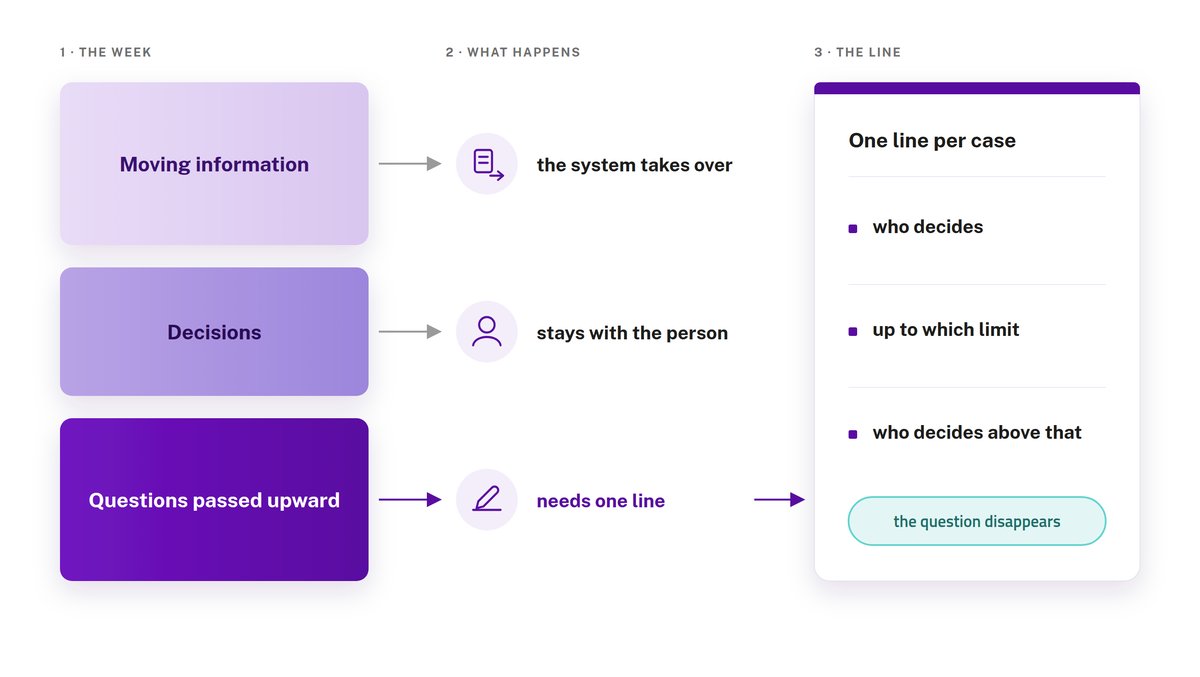
«The department head decides goodwill up to CHF 2,000 per case, above that the management.» One such line is enough. Whether the limit is generous or tight is your decision, not a benchmark from a book. The line needs a number, a deadline or a named exception. «Within reason» keeps producing questions.
Two things belong with it, otherwise it does not hold.
First the reporting, in the same line. You want to see how the limit is used. That is the part artificial intelligence in the company can deliver anyway once it reaches the data: a monthly overview of the cases decided within the limit, with the outliers at the top.
These lines need no revision of the regulations and no notary. One page that everyone can find carries the start; if it proves itself, it moves into the clean version of the organisational regulations.
Second the withdrawal. Whoever grants an authority should say when they would narrow it again. Otherwise the first tight decision becomes the reason to pull everything back, and for the next year every case gets discussed one by one again.
Two kinds of cases deliberately do not belong in such a line. Decisions that touch the company's reputation or people's safety stay at the top, even when they come up often. And cases where you are still unsure yourself which answer is right are not fit for delegating. What is missing there is the decision itself.
If you then want to know which workflow gets rebuilt first, work out beforehand what it costs today. There is only one window for that calculation, and it lies before the rebuild.
Where these lines change nothing
If the middle is overloaded because two positions are vacant, no rule about authority changes that. Then people are missing, and that is a different discussion.
Honestly, a line also does not help against a culture in which asking is safer than deciding. The line only creates the precondition. The test comes with the first mistake: if someone decides within the limit and something goes wrong, what happens next is what counts. Whoever revokes the limit then gets every question back for years.
The question that arrived this morning
Artificial intelligence in the company moves no boxes on the org chart. You can measure the difference by how many cases per week travel one level up only to collect an approval. Count them for two weeks before the rebuild and two weeks after.
We use the free first conversation for exactly this sorting: which questions get a line, and which workflow gets rebuilt first. Book a slot.
Look at the last question that landed on your desk this morning. Would you have decided differently from the person who asked?
If the answer is no, a line is missing for that case.
Frequently asked questions
Does artificial intelligence replace middle management?
We see no basis for that in Swiss SMEs. What falls away first is the work that moves information from one place to the next: collecting status, chasing numbers, forwarding. The decisions stay. What becomes visible is that it is often written down nowhere which of them a department head may take alone.
Which tasks of a department head disappear first?
The tasks where two competent people with the same documents would reach the same result. Collecting the weekly status, chasing deviations, writing minutes, copying numbers into a template. Everything that needs access and a template, but no judgement about the business.
How do you record decision rights in an SME?
With one line per recurring case: who decides, up to which limit, and who takes over beyond it. The limit needs a number, a deadline or a named exception. In a Swiss stock corporation the positions and their duties belong in the organisational regulations anyway (Art. 716b CO).