Europe regulates, America builds, and that is why we get the best AI models late or not at all. That is the usual story, and it no longer holds. In the first five months of 2026, every publicly released model from the four large providers reached the EU without delay.
What is missing sits one level up. It is the agents that read the inbox, book appointments, fill in forms and pay invoices on a person's behalf. Claude Duet, the dots in ChatGPT, Meta Muse, Gemini Spark and Siri AI on the iPhone: none of these five products can be used in the EU without restriction in early November 2026. For three of them, Switzerland sits on the same list as the EU. And Switzerland has neither the EU AI Act nor the Digital Markets Act.
What is missing in early November 2026
Status of the information: 9 November 2026, according to the providers' help pages. Lists like this change monthly, which is why the date sits so prominently here.
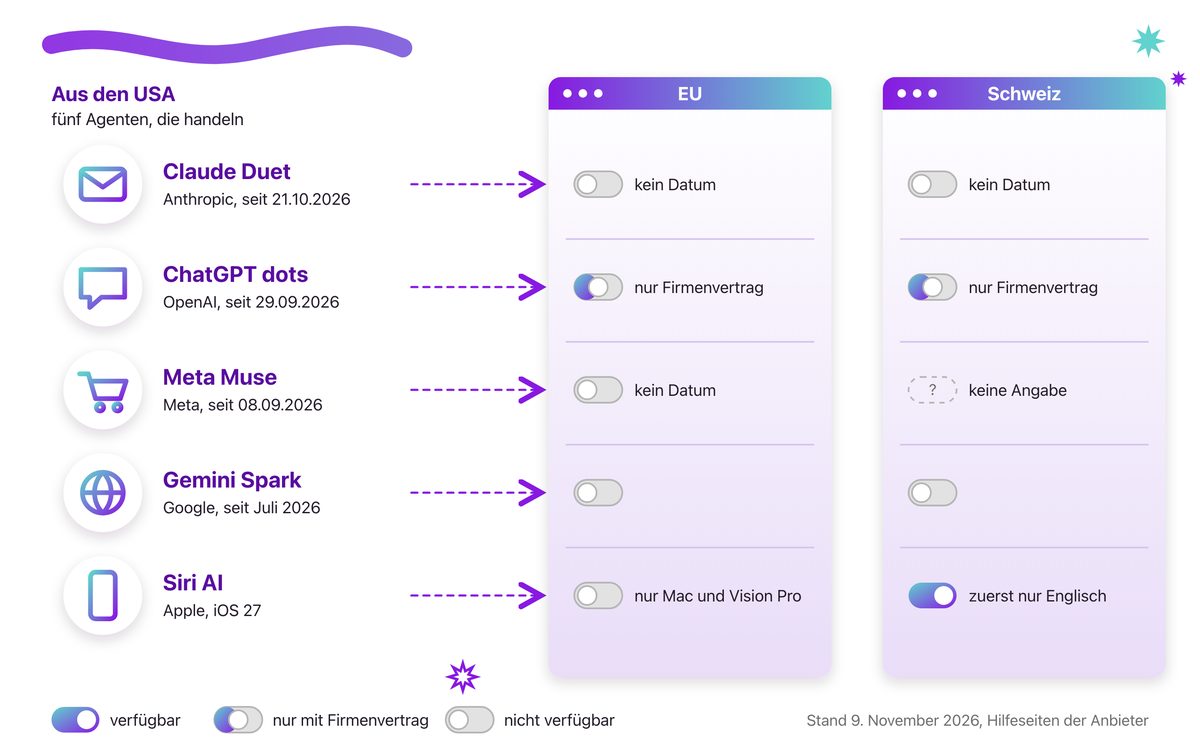
Anthropic's Claude Duet has been running since 21 October 2026 as a waitlisted preview, in the US only and only on the Pro, Max and Ultra plans. OpenAI's dots launched on 29 September 2026; on the Pro plan the EEA, Switzerland and the UK are left out "at launch", on Business Premium they are included everywhere. Meta Muse has been available in the US since 8 September and in Canada since 18 September, with no date for the EU. Google's Gemini Spark has run in more than 160 countries since July 2026, but not in the EEA, Switzerland or the UK. Siri AI arrives with iOS 27, but in the EU not on iPhone, iPad and Watch, only on Mac and Vision Pro. In Switzerland it does arrive, at first only with the system language set to English.
The five have one thing in common. They do not just answer, they act. An agent of this kind gets access to your inbox, your calendar, your browser and often a payment method. It keeps working after the chat window is closed and only speaks up when it needs a decision. That is the category we described in AI agents in companies. Now it exists as a product for the individual person, just not here.
The models arrive. Why not the agents?
A study by the Centre for the Governance of AI analysed 375 model releases by Meta, Google, OpenAI and Anthropic since 2018, published in June 2026. Relative to the US, 11 percent of the models arrived late or not at all in the EU, and 7 percent late or not at all in the UK. Meta led with 26 percent in the EU. In 56 of 68 cases examined, regulation was the main cause. The trend points down: from January to May 2026, no publicly released model was held back any more.
One detail from the same study explains more than the big numbers. Claude 3 Opus reached the EU as a web app 71 days late in 2024. Through the developer interface, the same model was available on the same day as in the US. The capability was there. What was late was the release to the end customer without a contract.
This pattern repeats in 2026 with the agents. The dots are available on Business Premium in every region where ChatGPT runs. On the Pro plan they are not available in the EEA, Switzerland and the UK. The same agent and the same model, just a different contract.
Why does it hit the agents in particular? A chat model processes what you type. An agent in the inbox processes what others have written to you, customers and suppliers for instance. That is third parties' personal data, continuously and without anyone consenting in the individual case. Add actions with consequences, a payment, say, or a deleted folder. For a provider's legal team that is a different review than a chat window. They run this review first where the legal basis is clearest and the market largest.
Three reasons that hold, and one that does not
First, data protection enforcement. The study names data protection rules as the main barrier, especially for training on personal data. The comparison with the UK shows where it comes from. The UK has almost identical data protection law, and yet fewer models are missing there. The difference lies in enforcement and in how fast authorities clarify what is allowed. Meta is the example: in June 2024 the company stopped the launch of Meta AI in Europe after the Irish data protection authority put the brakes on training with European users' public posts. Meta AI reached Europe in March 2025, text only, no images. Roughly 18 months after the US.
Second, the Digital Markets Act. Apple is the only one of the five providers that names a law. In Apple's reading, the DMA would require the company to give any third-party assistant the same access to the device and its apps as Siri AI. Apple proposed an intermediary, a "Trusted System Agent", and a staged launch over 18 months. The European Commission rejected both, according to Apple. The DMA applies to gatekeepers with their own operating system. It explains Apple. It does not apply to OpenAI or Anthropic, and Meta does not cite it.
Third, the order. OpenAI writes "at launch". Anthropic writes "US only during the research preview". Meta says nothing. None of the three names a law that forbids the launch. What they describe reads like a queue: the home market first, then Canada, then the countries with little review effort per user, then Europe. Our reading: business customers with a contract come before private customers, because the data processing agreement delivers the legal basis with it. Europe sits at the back of this queue because every single user here costs the most review effort. Nobody has forbidden anything. It is the provider's cost calculation.
And the AI Act? It is the usual suspect and, in the data, the weakest. The study found no robust evidence that the AI Act caused a delay. The deadlines do not fit the story either: the obligations for general-purpose models have applied since 2 August 2025, the transparency obligations since 2 August 2026. The EU moved the high-risk obligations to 2 December 2027 and 2 August 2028 with the Digital Omnibus in July 2026. An agent that sorts your inbox does not normally fall into the high-risk class; exceptions such as pre-screening job applications exist. What the EU AI Act means in Switzerland we have written up separately. One caveat belongs here: the study's data ends in May 2026, before the transparency obligations took effect. Whether the AI Act gains more weight later, we honestly do not know.
The switch also sits in Washington
In June 2026 a fourth reason appeared that has nothing to do with Brussels. On 12 June the US Department of Commerce required an export licence for Anthropic's models Fable 5 and Mythos 5. Anthropic switched both models off worldwide, including in the US. On 30 June the department lifted the requirement, and on 1 July Fable 5 was available again. 19 days in which Anthropic's strongest publicly available model was missing for companies in Zurich just as it was for companies in Munich and Boston.
That was the first case in which a frontier model disappeared not because of Brussels but because of Washington. The study draws the same conclusion: export controls and programmes for selected partners could limit Europe's access more than its own regulation in future. That applies to Switzerland and the EU in equal measure. We covered the topic more fundamentally in Digital sovereignty for Swiss companies. June made it concrete.
Switzerland pays the European price without the European law
Switzerland has no AI law. The Federal Council decided against one on 12 February 2025 and relies instead on the Council of Europe's AI convention and targeted adjustments. The Digital Markets Act does not apply here, the AI Act only indirectly through EU customers. Even so, OpenAI's dots and Google's Gemini Spark put Switzerland on the same block list as the EEA.
Apple does it differently. A spokesperson confirmed the day after the announcement that the block affects only the 27 EU countries. Siri AI comes to Swiss iPhones, at first with the system language set to English. The difference explains a lot. Apple's problem is a law, and that law ends at the EU border. OpenAI's and Google's problem is the data protection regime, and the Swiss Data Protection Act is on a par with the GDPR in effect. For the risk team in San Francisco, Baar is therefore the same as Berlin.
That is the uncomfortable lesson for a country that relies on independence in regulation. Whoever unlocks the agents for private customers draws the line where the review effort is similar. The legal text is secondary to that. Switzerland has voted on none of these texts and still gets the products as late as the EU.
What this means for your business
The capability is not blocked. One door of three is blocked. The developer interface: for Claude 3 Opus it opened on the same day as in the US. The business contract: at OpenAI it delivers the agents today in every region. Only the consumer product on an individual plan waits. For a business the consumer product is the wrong door anyway. An agent in the company inbox needs a data processing agreement, access rules and a log. All of that comes with the business contract and not with a Pro plan on a private card.
That is how we run our own business. Our agents run through the interface, not through a consumer product. Three things belong to us and not to the provider: the company context in plain text files, the work instructions with test cases, and the rule for which actions an agent never performs alone. For us those are money, contracts, deleting and any sending to external parties. When the model changes or fails, we connect another one to the same source. The context does not move, because it never lived with the model.
"Then we will just wait until Duet reaches Switzerland." You can. Then the work on the context begins on the day your competitor has it behind them. The agent itself is set up quickly on the day it is unlocked. The context, the rules and the access take months, whichever product runs in the end. What has to stay with you after a mandate, we wrote up in AI consulting: what remains.
Four points you can check this week without waiting for a provider:
- The contract door. Check whether your AI provider offers a Business or Enterprise contract with a data processing agreement, and whether the agent feature in it is unlocked for Switzerland. At OpenAI it is, according to the release notes.
- Third parties' personal data. An agent in the inbox reads what customers and suppliers have written. Where the risk is high, Art. 22 of the Swiss Data Protection Act requires a data protection impact assessment. Write down beforehand which mailboxes, which data, which recipients.
- The approval rule. Define which actions an agent never performs alone. Paying, signing, deleting and sending to external parties are the usual core. How to set that up cleanly in your governance for AI agents is part of what we build for clients under AI governance and secure adoption.
- The second route. June showed that a model can disappear overnight. A second model for the recurring work, if possible one that runs locally, costs little and spares you 19 days of standstill.
Two questions for your business
Which recurring work in your company is waiting for an agent that officially does not exist in Switzerland yet? And how much of it could be built with what is reachable today through a business contract or the interface? In our experience, considerably more than the headlines suggest. Where to start with context, rules and access, we show under AI in operations.
Frequently asked questions
Is Claude Duet available in Switzerland?
No. Claude Duet has been running since 21 October 2026 as a waitlisted preview, in the US only and only on the Pro, Max and Ultra plans. Team and Enterprise plans follow later according to Anthropic, and there is no date for Switzerland or the EU. As of 9 November 2026.
Are the ChatGPT dots available in Switzerland?
Not on the Pro plan. OpenAI excluded Switzerland, the EEA and the UK at the launch on 29 September 2026. On the Business Premium plan the dots are available in every region where ChatGPT runs, which includes Switzerland. For companies that is the right route anyway, because the contract governs the data processing.
Is Siri AI coming to Swiss iPhones?
Yes. On 9 June 2026 Apple confirmed that the block affects only the 27 EU countries. Swiss users get Siri AI with iOS 27 as a beta, at first only with the system language set to English, with more languages to follow. In the EU, Siri AI is for now available only on the Mac and the Vision Pro.