TLDR
IT leaders lose the board's trust not because of poor IT work, but because they speak the wrong language. The board thinks in risk, money, and future, not infrastructure and uptime. If you learn to translate your technical reality into business language, you fundamentally change your role in the company. Start with the one-pager: one page, four questions, zero jargon.
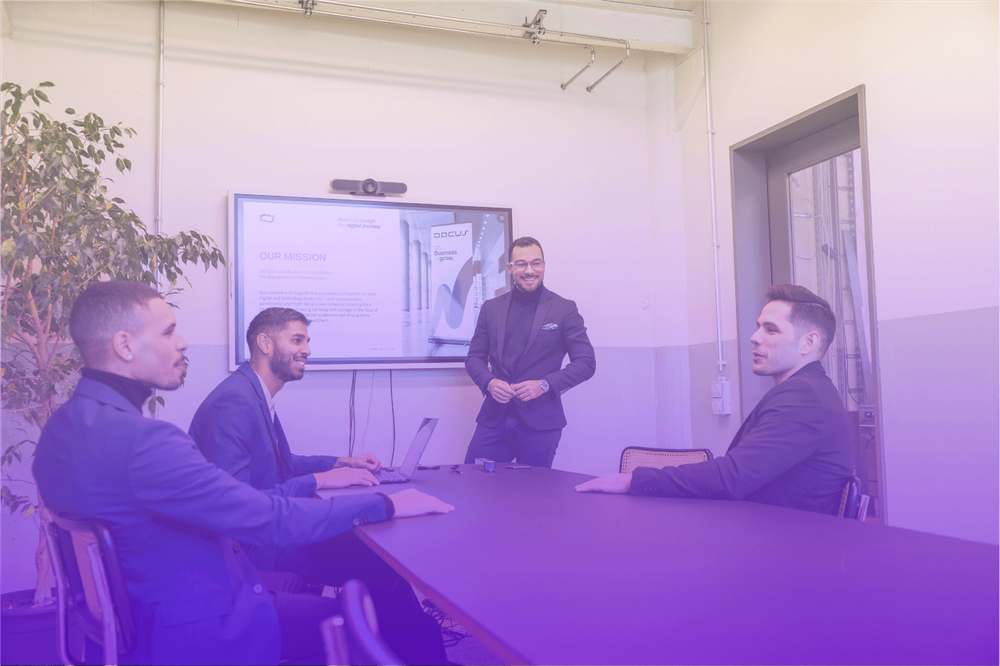
Twenty slides. No questions.
Imagine this: You spent three weeks working on this presentation. Architecture diagrams, migration plan, security metrics, uptime statistics. Twenty slides. All correct, all relevant, all carefully prepared.
The board watches. Nods. One person quickly taps on a phone. You get to the last slide.
"Any questions?"
Silence. Someone looks at the clock.
"Thank you, very informative."
The meeting ends fifteen minutes earlier than planned. On the way back to the office, you wonder: Did they even listen?
The answer is uncomfortable: Yes, they listened. But they heard nothing that concerned them. You explained infrastructure. They wanted to talk about the company.
That is the board communication gap, and it costs IT leaders more than just bad meetings. It costs budgets, projects, and sometimes influence over strategic decisions. We see this again and again: technically excellent IT leaders who remain invisible in the boardroom because they speak the wrong language.
What the board really wants to know
Before we talk about communication, we need to talk about perspective.
A board is not there to understand IT. It is there to protect and steer the company. From this perspective, IT has exactly four relevant dimensions:
Risk. Are we protected? What could go wrong? What is our exposure if something happens, and what do we do then?
Money. What does IT cost, and what does it deliver? Are we investing the right budget in the right things? Do we have control over costs?
Future. Are we positioned for the next three to five years? What is changing in our market and in our technology, and are we prepared for it?
Trust. Can the IT team manage this? Do they have it under control? Should we be worried, or not?
That is all. No architecture diagrams. No patch-level statistics. No migration roadmaps with 47 milestones.
If your presentation does not answer these four questions, after thirty minutes the board has nothing to work with. You have given them work, not relief.
The translation task
Here is what we repeatedly learn in our work with IT leaders: Board-ready IT is not simplification. It is translation.
You know what happened. You know what it means. The task is to translate that knowledge into language that is effective in the context of the board.
A few practical examples:
See the pattern? On the right it always says: risk, money, or trust. On the left is technology.
Both are true. Only the right side is relevant to the board.
The framework: Four tools for board-ready IT
This is the practical part. If you want to start changing your board communication tomorrow, start here.
The one-pager
Forget the twenty slides. Write one page instead.
One page with four sections: What is our current risk picture? How are our IT costs developing, and what does the budget deliver? Where do we stand strategically for the next few years? And: Is there anything where we as a board need to act?
That sounds like too little. It is exactly right. The board rarely has more than ten minutes for the IT topic. A good one-pager creates more clarity in five minutes than twenty technical slides in half an hour.
The traffic-light dashboard
People process visually, especially under time pressure. A dashboard with three colors for the most important IT areas gives the board immediate orientation.
Green: everything under control. Yellow: attention needed, we have a plan. Red: active risk, here we may need a decision.
Important: Be honest. A dashboard that is always green loses all credibility after three quarters. A real yellow with a good explanatory text builds more trust than polished green.
We recommend six to eight areas: cybersecurity, business continuity, IT costs, strategic projects, compliance, and the availability of critical systems.
Risk storytelling instead of risk statistics
Numbers alone do not move anyone. Scenarios do.
Instead of: "We have 87 open vulnerabilities in the High category."
Better: "If we do not act now: An attacker exploiting one of these gaps could access our customer data within 72 hours. That would be a reportable incident under the GDPR, with potential fines up to CHF X and reputational damage we cannot afford. Our plan: Over the next six weeks, we will close the 30 most critical ones. Budget: CHF Y."
Proactive communication
This is the most uncomfortable and the most important part. Do not wait for bad news.
If a project is delayed, communicate it early, with cause, consequence, and measure. If a risk arises, put it on the table before it becomes a problem.
Board members understand that things go wrong. What they do not accept, and what permanently damages trust, is the feeling of being surprised. "I should have known earlier" is the most dangerous sentence in a boardroom.
The trust-building cycle
One good presentation is not enough. Trust develops over time, and through consistency.
We call this the trust-building cycle: Consistent reporting creates expectations. When you meet expectations and forecasts come true, credibility develops. Credibility makes proactive risk communication possible, because people believe you when you say "this will be a problem." And all of this creates something you cannot buy: The board asks you on its own what you think.
That is the moment when IT leaders move from a "technical resource" to a strategic partner. We have seen it. It does not happen after one good meeting, it happens after four quarters of consistent, reliable, business-oriented communication.
What you should avoid
Too much detail. Technical depth in a board meeting is a sign of lacking perspective, not competence.
Defensive posture. If something went wrong and you explain yourself instead of addressing the problem, you lose ground.
No business context. "We modernized the system" is worthless without "and that means for the company..."
No outlook. Retrospective reports without a forward-looking perspective show operations, not leadership.
Promises you cannot keep. In the Swiss board context, this is especially sensitive. Overly optimistic forecasts that then do not materialize damage your credibility faster than any technical problem.
The Swiss board: a brief word on context
Anyone working with a board in Switzerland knows: this is not an American boardroom format. No show-and-tell, no pitches.
Swiss boards want substance, not rhetoric. They want data that is reliable, not projections. They want to hear about problems early, not after the fact.
IT credibility in this environment is built slowly and lost quickly. If you become known as a reliable, business-oriented voice, you will be included in strategic discussions that other IT leaders never reach.
To put it simply
Board-ready IT is not a PR task for IT leaders. It is a leadership task. The ability to translate technical reality into business language determines whether IT is perceived as a cost center or as a strategic partner. You do not need to become a better presenter, you need to become a better translator.
If someone has to do that translation work permanently without you creating a full-time role, that is a Fractional CISO mandate.
If you want to know what your current IT strategy looks like in the boardroom context, and where you can specifically start, we would be happy to be your sparring partner. More on our IT Strategy page.