The awkward elephant in the room
Last week a CTO told me: "We need to finally do something with AI. The board keeps asking."
Sound familiar? That pressure to start something with AI just because everyone is talking about it? In a previous article, we wrote about why that pressure is not entirely unjustified.
The MIT GenAI Divide Study 2025 shows that 95% of GenAI pilot projects fail to achieve the expected result. The reason is almost never the technology itself, but rather that companies start without checking whether the foundations are in place.
Why most AI projects fail
This is the pattern we see in practically every failed AI project:
The "Learning Gap" MIT calls it the "Learning Gap": organizations do not understand how to use AI tools correctly or how to design workflows around them. The models can be as good as they like. If no one knows how to integrate them into real work processes, it does not help.
Data chaos 60% of AI projects will be canceled by 2026 because of missing "AI-ready data." 80% of the time is spent on data cleansing, not analysis. And 63% of companies are not sure whether their data management practices are suitable for AI.
Missing roadmap Only 48% of Swiss companies have an AI roadmap at all. Only 13% work with measurable KPIs for their AI projects. That is like starting a journey without knowing where you are going, and without checking whether you have enough fuel.
The skills gap 53% of Swiss companies do not have the talent they need to implement AI. At the same time, 68% of stakeholders expect unrealistic ROI timelines.
What is an AI readiness check?
Before we continue: What do we actually mean by "AI readiness"?
AI readiness is not a yes/no switch. It is a maturity profile across several dimensions. It answers the question: "Do we have the foundations to introduce AI successfully, technically, organizationally, and culturally?"
An AI readiness check helps you:
- Identify blind spots before they become expensive
- Set priorities: what needs to be fixed first?
- Set realistic expectations internally and toward the board
- Use the budget wisely, investing in foundations rather than showcase projects
Figure: AI projects without a readiness check are like houses without a foundation inspection; they look good at first, but they do not last.
The 5 dimensions of AI readiness
After dozens of AI consulting projects, we developed a framework that works in practice. Five dimensions that together determine whether you are ready or still have some homework to do.
Dimension 1: Data readiness
The question: Do you have data that AI can actually use?
This is where most people fail. Not because there is no data, but because it is stuck in silos, inconsistent, or simply wrong.
What we check:
- Is your data centralized or scattered?
- How much time do you spend on data cleansing versus analysis?
- Are there clear data governance policies?
- Who is responsible for data quality?
Benchmark: 76% of AI leaders have fully centralized data. On average, the figure is only 19%.
Dimension 2: Technological infrastructure
The question: Can your IT landscape support AI at all?
Legacy systems are the silent killer of AI projects. 63% of Swiss companies have modernization costs that block new investments.
What we check:
- Is your cloud infrastructure AI-ready?
- Can your systems communicate with each other?
- Do you have the computing capacity for AI workloads?
- Are there documented APIs and interfaces?
Benchmark: Only 15% of companies have networks that are fully AI-ready.
Dimension 3: Organizational readiness
The question: Does anyone know who is responsible for AI?
Without clear governance, AI ends in chaos. Every department does its own thing, nobody measures success consistently, and in the end no one knows whether the whole thing is worth it.
What we check:
- Is there a documented AI strategy?
- Who decides on AI investments?
- Are responsibilities assigned clearly?
- Are KPIs measured systematically?
Benchmark: Only 48% have an AI roadmap. Only 13% have measurable KPIs.
Dimension 4: Skills & talent
The question: Do we have the skills to implement AI?
You can have the best AI strategy in the world: without the right people, it remains paper.
What we check:
- Is there AI expertise on the team?
- Are training programs planned?
- How are the change management capabilities?
- Is there openness to external support?
Benchmark: 53% do not have the necessary talent. 58% see the skills gap as a brake on innovation.
Dimension 5: Corporate culture
The question: Is your organization ready for change?
This is often underestimated. AI changes the way people work. Without cultural readiness, there is resistance, and resistance kills projects.
What we check:
- Is there openness to experiments (and mistakes)?
- Do the business units trust new technologies?
- Is leadership behind it?
- How are failures handled?
Benchmark: Among AI leaders, 57% of business units trust AI solutions. Among laggards, only 14% do.
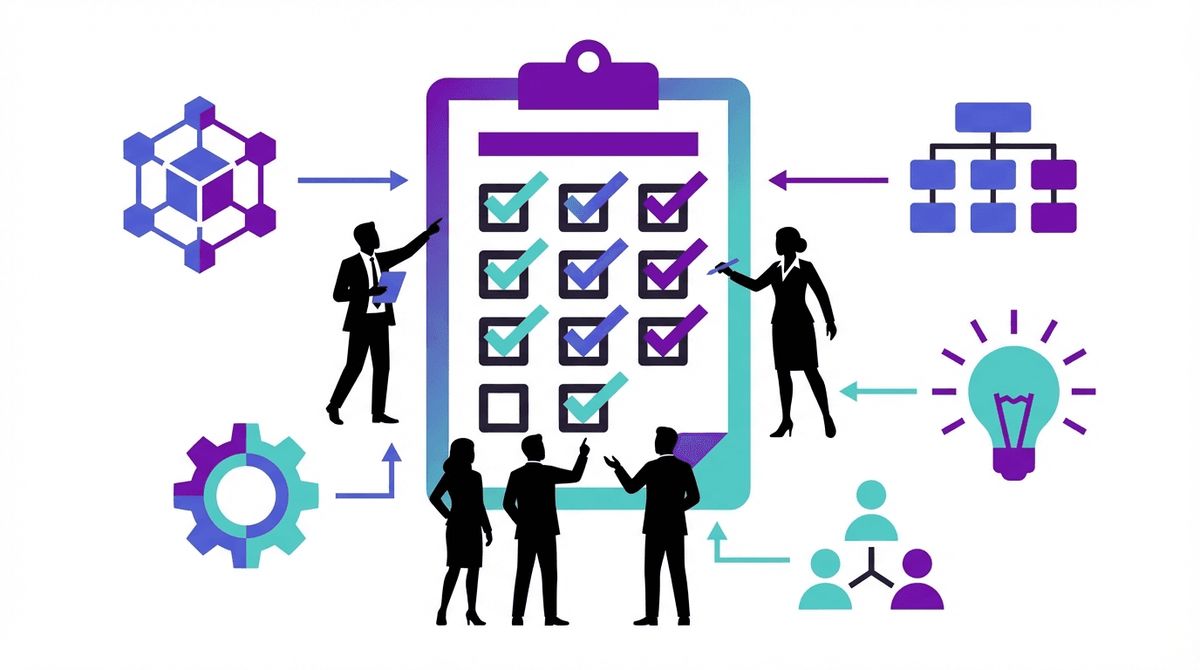
Figure: The 5 dimensions of AI readiness, all of which must work together for AI projects to succeed.
Your quick check: Where do you stand?
Here is a simple self-test. Rate each statement from 1 (does not apply) to 5 (fully applies):
Data readiness
- Our data is centrally accessible and documented
- We have clear data quality standards
- There are defined responsibilities for data governance
Technology
- Our IT systems can communicate with one another
- We have cloud infrastructure that can scale
- Legacy systems do not block new initiatives
Organization
- There is a documented AI strategy or roadmap
- Responsibilities for AI are clearly assigned
- We measure the success of IT projects with clear KPIs
Skills
- We have employees with basic AI knowledge
- There is a budget for AI-related training
- Change management is one of our strengths
Culture
- Mistakes are seen as opportunities to learn
- Management visibly stands behind innovation
- New technologies are generally welcomed positively
Evaluation:
What should you do with the result?
If you are an "Explorer" (15-30 points)
No reason to panic. Many Swiss companies are here. But: do not start any AI pilots before you have laid the groundwork.
Your next steps:
- Conduct a data assessment: where is your data located?
- Establish data governance basics
- Analyze the skills gap and plan training
- Get leadership buy-in for the preparatory work
If you are a "Beginner" (31-45 points)
You have the basics, but there are gaps. Focus on closing the biggest weaknesses.
Your next steps:
- Identify your weakest dimension
- Create a prioritized roadmap
- Start with low-risk pilots in controlled areas
- Build internal AI champions
If you are a "Developer" (46-60 points)
A good starting position. You can launch targeted pilots, but choose them wisely.
Your next steps:
- Identify use cases with clear business value (more on this in our article: How companies can actually use AI in a meaningful way)
- Define measurable success KPIs
- Plan the scaling path from the start
- Establish governance for productive AI use
If you are a "Leader" (61-75 points)
Congratulations. You belong to the 9% of Swiss companies that are ready. Time to scale.
Your next steps:
- Develop a company-wide AI strategy
- Build a center of excellence
- Focus on ROI measurement and scaling
- Share your knowledge, become a role model
The Swiss perspective
Here is the good news: Swiss companies have specific advantages.
Agility: SMEs can make decisions faster than large corporations. No 12-month committee processes.
Pragmatism: Swiss business culture is solution-oriented. Less hype, more substance.
Commitment to quality: The focus on "it has to work" protects against premature bad investments.
But there is also the reality: according to the Cisco AI Readiness Index, only 9% of Swiss companies are true AI leaders. That is only a minimal improvement compared with previous years.
The question is: do you want to be among the 9%, or wait until the competition moves ahead?
The key takeaways
- AI readiness is not a luxury: it is the foundation for every successful AI deployment
- The 5 dimensions (data, technology, organization, skills, culture) must work together
- An honest self-assessment saves time, money, and frustration
- Better to start later and do it right than to start too early and fail
- Swiss companies have advantages if they make use of them
Next step
The quick check above gives you an initial orientation. But a well-founded assessment requires more depth.
We offer a structured AI readiness check that systematically examines all 5 dimensions, with concrete recommendations for action and a prioritized roadmap.
Interested? Write to us for a non-binding conversation.
If the check shows gaps, the answer is rarely more technology. What we start with instead is described under AI governance and secure AI adoption.
Sources:
- MIT GenAI Divide Report 2025
- Cisco AI Readiness Index 2025
- KPMG Digital Trust Study
- Gartner AI & Data Management Research 2025
- AXA SME Labor Market Study 2025
- Microsoft Work Trend Index 2025