You have probably already had several conversations about AI. Perhaps your team has tried ChatGPT, perhaps you purchased Copilot licenses, or someone from management asked what you are planning with AI. The pressure to have an answer is growing noticeably right now in almost all Swiss SMEs.
The pattern we observe with our clients is usually the same. The company buys a tool because it sounds promising or because the competition seems to be further ahead. Employees try it and find it interesting, but without a concrete assignment usage remains irregular. After three months, the licenses are still running, nobody can say what has changed as a result, and AI has become just another app that is open in the background.
The problem is the sequence, not the technology
Those who start with the tool instead of the problem end up in this situation. This is neither a failure of the technology nor a mistake by employees. It is a planning error that slips into the purchasing decision because the pressure to "do something with AI" forces faster decisions than analyzing which problems should be solved.
An AI tool is a tool for a specific job. If it is unclear which job you want to do, the tool cannot show its value. A Copilot license without a defined use case does not create efficiency. That sounds self-evident, but in practice this step is skipped because the tools are so accessible that buying them is easier than analyzing the problem.
What SMEs do that use AI successfully
The companies where AI makes a measurable difference all have one thing in common: they did not start with the technology. They started with a specific bottleneck where the task was clearly defined and success was measurable.
An accounting office that manually categorizes receipts from various sources every day has a clear starting point. The task has a defined format, a known error rate, and employees know how much time they spend on it each day. If AI takes over this categorization and the error rate drops, that can be measured. The use case can be justified convincingly, and the team sees the difference in daily work.
A marketing team that is supposed to 'experiment creatively with AI' does not have a clear task. The results are hard to measure, usage remains noncommittal, and the value cannot be communicated internally. This is not a criticism of AI in marketing, but of task definitions that are too vague to give a tool a fair chance.
What regularly goes wrong with tool-first rollouts
In our consulting practice, we see three patterns that repeat themselves when AI rollouts are started without problem definition. The first: usage remains limited to a few enthusiasts. That person uses the tool intensively; everyone else hardly at all. The value does not scale because it depends on one person rather than a process, and if that person leaves the company, the knowledge is gone.
The second pattern is parallel solutions. Different teams use different AI tools for similar tasks without anyone knowing what the others are doing. This produces neither scale effects nor institutional knowledge. What worked for one team stays there.
The third pattern is the most dangerous: uncontrolled data sharing. Employees copy customer data or contract content into public AI tools because nobody has defined a policy. That is not an accusation; they want to be productive. It is a governance problem that can be solved before purchase with clear processes, but is difficult to fix retroactively once usage is embedded.
Shadow AI: What it shows you about your company
Shadow AI describes AI use that employees carry out on their own initiative and without company policies. That sounds like a problem, but it is a signal. It shows that the tools are useful enough to be used voluntarily, and that your team is open to new ways of working. That is a good starting point for a structured rollout.
The problem is when this use remains uncoordinated. Your company bears the risk without systematically benefiting from the value. The willingness is there in your team; what is still missing is the structure so that it can be turned into measurable results.
How to build a robust pilot
Start with a question: Which task in your company costs the most time per week and has a clearly defined, repeatable format? These do not have to be major transformation projects. Often they are tasks that are so routine that nobody questions anymore how much time they take.
Once you have found that task, check two conditions. Can you measure success, that is, is there an error rate or processing time you can compare before and after the pilot? And can the data the tool needs be used in compliance with data protection requirements? If both questions can be answered with yes, you have a solid starting point.
Keep the first pilot small: four to six weeks, one task, one team. You do not need a company-wide rollout to learn what works. A well-defined pilot in one area gives you more actionable insights than a dozen licenses without a clear mandate, and it can be rolled back if it turns out the tool is not the right fit.
Which processes are a good fit
In our work with Swiss SMEs, two categories have proven to be good starting points for first pilots. The first is document processing: incoming receipts or structured requests that are processed according to defined rules. Here the task is clear, the output is measurable, and the risk of a poor result can be identified early.
The second category is structured communication: first responses to standard inquiries or preparing meeting notes according to a fixed template. These tasks do not involve creative discretion; they have a format. Where a format exists, AI can provide reliable support, and employees can assess the result because they know what it should look like.
What comes after the pilot
A pilot without evaluation is an experiment without a learning outcome. Plan from the start how you will assess it after the test period: What worked, and what would need to change in the process for the tool to fit better? Asking these questions before the pilot starts helps you measure the right things.
Companies that use AI sensibly over the long term repeat this cycle consistently: define, pilot, evaluate, scale. Not every pilot leads to scaling. Sometimes the result is that the problem was smaller than expected, or that another tool would have been a better fit. That is not a failure; it is the information you need for the next step.
The next step
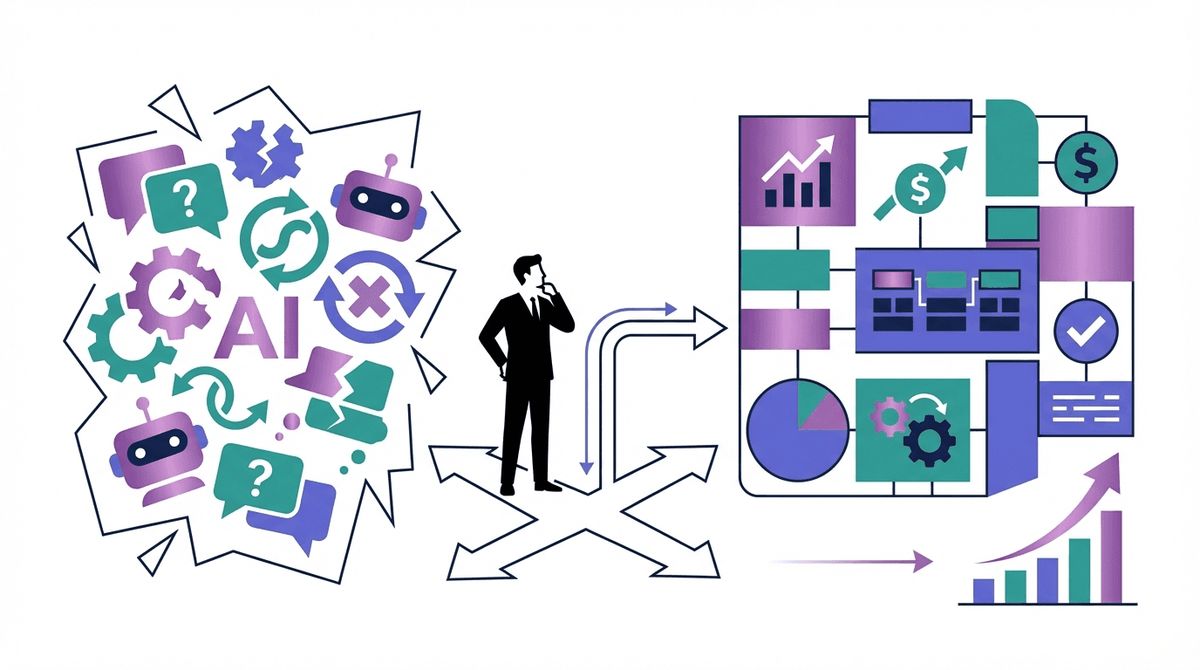
Chaos turns into value once somebody sets usage rules and approvals. That is the first step of our AI governance.
If you know where you could start a pilot but are unsure how to structure it, we would be happy to talk. We help Swiss SMEs move from 'we should do something with AI' to a concrete first step that is measurable and does not depend on a single committed person. Contact us, and together we will look at where the greatest leverage lies for you.