Yannick H.,
Too Long; Didn't Read
Die meisten IT-Risiken sind keine technischen Probleme sondern blinde Flecken in der Geschäftsführung.
Du führst ein Unternehmen mit 50 oder mehr Mitarbeitenden. Dein letzter ernsthafter Blick auf die IT war... wann genau?
Nicht der Blick auf die Rechnung. Den wirfst du regelmässig. Wir meinen den richtigen Blick: Was läuft da eigentlich? Was kostet es wirklich? Wo sind die Risiken, die du nicht siehst?
Falls du gerade überlegst. Das ist die Antwort.
Warum IT-Assessments zur Chefsache gehören
Wir führen jedes Jahr dutzende Erstgespräche mit Geschäftsführern Schweizer KMU. Die IT-Abteilung hat in der Regel alles "im Griff". Zumindest laut Statusbericht. Und dann kommt der Moment, in dem wir drei einfache Fragen stellen und plötzlich wird es still.
Nicht weil jemand etwas versteckt. Sondern weil bestimmte Fragen schlicht nie gestellt werden.
Laut Branchenstudien haben nur rund 35% der KMU eine dokumentierte IT-Strategie. Das bedeutet: Zwei von drei Unternehmen steuern einen ihrer grössten Kostenblöcke im Blindflug.
Die Konsequenzen sind vorhersehbar:
IT-Kosten wachsen schneller als der Umsatz ohne dass jemand erklären kann, warum
Sicherheitslücken bleiben unentdeckt, bis etwas passiert
Compliance-Anforderungen wie NIS2 oder ISO 27001 werden ignoriert, bis ein Auditor vor der Tür steht
Das Problem ist nicht technisch. Es ist organisatorisch. IT wird delegiert, statt geführt. Und genau da setzen wir an.
Das 30-Minuten IT-Assessment: Fünf Fragen
Wir haben aus hunderten Erstgesprächen ein Format entwickelt, das in 30 Minuten die wichtigsten blinden Flecken aufdeckt. Keine PowerPoint-Präsentation, kein 200-Seiten-Report. Fünf strategische Fragen, die jeder Geschäftsführer beantworten können sollte.
Probier es aus. Nimm dir einen Kaffee und 30 Minuten. Ehrliche Antworten zählen.
Frage 1: Was kostet deine IT wirklich?
Nicht die monatliche Rechnung. Die Gesamtkosten.
Schweizer Unternehmen geben im Schnitt 5-8% ihres Umsatzes für IT aus. Bei einem KMU mit CHF 20 Millionen Umsatz sind das CHF 1-1.6 Millionen pro Jahr. Das ist viel Geld. Und die meisten Geschäftsführer kennen nur den sichtbaren Teil: Lizenzen, Hardware, vielleicht Cloud-Kosten. Der Rest: Schatten-IT, versteckte Wartungsverträge, nicht genutzte Lizenzen, interne Personalkosten für IT-Aufgaben bleibt im Dunkeln.
Hier ein Beispiel, das wir ständig sehen: Ein Unternehmen zahlt für 100 Microsoft-365-Lizenzen, aber nur 40 werden aktiv genutzt. Die restlichen 60 kosten trotzdem. Oder: Drei verschiedene Abteilungen haben unabhängig voneinander CRM-Tools angeschafft. Keiner weiss vom anderen. (Wir haben das ausführlich beschrieben in unserem Artikel über Lizenzkosten und Nutzung.)
Wir haben bei Kunden regelmässig 30-45% Einsparpotenzial gefunden. Nicht weil jemand verschwendet hat. Sondern weil niemand hingeschaut hat.
Kannst du innerhalb von zwei Minuten sagen, was deine IT pro Mitarbeiter und Monat kostet? Wenn nicht, ist das dein erster blinder Fleck.
Frage 2: Was passiert, wenn morgen alles ausfällt?
Ransomware. Serverausfall. Cloud-Ausfall. Fehler beim Update. Die Ursache ist fast egal. Entscheidend ist: Wie schnell bist du wieder online?
Mehr als 60% der KMU haben keine getesteten Business-Continuity-Pläne. Einen Plan zu haben ist das eine. Ihn getestet zu haben, das andere. (Wir haben ausführlich darüber geschrieben, warum Business-Continuity-Pläne im Ernstfall versagen.)
Frag deinen IT-Leiter: Wann war der letzte vollständige Recovery-Test? Wie lange hat er gedauert? Was hat nicht funktioniert?
Wenn die Antwort vage bleibt, weisst du genug.
Frage 3: Welche drei grössten IT-Risiken hast du gerade?
Nicht die technischen. Die geschäftlichen.
43% der Cyberangriffe richten sich gegen kleine und mittlere Unternehmen. Und die durchschnittlichen Kosten eines Datenvorfalls liegen laut IBM bei über 100.000 Euro für KMU. Aber das Risiko ist nicht nur Cyber.
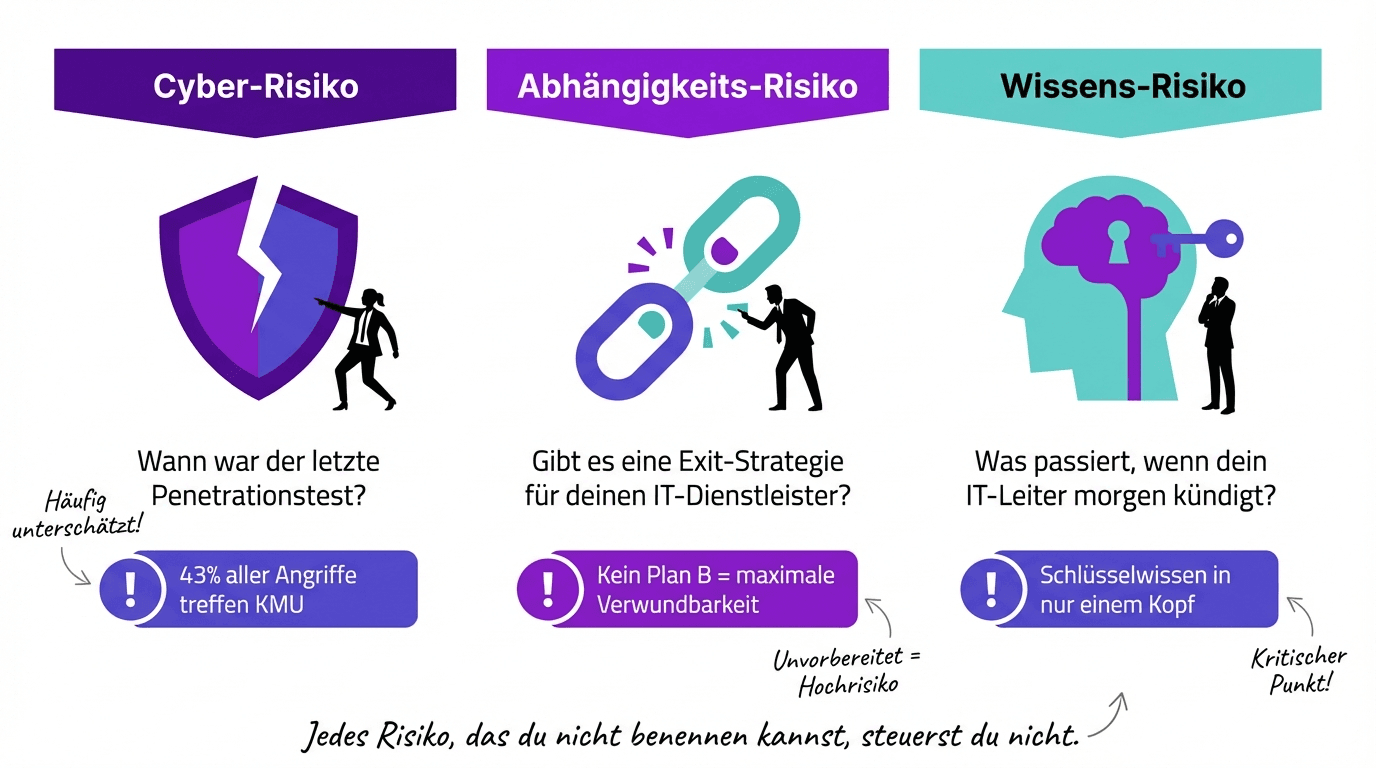
Es geht auch um:
Abhängigkeit von einem einzigen IT-Dienstleister ohne Exit-Strategie
Schlüsselwissen, das nur in einem Kopf steckt (was passiert, wenn dein IT-Leiter kündigt?)
Legacy-Systeme, die niemand mehr warten kann, aber alle nutzen
Wenn du als Geschäftsführer nicht die Top-3-Risiken benennen kannst, fehlt dir die Grundlage für jede IT-Investitionsentscheidung. Wir beschreiben die fünf typischen Warnsignale in einem separaten Artikel. Die meisten davon erkennt man ohne technisches Wissen.
Frage 4: Unterstützt deine IT das Geschäftswachstum oder bremst sie?
Hier wird es strategisch. Die meisten IT-Landschaften wachsen organisch. Neue Software hier, ein Plugin dort, ein Cloud-Service weil der Kollege ihn empfohlen hat. Nach zehn Jahren ist das Ergebnis: Insellösungen, doppelte Datenhaltung, Integrationschaos.
Die Frage ist nicht: Funktioniert das alles? (Tut es meist - irgendwie.)
Die Frage ist: Kann deine IT mithalten, wenn du nächstes Jahr 20% wachsen willst? Einen neuen Standort eröffnest? Einen Akquisitions-Target integrieren musst?
Wir sehen regelmässig Unternehmen, die an ihrer IT scheitern, nicht an ihrem Geschäftsmodell. Der neue Standort kann nicht angebunden werden, weil die VPN-Infrastruktur am Limit ist. Die Akquisition verzoeert sich, weil niemand weiss, wie man zwei Active Directories zusammenführt. Das ERP kann nicht skaliert werden, weil es auf einer Version läuft, die seit drei Jahren keine Updates mehr bekommt.
70% der IT-Projekte im Mittelstand verfehlen ihre Ziele bei Zeit, Budget oder Qualität. Das liegt selten an der Technik. Es liegt an fehlender Strategie und fehlender Vorarbeit. (Dazu passt unser Artikel: Wie du IT-Entscheidungen triffst, die nicht in der Katastrophe enden.)
Frage 5: Bekommst du die richtigen Informationen?
Die letzte Frage ist die wichtigste und die unbequemste.
Dein IT-Leiter berichtet dir regelmässig. Aber bekommst du die Informationen, die du als Geschäftsführer brauchst? Oder bekommst du einen technischen Statusbericht, mit dem du nichts anfangen kannst?
Typisch: Du bekommst eine Mail mit "99.9% Uptime letzten Monat" und "47 Tickets geschlossen". Schön. Aber was bedeutet das für dein Geschäft? Nichts. Das ist wie ein Finanzbericht, der nur die Anzahl Buchungen zeigt, aber nicht den Kontostand.
Ein nützliches IT-Reporting für die Geschäftsführung hat genau drei Dimensionen:
Kosten: Was geben wir aus, wofür, und ist das angemessen?
Risiken: Was sind unsere grössten Expositionen und wie adressieren wir sie?
Wert: Welchen messbaren Geschäftswert liefert die IT?
Wenn dein IT-Reporting diese drei Fragen nicht beantwortet, bekommst du die falschen Informationen. Und ohne die richtigen Informationen triffst du die falschen Entscheidungen.
Was dein Ergebnis bedeutet
Nimm dir einen Moment. Wie hast du abgeschnitten?
Alle fünf Fragen klar beantwortet? Glückwunsch! Du bist in einer Minderheit. Die meisten Geschäftsführer können zwei oder drei davon beantworten. Alle fünf? Selten.
Zwei oder mehr Fragen waren unklar? Das ist kein Versagen. Das ist normal. Aber es ist ein Signal, dass deine IT ein Führungsvakuum hat und das kostet dich Geld, Zeit und Sicherheit.
Jede unbeantwortete Frage ist ein Risiko, das du derzeit nicht steuerst.
Was wir bei jedem IT-Audit finden
Wir wollen ehrlich sein: Wir führen dieses Assessment nicht, weil es nett ist. Wir führen es, weil es funktioniert.
Was wir fast immer finden: Lizenzkosten für Software, die niemand nutzt. Backup-Strategien, die nie getestet wurden. IT-Dienstleister-Verträge ohne Exit-Klauseln. Und Geschäftsführer, die zum ersten Mal die richtigen Fragen stellen.
Wir haben die typischen Findings ausführlich dokumentiert. Fast jedes KMU erkennt sich wieder.
Die ehrliche Frage
Du hast jetzt fünf Fragen. 30 Minuten. Kein Berater nötig, kein Budget, kein Projekt.
Aber hier ist die eigentliche Frage: Wirst du sie dir stellen?
Nicht nächsten Monat. Nicht beim nächsten Strategie-Offsite. Diese Woche.
Die Antworten werden unbequem sein. Aber sie werden dir zeigen, wo dein grösster Handlungsbedarf liegt — bevor es jemand anderes tut.
(Und falls du nach den 30 Minuten jemanden brauchst, der die Antworten mit dir sortiert: Genau dafür sind wir da. Vendor-neutral, pragmatisch, und mit der Erfahrung aus 50+ Projekten bei Schweizer Unternehmen. IT-Strategie-Beratung)