
Yannick H.,
Too Long; Didn't Read
49% of IT project failures are attributed to poor decision-making processes, not the technology itself. The typical pitfalls: demo-driven decisions, focusing on purchase price instead of total cost, technology before people, and the belief 'we are special.' Organizations with structured evaluation achieve 78% better results. The difference between success and disaster lies not in the choice, but in the process.
The statistic you should know
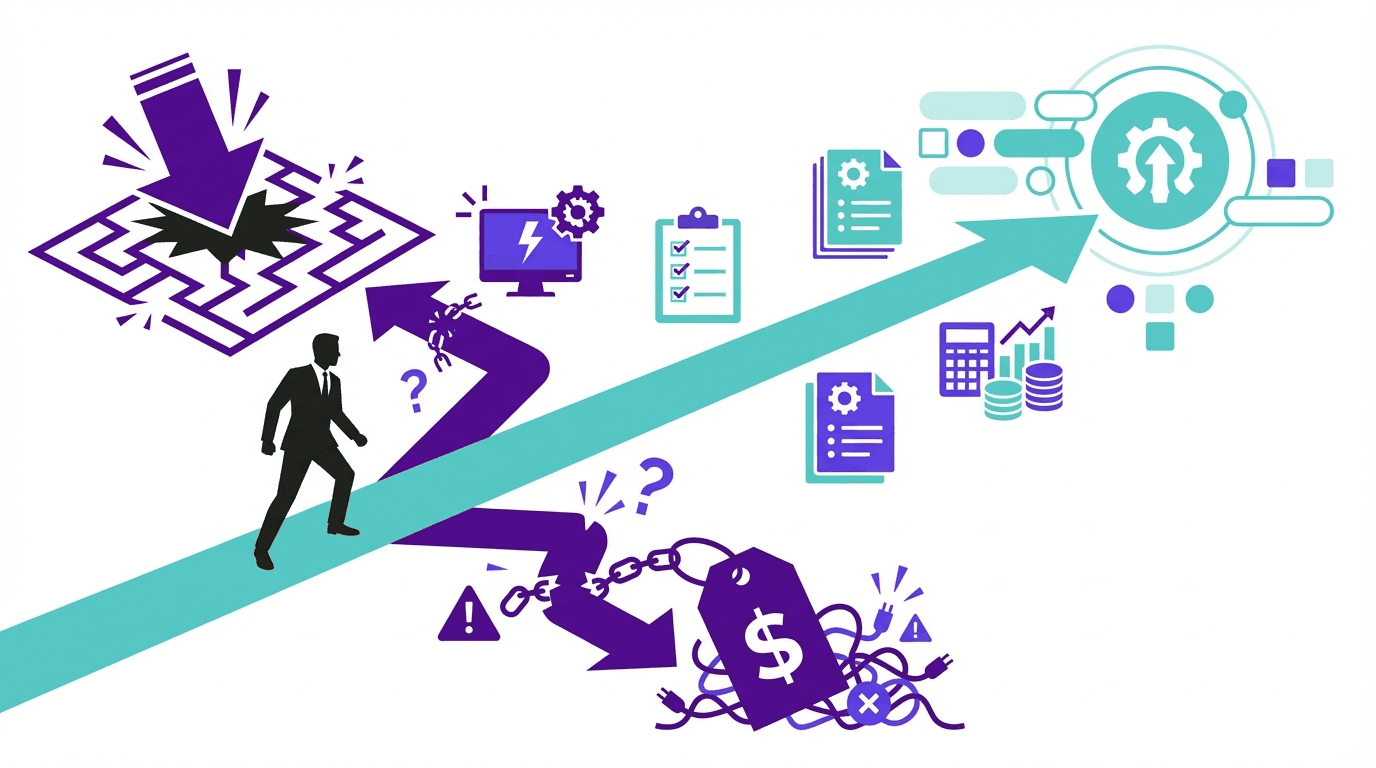
49% of IT project failures are attributed to poor vendor selection processes.
(Source: Enterprise Software Selection Study)
Not because of the wrong technology. Not because of incompetent employees. Not because of unforeseeable market changes.
Because of the decision-making process.
Almost half of all IT projects fail because the decision was made incorrectly—not because the wrong option was chosen.
That is an uncomfortable insight. Because it means: the disaster was avoidable. Not through more budget. Not through better technology. But through a better process.
Why good managers make bad IT decisions
Most IT decisions are not made rationally. They are made emotionally and rationalized afterward.
That sounds harsh. But look at how typical IT decisions are made:
A vendor delivers an impressive demo
The decision-makers are enthusiastic
The decision is made—often in that very moment
Afterward, reasons are collected for why this decision is the right one
The actual business requirements? They are often only defined after the emotional decision—to justify the choice.
67% of software projects fail due to incorrect build-vs-buy decisions. Not because the question is difficult. But because it is answered emotionally.
The 5 decision traps
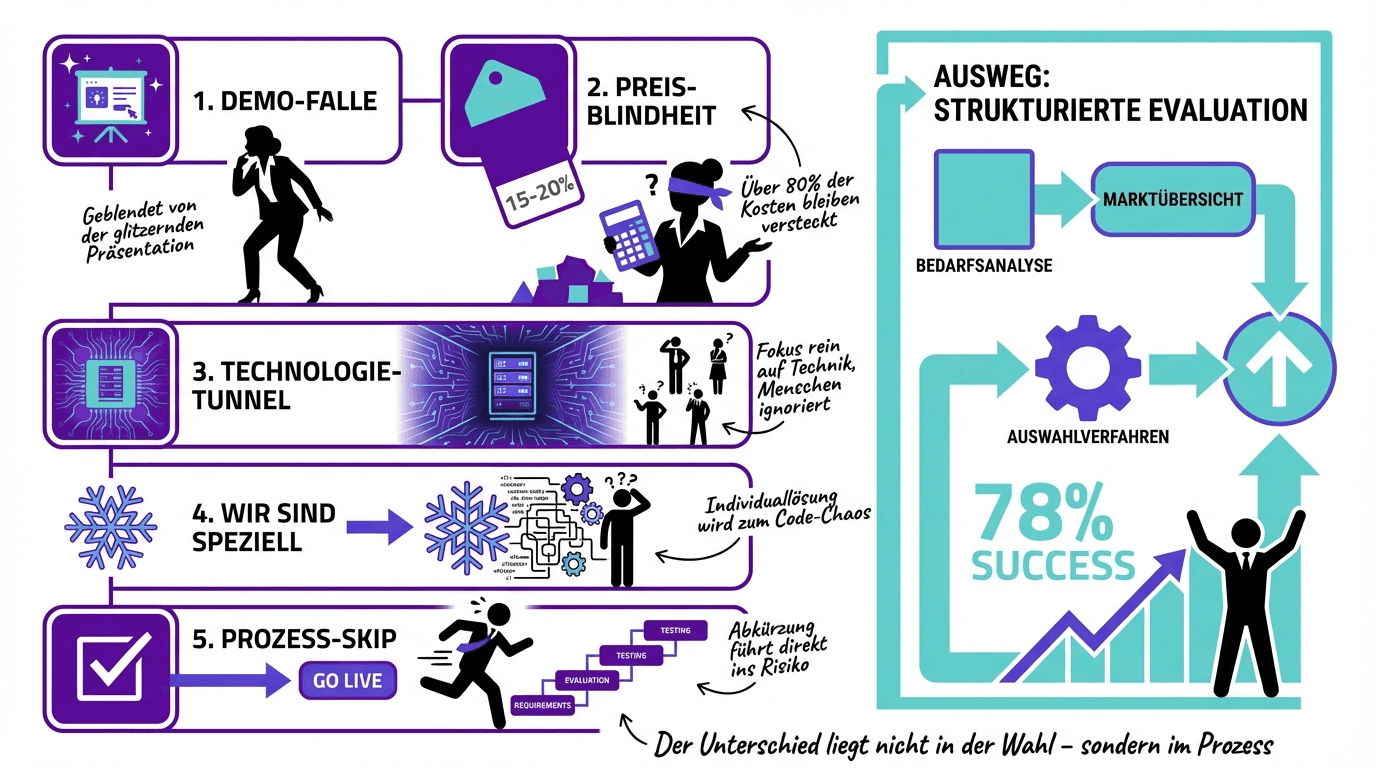
After hundreds of IT projects, we keep seeing the same patterns. Here are the five traps companies fall into most often:
Trap 1: The demo trap
The pattern: An impressive presentation influences the decision more than real business requirements.
How it happens:
The vendor shows a perfectly choreographed demo
Features you will never need look spectacular
The complexity of real implementation is not visible
References are mentioned, but not verified
The consequence: Projects with 300% cost overruns—because reality does not match the demo.
The way out: Define your requirements before you see the first demo. Not after.
Trap 2: Price blindness
The pattern: The focus is on the purchase price—not on the actual costs.
Here is a number you should know:
The purchase price represents only 15–20% of total cost of ownership over 5–10 years.
(Source: Enterprise Software Selection Guide)
That means: 80–85% of costs arise after the purchase.
What is missing from the calculation:
Implementation costs (often higher than the license)
Training effort (for years, not weeks)
Maintenance and support
Integration with existing systems
Adjustments and customization
Opportunity costs during the transition
The consequence: The “cheapest” solution becomes the most expensive.
The way out: Calculate TCO over 5–10 years. Not the list price.
Trap 3: The technology tunnel
The pattern: The decision focuses on technology—people and processes are ignored.
McKinsey has a striking number on this:
Organizations that invest in cultural change have 5.3x higher success rates than those that focus only on technology.
(Source: McKinsey Digital Transformation Study)
5.3x. That is not a marginal difference. That is the difference between success and failure.
How it happens:
Change management is planned as “phase 2”—if at all
User buy-in is assumed
Process changes are underestimated
Training comes too late and is too limited
The consequence: 70% of companies cannot track whether new applications are even being used as intended. The software is there—but no one uses it correctly.
The way out: People before technology. Change management from day one.
Trap 4: The “we are special” trap
The pattern: The belief that standard solutions cannot work for your supposedly unique requirements.
One of the most common statements in IT projects: “It’s different for us.”
In most cases, it is not.
67% of build-vs-buy decisions fail—often because companies overestimate their uniqueness and build custom solutions where a standard one would have been sufficient.
The consequences of custom solutions:
Higher development costs
Maintenance dependency on internal or external developers
No updates and improvements from the product community
Lock-in to in-house developments
The way out: Ask yourself honestly: are our requirements truly unique—or do we just believe they are?
Trap 5: Process skipping
The pattern: Structured evaluation is skipped—due to time pressure, overconfidence, or both.
The numbers speak for themselves:
78% of organizations report better outcomes after introducing structured vendor evaluation.
(Source: Enterprise Software Selection Study)
How it happens:
“We know the market, we don’t need a formal evaluation”
Time pressure: “We need to be live by Q3”
A stakeholder already has a favorite
“We’ve always done it this way”
The consequence: Gut feeling instead of facts. And a 49% error rate.
The way out: A structured process. Weighted criteria. Documented decisions.
The 6 questions before every IT decision
Before you make your next IT decision, ask yourself these questions:
1. What are our business requirements—before we look at demos?
Define what you need before someone shows you what they want to sell. Otherwise, the vendor sets the agenda.
2. What are the true costs over 5–10 years?
Not the list price. The total cost of ownership. Including implementation, training, maintenance, integration, and adjustments.
3. Who has to use this solution every day—and what do they need?
Not what IT wants. Not what looks impressive. What daily users need to be productive.
4. Are our requirements truly unique—or do we just believe they are?
Question the “it’s different for us” statements. In 80% of cases, it is not different enough for custom development.
5. What happens if this project fails?
McKinsey says: 17% of large IT projects threaten the company’s existence. Do you know your risk?
6. Can we speak with three real reference customers?
Not the ones the vendor suggests. Real customers with similar requirements. With critical questions.
What good IT decisions have in common
After hundreds of projects, we see clear patterns in successful IT decisions:
Requirements before demos. Business requirements are defined and prioritized before the first vendor presents.
TCO instead of purchase price. The decision is based on 5–10-year costs, not on the cheapest offer.
People before technology. Change management starts with the decision—not after go-live.
Structured evaluation. Weighted criteria, scoring methodology, documented decision paths.
Verified references. Real conversations with real customers—not glossy case studies.
The question that remains
Not: “Which technology do we need?”
But: “How do we make this decision?”
49% of project failures are not caused by the wrong choice—but by the wrong process. The difference between success and disaster is not in the option you choose. It lies in how you decide.
The difference
Most IT consultants sell you a solution.
We help you make the right decision.
The difference: We have no interest in which vendor you choose. We are interested in your project succeeding.
That means:
Neutral evaluation without vendor bias
Structured decision-making process
Pattern recognition from hundreds of projects
TCO calculation instead of proposal comparison
Change management from the very beginning
Sources: