
Marc H.,
Too Long; Didn't Read
Most IT projects exceed their budget not due to poor planning or incompetent providers – the issue is structural. 70% of all IT projects cost more than planned, averaging 27-43% over budget. In this article, we reveal the hidden cost drivers, the incentive problems within the industry, and how you can budget like someone who has done it a hundred times.

The IT Project Paradox
You know the scenario.
The offer comes in. CHF 150,000 for the new software. Everything is clearly defined, great presentation, the vendor seems competent. You sign.
Six months later: CHF 230,000. And you wonder what went wrong.
Here's the thing... probably nothing went wrong. At least nothing unusual. You simply experienced the statistics.
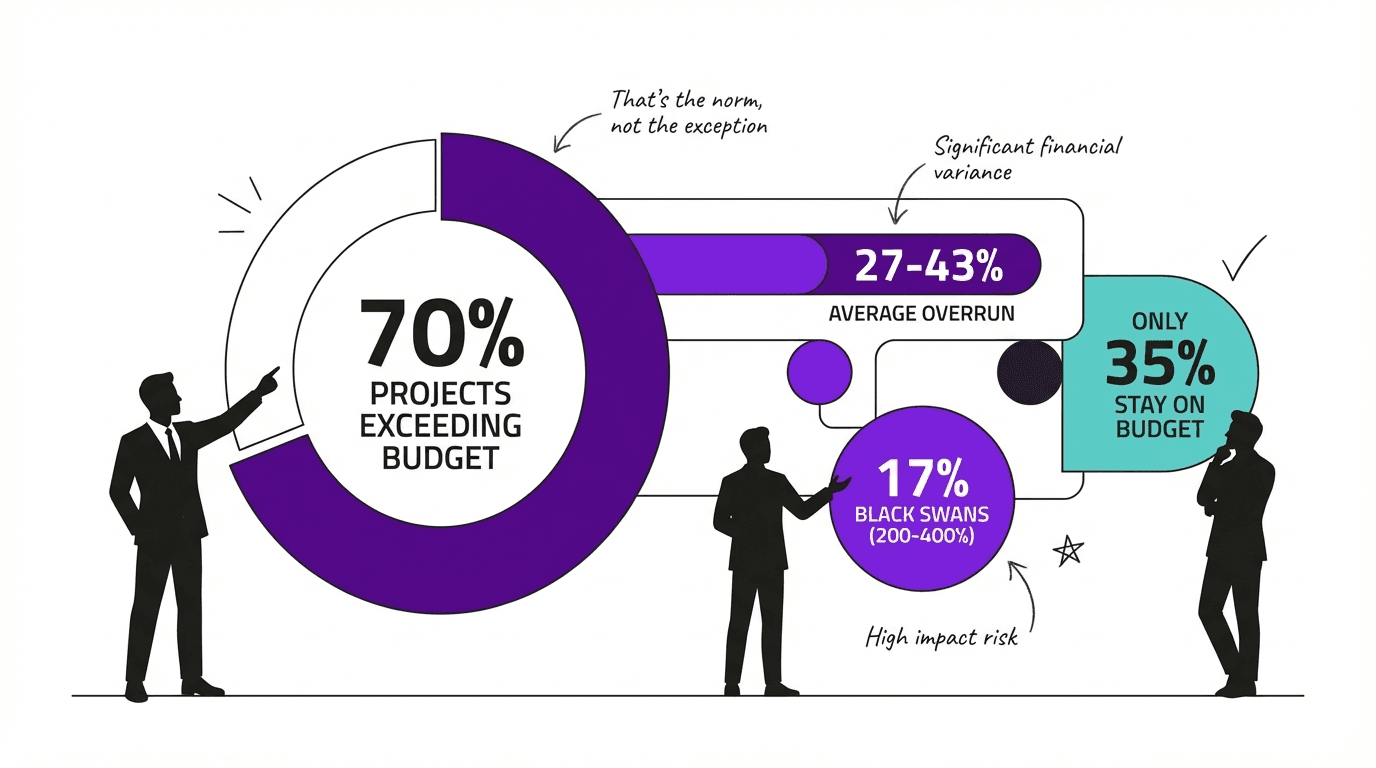
70% of IT projects exceed their budget. That's not an outlier – that's the norm.
The Numbers No One Mentions
Let's talk briefly about reality. Not the marketing version vendors tell you. The real one.
What research shows:
70% of IT projects exceed their budget (PMI, Standish Group)
27-43% average cost overrun on these projects
Only 35% are completed within the original budget
17% are "Black Swans" – projects with 200-400% cost overrun
Read that again. Only about one-third of all IT projects stay within budget. Two-thirds do not.
And then there are the extreme cases. McKinsey found that nearly one in five IT projects is a "Black Swan" – a project that runs completely off the rails. Not 20% over budget. 200-400% over budget.
These aren't bad projects from bad companies. This is the reality of the IT industry.
Scope Creep Is Not the Problem
"Scope Creep!" – that's usually the first explanation when projects become more expensive.
But here's what we've learned after dozens of projects: Scope Creep is not the problem. Scope Creep is a symptom.
52% of all projects are affected by Scope Creep. But why?
The real causes:
Unclear requirements from the start – 37% of project failures derive from unclear goals
Contracts that do not realistically depict changes – "What is not explicitly included costs extra"
Missing buffers for unforeseen events – Every change becomes an expensive change request
The problem is not that requirements change. They always do. The problem is that the original estimate pretends they won't.
The Hidden Cost Drivers
Now it gets interesting. These costs do not appear in any offer – but they will come. Guaranteed.
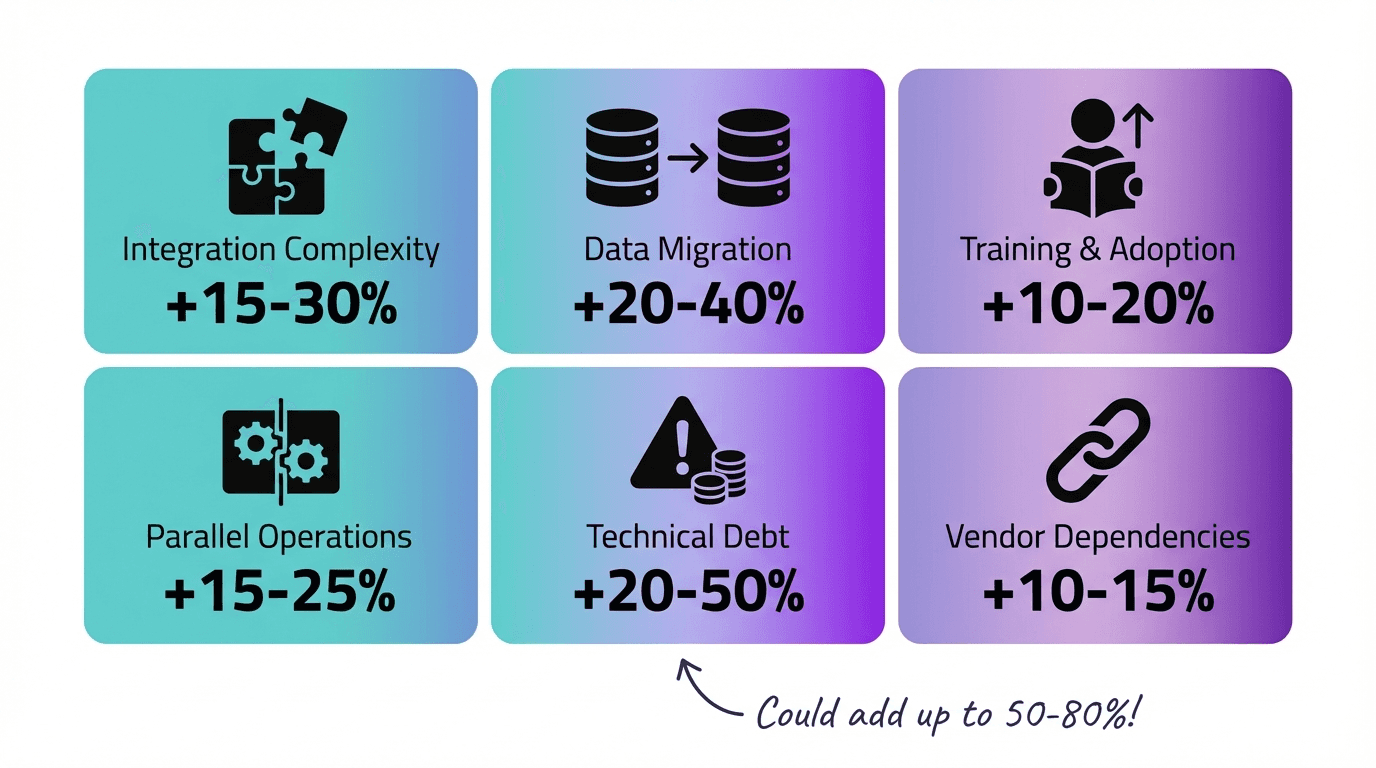
1. Integration Complexity
The problem: Your existing systems are more complex than documented.
Typical impact: +15-30% of estimated costs
The old ERP that "just needs an interface"? It has three undocumented workarounds that were implemented sometime ten years ago. Nobody really remembers why. But without them, everything collapses.
2. Data Migration
The problem: Data quality is worse than assumed. Mapping is more complex than expected.
Typical impact: +20-40% of migration costs
"The data is clean" – we've heard that a hundred times. It never is. Never. Duplicates, missing fields, inconsistent formats, historical legacy issues. All of this needs to be cleaned up before migration can happen.
3. Training & Adoption
The problem: Training and change management are chronically underestimated.
Typical impact: +10-20% of total costs
The software is live. Technically everything is perfect. And then... no one uses it properly. Because no one had time to adequately train the staff. So the old system keeps running in parallel. Or workarounds emerge that undermine the new logic.
4. Parallel Operation
The problem: Old and new systems must run simultaneously.
Typical impact: +15-25% during the transition phase
Suddenly, you're paying for two systems, two maintenance contracts, two teams that both need to know them. And the "short parallel operation" of three months turns into six. Or twelve.
5. Hidden Technical Debt
The problem: The technical debts in the old system only become visible during the project.
Typical impact: Unforeseeable – often +20-50%
"We did it that way back then because it had to be fast." Those shortcuts from five years ago? They take revenge now. And cleaning them up was never part of the offer.
6. Vendor Dependencies
The problem: External partners do not deliver on time or meet the expected quality.
Typical impact: +10-15%
Your project is waiting on the API from the third-party supplier. It arrives two months late. In the meantime, your team does not stand still – they are working on workarounds that will have to be redone later.
The Offer Problem
Here's an uncomfortable truth: The incentive structures in the IT industry work against realistic estimates.
How Vendors Calculate
Low-Ball Bids: The provider with the lowest bid wins. So it's calculated tightly. Very tightly. The difference is later made up through change requests.
Optimistic Estimates: The offer is based on the best-case scenario. Everything runs perfectly, no surprises, the client knows exactly what they want. That... almost never happens.
Hourly Billing: With Time & Material, the vendor has no incentive for efficiency. A longer project = more revenue. It’s not malicious. It's just... business.
Scope Ambiguity as a Feature: What's not explicitly in the contract is later charged as an additional service. The more vague the original offer, the more room for add-ons.
Don't get us wrong – most IT vendors are not frauds. They just operate in a system that rewards unrealistic estimates and penalizes realistic ones.
How to Budget Realistically
Enough problem analysis. Here's what experienced project managers do differently.
The Three-Point Estimation
Forget single numbers. Any serious budget needs three scenarios:
Scenario | Description | Probability |
|---|---|---|
Optimistic | Everything goes perfectly | ~10% |
Realistic | Normal hurdles, typical delays | ~70% |
Pessimistic | Significant problems occur | ~20% |
The Formula: Budget = (Optimistic + 4×Realistic + Pessimistic) / 6
If your vendor only gives you one number, you probably received the optimistic estimate.
Contingency Planning
Every IT project needs a buffer. But how large?
Project Type | Recommended Reserve |
|---|---|
Small, known projects | 15-20% |
Medium projects | 20-30% |
Large, complex projects | 30-50% |
New technology | 40-60% |
Yes, 40-60% for new technology. That sounds like a lot. But take a look at the statistics above again.
What Experienced Project Managers Do
Utilize historical data – How did similar projects run in the past?
Get independent estimates – Not just from the vendor who wants the contract
Estimate bottom-up AND top-down – and understand the differences
Phase-based budget gates – Don't release everything at once
Define change management from the start – How will changes be evaluated and priced?
The Questions You Should Ask Your Vendor
Here’s your toolbox for the next vendor discussion:
Before Signing:
"What is NOT included in the offer?"
"What assumptions have you made for this estimate?"
"What happens if requirements change?"
"How much contingency is calculated?"
"Can you provide me with reference projects – with final costs vs. original offer?"
The last question is the most important. A vendor who can honestly tell you "Project X was 15% over budget because of Y" is worth its weight in gold. One who claims all projects stayed within budget... well.
The Short Version
Here’s what you should take away:
70% of IT projects exceed their budget – that’s the norm, not the exception
Scope Creep is a symptom, not the cause – the problem is unclear requirements and unrealistic contracts
Hidden cost drivers (integration, migration, training, parallel operation, Tech Debt) are predictable – even if they aren’t in the offer
Industry incentive structures reward optimistic estimates
Realistic budgeting means: three-point estimate, adequate reserves, utilize historical data
What to Do?
The next time an IT offer lands on your desk:
Take the number
Ask about the assumptions
Include at least 25-30% reserves
Ask the five questions above
And if you think "I'd like someone to help me realistically assess the offer before I sign" – that's exactly what we do. Without our own agenda, without vendor partnerships, without an interest in making the project bigger than necessary.
(We don’t earn more if your project becomes more expensive. That makes a difference.)
Related Articles: