
Alexis M.,
Too Long; Didn't Read
Most IT contracts protect the vendor — not you. Five clauses make the difference between a fair contract and one that gives you headaches three years from now: exit rights, SLA penalties, data ownership, price escalation caps, and audit rights. You won’t find any of them in the standard contract — but all of them are negotiable.
IT vendor contract clauses determine whether you are in a partnership or in a trap. Last week, we spoke with a client who has been trying for eight months to switch IT service providers. The data is there. The processes depend on it. And in the contract? No reasonable exit clause. A handover period that is effectively impossible. And migration support "on a time-and-materials basis" – meaning hourly rates that make the switch economically unattractive.
This is not an isolated case. It is the rule.
(We also wrote an article about this, describing exactly this scenario: Vendor lock-in – you want to switch, but you can't. If you recognize this, read that first.)
The good news: Almost every contract is negotiable. Vendors want business. They only say "that's not possible" when you don't know what to ask for – or when you don't ask for it.
Here are the five clauses that really matter. Not as a legal teaching piece – but as we enforce them in real IT contract negotiations.
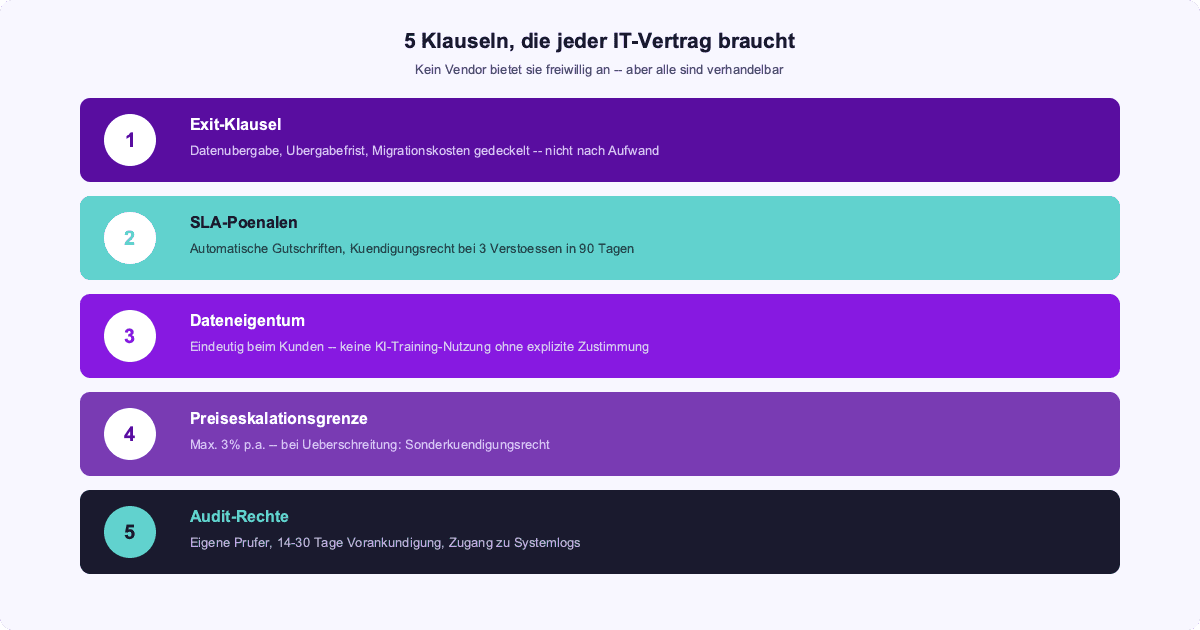
1. Exit clause: Your right to leave – for real
This is the most important clause of all. And the one that is most often missing – or phrased so vaguely that it is worthless in practice.
An exit clause regulates what happens when you want or need to terminate the contract. What you receive. In what format. Within what timeframe. Who bears the costs.
What standard contracts typically include: a notice period (sometimes 90, sometimes 180 days), and a vague statement about "support during handover." What that actually means is nowhere defined. Hourly rates for migration assistance? Not either.
What a good exit clause includes:
Concrete data delivery in machine-readable, standardized formats (no proprietary exports that you then still have to convert)
Maximum handover period with milestone plan
Fixed price or price cap for migration assistance – not "on a time-and-materials basis"
Right to run parallel operations during the migration phase
Guaranteed support for at least 90 days after contract end
Vendors do not like this. Because it weakens their negotiating position when you really want to leave. That is exactly why it matters.
Our tip: Negotiate the exit clause at the beginning – when you have not yet invested in the contract and both sides are still willing to negotiate. If you only ask at the end, your position is weaker.
2. SLA penalties: When "we apologize" is not enough
SLAs are included in almost every IT service provider contract. Availability of 99.9%, response times of four hours, resolution times by end of business. That sounds good.
The problem: In many contracts, it states what the vendor guarantees – but not what happens if they fail to meet that guarantee.
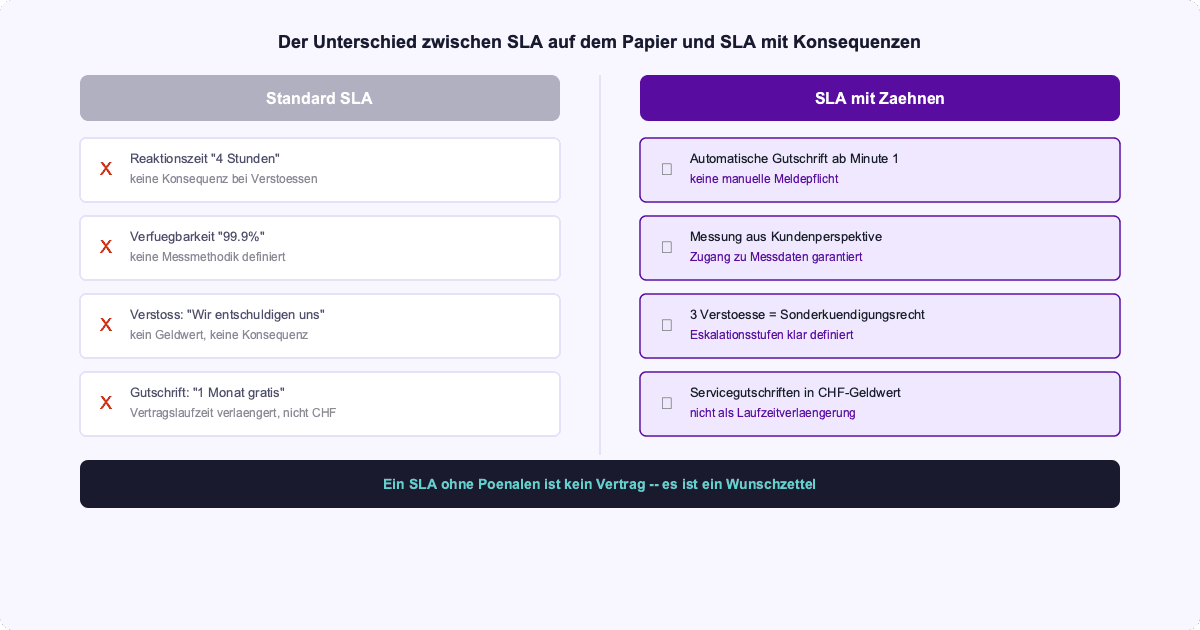
No automatic credits. No penalties. Instead: "The customer shall notify the vendor in writing of SLA breaches, and the vendor shall make efforts to avoid recurrence." That is not a contract – it is a wish list.
What an SLA clause with teeth needs:
Automatic credits when targets are missed – no manual reporting obligation for every incident
Escalation steps: In the event of repeated breaches (e.g. three times within 90 days), an extraordinary termination right arises
Clear measurement methodology: How is availability measured? From which point to which point? Who has access to the measurement data?
Service credits in monetary value, not just as an extension of the contract term
(The latter is a classic trick: "We will give you one month for free." Great – but if the service is bad, you may not want it extended in the first place.)
We have also written about SLA negotiations and what can go wrong in that context: If you are currently considering whether your current MSP was the right choice, our article on common mistakes when selecting an MSP is worth reading.
3. Data ownership: Whose data is it, really?
This question sounds trivial. The answer is not.
Standard contracts often grant vendors broad usage rights to your data. "For the provision of services and to improve our services" – a formulation that allows a great deal. Aggregated usage data, benchmarks, training material for AI models. All included, all possible.
And then there is the other problem: You do not always know exactly where your data is located, which subcontractors have access, and whether your data is replicated to the United States – which, depending on the industry, is a real compliance issue.
What you want in the contract:
Clear statement: You own your data. Always. The vendor has a limited right of use solely for the provision of services.
No use for product development, training, or benchmarking without explicit written consent
Transparency regarding data locations and subcontractors – including notice of changes
Data deletion protocol at contract end (when will data be deleted, how will this be confirmed?)
The data ownership issue is particularly relevant if you work with customer data, regulated data (e.g. in healthcare or finance), or if your vendor offers AI services trained on usage data. In these cases, the contractual clause is not only commercially important – it is a compliance necessity.
4. Price escalation limits: What the contract will cost in three years
This is what we see most often: A company signs a contract on attractive terms. Cheap, because the vendor wants to gain market share. And then, in the second or third year, the price adjustments arrive.
"In line with general cost trends" or "according to CPI adjustments" – formulations that sound entirely legitimate and in practice mean: The vendor can raise prices every year without you being able to do much about it, unless you initiate a switch.
We have seen situations where monthly costs nearly doubled within three years. Not because of additional services. Only because of price escalation that was contractually permitted.
What you should negotiate:
Fixed price escalation cap – e.g. a maximum of 3% per year, regardless of inflation or the vendor's internal cost increases
Minimum contract term without price changes – the first 12 to 18 months at the agreed price, period
Right to extraordinary termination in the event of price increases above the agreed threshold – this creates a real incentive for the vendor to stay moderate
Transparency regarding price components – what exactly costs what, so adjustments remain understandable
Vendors will say: "We cannot impose price shackles on ourselves." That is true. But you can secure exit rights that limit the risk for you. That is the compromise we enforce in most cases.
On outsourcing costs that develop differently than expected, we have a direct article: Outsourcing saves money – or does it?. It is worth reading before you sign.
5. Audit rights: Only those who can inspect know what is going on
This is the clause that is negotiated least often – and is most often missing in times of crisis.
Audit rights mean: You have the right to inspect your vendor's service delivery. Security standards, SLA compliance, data storage locations, subcontractors, compliance status. Not because you fundamentally distrust them – but because you should have the right to check.
Many standard contracts do not include audit rights. Some include "the right to review aggregated reports prepared by the vendor" – which in practice means nothing. You only see what the vendor wants to show you.
What good audit rights include:
The right to appoint your own auditors (internal or external third parties) – not just the vendor's auditors
Reasonable advance notice (14-30 days is enough in most cases)
Access to relevant system logs, security certificates, subcontractor contracts
For regulated industries: explicit right to inspection by regulators or their appointed representatives
Vendors often respond to this request with "that is not common here." That is not a rejection – it is the start of a negotiation. We have enforced audit rights in most contracts, sometimes limited, but always in a form that is actually usable.
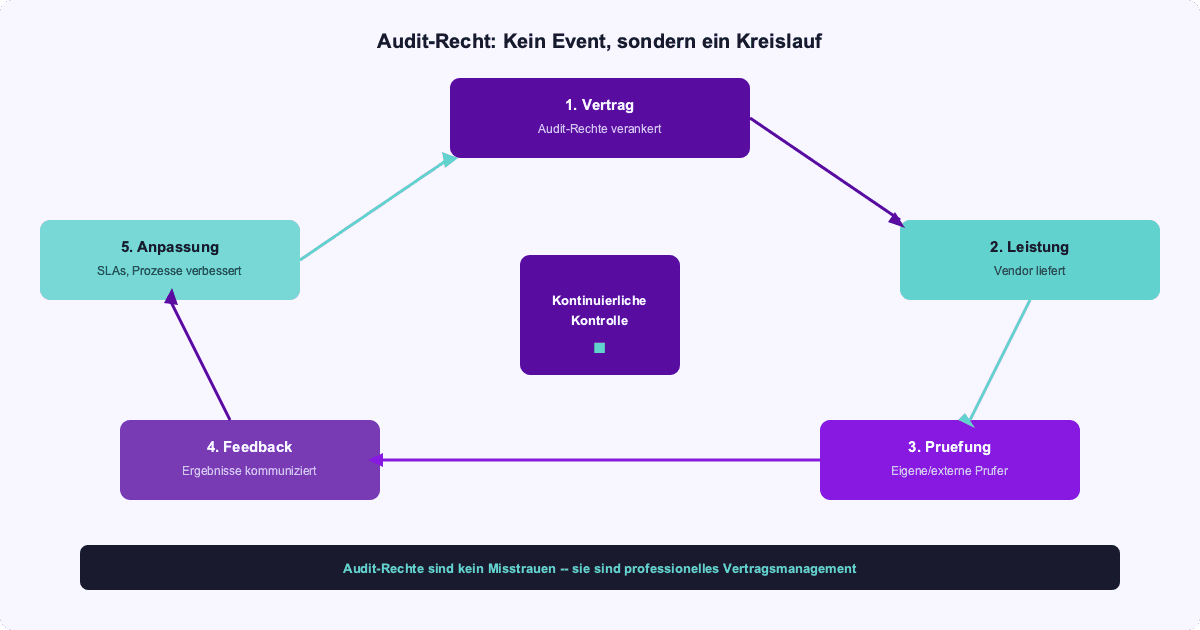
IT vendor contract clauses: Before you sign
No vendor will offer you these five clauses on their own. That is not malicious intent – that is standard process. Standard contracts are designed to benefit the vendor. If you do not negotiate, you accept that.
The good news from our experience: Almost everything is negotiable. Vendors who want to do good business will discuss all five points. Some will hesitate, some will suggest compromises. But anyone who dismisses these clauses at the mere mention of them is telling you something important.
Before you sign your next IT service provider contract, go through this list:
Exit clause with concrete handover obligations and price cap
SLA penalties with automatic credits and termination rights
Data ownership clearly with the customer, usage rights clearly limited
Price escalation limit firmly anchored
Audit rights through your own or external auditors
That is not distrust. That is contract management. And that is exactly the difference between a vendor contract that works for you – and one where you only realize three years later how it really functions.
If you are currently negotiating an IT contract or want it reviewed, talk to us. This is exactly the kind of work we do for our clients.