
The meeting runs fifty minutes, and by the end nobody has decided anything.
It is called the ISO 27001 management review, it sits in the calendar once a year, and it usually runs the same way. The person who looks after the ISMS has prepared twelve slides: open actions, the traffic lights from the internal audit, two incidents, the risk list with last year's colours. They present. The management board listens, asks two questions, thanks them for the overview. A sentence appears in the minutes afterwards: the management board takes note of the report.
Formally the meeting took place. There is a date, an attendance list and a set of minutes, and what the standard asks for in this clause is still missing.
What does ISO 27001 require in clause 9.3?
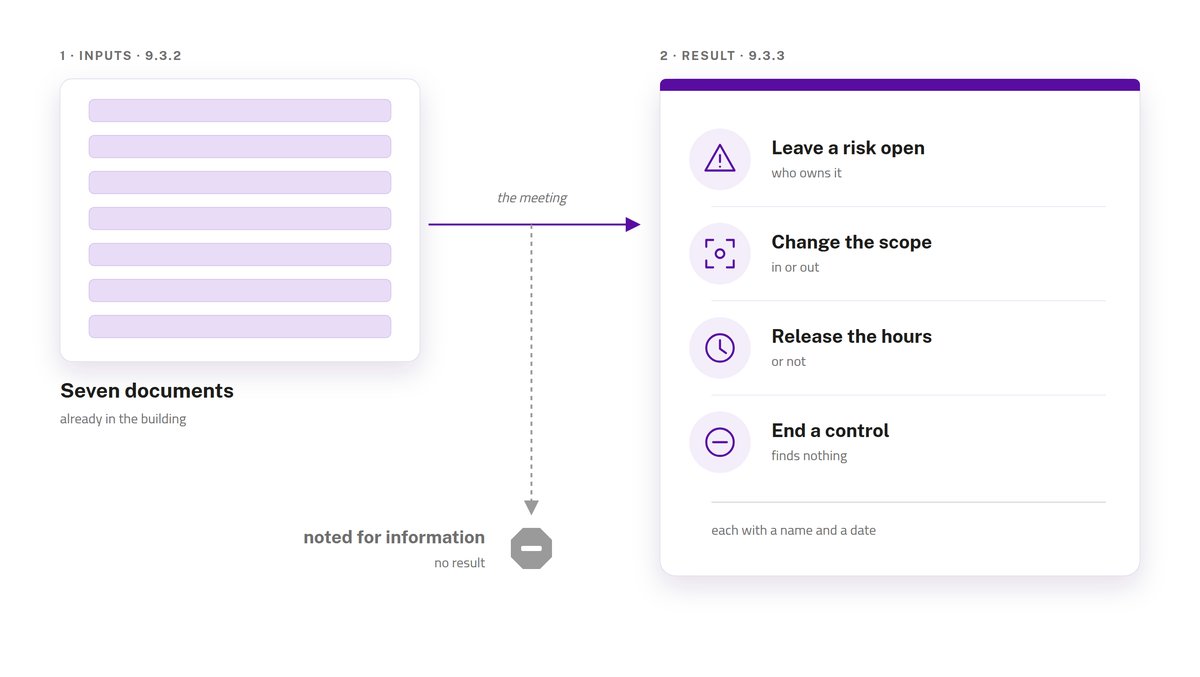
Clause 9.3 has three parts. 9.3.1 says who reviews and when: top management, at planned intervals, looking at whether the system is still suitable, adequate and effective. 9.3.2 lists seven inputs that have to be considered. 9.3.3 requires decisions as the result, on opportunities for improvement and on changes to the ISMS, recorded in writing.
That three-way split is why so many management reviews stand out in an audit even though the minutes exist. Anyone running an ISMS to ISO 27001 usually delivers the inputs in full and in good order. What then lands in the minutes as the result is the summary of a presentation.
The seven inputs are the easy part
Clause 9.3.2 names seven things that have to be on the table. Translated into the language of a meeting:
- the status of actions from the previous review
- what has changed in the internal and external issues
- what has changed in the needs and expectations of interested parties, meaning customers, authorities, owners, insurers
- feedback on information security performance: nonconformities and corrective actions, monitoring and measurement results, audit results, and whether the objectives set were met
- feedback from the interested parties themselves
- the results of the risk assessment and the status of the risk treatment plan
- opportunities for continual improvement
All of it already exists somewhere in the building. The audit results sit in the internal audit report, the incidents in the ticket system, the risks in the register, the customer requirements in the last questionnaire that a large client's procurement team sent over, and preparing the review is therefore mostly collecting and sorting.
One of the seven is almost always missing anyway, and it is the third: what has changed among the interested parties. The numbers from your own house are easy to get. That a large client has been attaching a requirements catalogue since the spring, that the cyber insurer asks two new questions at renewal, that a supplier has widened its access. None of that is in a register, it sits with sales or procurement. Honestly, this is the line we have to ask about most often in our own mandates, and it is the only one that connects the ISMS to the business.
The rest is legwork, which is why it lands with the person who built the ISMS. That is right, it is their job. But whoever collects the material also sets how the meeting runs. A person who has prepared twelve slides presents twelve slides, and the decisions that should follow are not theirs to make.
The result is a decision, not a report
Clause 9.3.3 is short. The results of the management review have to include decisions on opportunities for improvement and on any need for changes to the management system.
In our experience an SME faces almost always the same four kinds of decision in this meeting.
First: a residual risk stays open, deliberately. Two-factor sign-in for the production environment will not happen this year because the machine controller does not support it. That is a legitimate decision, but it needs someone to carry it. Who may accept an IT risk and who may not, we have taken apart elsewhere.
Second, the scope changes. A new site has been added, a department has been working since February in a tool that appears nowhere in the documentation. Either it belongs in the system or it is deliberately left out. Both are fine, as long as it has been decided.
Third, it is about means, and usually about hours rather than money. The board releases the half day per month that the access review needs, or it does not release it. Both are decisions, and only one of them tends to get said out loud.
Fourth, something ends. A control that has run for two years and never found anything gets dropped. That is the decision that is recorded least often, even though it gives back the most time.
Each of these four sentences needs a name and a date. The sentence saying that the management board took note of the report is none of them.
Why the meeting still runs as a presentation
This is not a documentation problem. No template and no ISMS tool solves it, however good the templates have become.
A decision costs somebody something. Whoever accepts a residual risk writes their name next to it. The half day per month for the access review is taken away from somewhere else by the board. And whoever drops a control has to explain later why, if something does happen. Taking note costs nobody anything. It feels like oversight and commits no one to anything.
Then there is the attendance. In many SMEs nobody in that meeting may commit money and hours without asking first, and then the meeting cannot produce anything other than a note. Anyone who wants to change that changes who is in the room first, and the template second.
Who "top management" means in an SME
The standard says top management, meaning whoever steers the organisation at the highest level, in a Swiss SME the management board. The head of IT, an information security officer or an external adviser may prepare the review and take part in it. Reviewing in the sense of 9.3.1 is not something they can do.
Swiss company law has a counterpart that shortens the discussion in many boards of directors. Under Art. 716a para. 1 no. 5 of the Swiss Code of Obligations, the non-transferable and inalienable duties of the board of directors include "the overall supervision of the persons entrusted with managing the company, in particular with regard to compliance with the law, articles of association, operational regulations and directives". And in the same article, paragraph 2: the board "shall ensure appropriate reporting to its members".
Which means, in plain terms: the duty to be reported to and to look is in the law already, certificate or no certificate. Art. 717 para. 1 adds that the members of the board of directors and third parties engaged in managing the company must carry out their duties "with all due diligence". Clause 9.3 does not invent this oversight. It gives it a date, an agenda, a list of inputs and a set of minutes.
In practice: the management board runs the review, and the result goes to the board of directors, at least once a year, in business language rather than in clause numbers. Without that reporting the board of directors cannot exercise its supervision, whether or not an auditor asks about it.
How often does the ISO 27001 management review have to happen?
Clause 9.3.1 says "at planned intervals". No annual rhythm, no quarter, no minimum number. All that is required is that the intervals are planned and fit the business. Once a year is allowed, twice is too, and after a big change an extra session belongs in the calendar.
The annual rhythm almost everyone runs does not come from the standard, it comes from the audit calendar: the surveillance audit takes place in every calendar year except the recertification year, and the review is scheduled shortly before it so that it is available during the audit.
That works, with one side effect. One session per year collects twelve months of material. Then fifty minutes face an agenda that would need two hours, and what gets cut is the end, which is the decision part.
In our experience two sessions a year of sixty minutes each carry better than one of two hours, especially when they are attached to a management meeting that is in the calendar anyway. And when something big happens in the business, a new site, an incident, a large client with a requirements catalogue, the review belongs shortly after it rather than in December.
How an auditor sees that nothing was decided
From the minutes. Four patterns stand out first in an ISO 27001 management review, and in our experience one look is enough.
The minutes contain no result sentence, only a summary of the presentation. For whatever is supposed to change, the name and the date are missing. The open items from the last review do not appear, even though the list in 9.3.2 starts with exactly those. And the action plan from the internal audit looks the same after the review as before it.
The last pattern weighs most, because it touches the purpose in 9.3.1. If the review changes nothing in the list that served as its input, nobody has judged whether the system is still suitable and effective. Which records the standard requires in writing and which it does not is in our post on the mandatory documents.
Short minutes, on the other hand, are fine. The standard asks for no length, and one page with four decisions, each with an owner and a deadline, carries more than twenty pages of status report.
The agenda for the next session
Take the next ISO 27001 management review in your calendar and rewrite the agenda. The inputs under 9.3.2 stay preparatory work: they go out beforehand as a document and are not presented in the meeting. Instead four lines sit on the agenda, and each one demands a word at the end:
Which residual risk do we deliberately leave open this year, and who carries it? What changes in the scope? Which hours and which money do we release? And which control do we end because it brings nothing?
Then write the minutes as decisions: four sentences with four names and four dates. The change costs nothing except the willingness to settle something in the meeting itself.
An outside view on which four lines are genuinely up for decision at your company this year is already half the preparation. That is what the free first conversation is for. It replaces no meeting, it only makes the agenda shorter.
Frequently asked questions
Is a management review mandatory for ISO 27001?
Yes. Clause 9.3 requires top management to review the ISMS at planned intervals and to keep the results in writing. Without a management review that actually took place there is no certificate. The standard names no annual rhythm, it asks for planned intervals that fit the business.
Who has to attend the management review?
Top management, which in a Swiss SME means the management board. The head of IT, an information security officer or an external adviser may prepare it and take part, but reviewing in the sense of 9.3.1 is not theirs to do. What matters is that someone in the room may commit hours and money.
What has to be in the minutes of a management review?
Decisions, not a summary. Clause 9.3.3 requires resolutions on opportunities for improvement and on changes to the ISMS, each with an owner and a deadline. One page with four such lines carries more than twenty pages of status report. A sentence saying the report was noted does not meet 9.3.3.