
Jessica A.,
Too Long; Didn't Read
The numbers speak for themselves: Swiss companies pay, on average, 30 to 40 percent more for stable cloud workloads than for comparable dedicated infrastructure. Cloud repatriation is not a step backward, but a data-driven decision. The first step is an honest five-year cost analysis that includes egress fees, support costs, and overprovisioned resources.
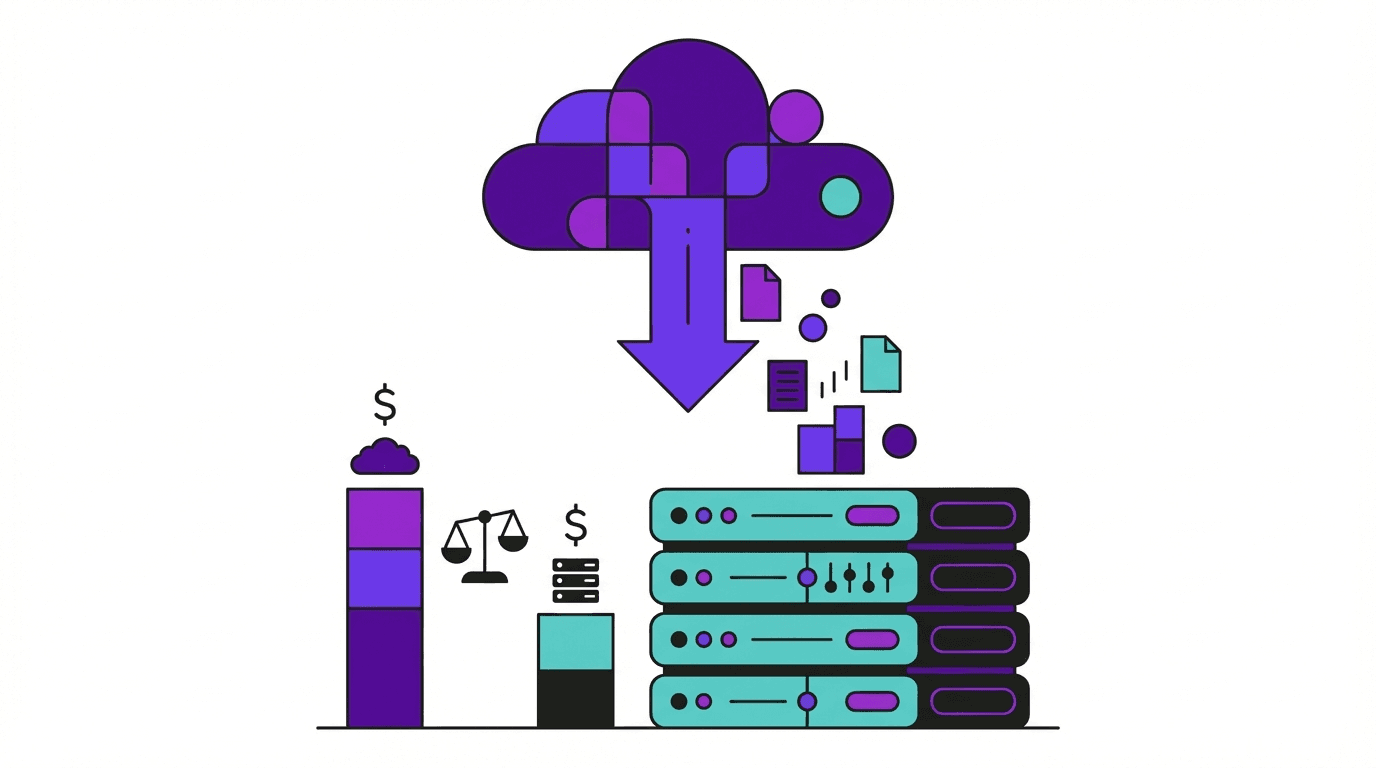
TLDR: The numbers speak for themselves: Swiss companies pay, on average, 30 to 40 percent more for stable cloud workloads than for comparable dedicated infrastructure. Cloud repatriation is not a step backward, but a data-driven decision. The first step is an honest five-year calculation that includes egress fees, support costs, and overprovisioned resources.
CHF 14,400 per year for a workload that could cost CHF 8,500
We recently ran the numbers with a manufacturing company from German-speaking Switzerland. 180 employees, ERP system in the public cloud for four years. The monthly bill: around CHF 1,200. Sounds like a normal amount.
Then we broke it down. CHF 480 compute for an instance running 24/7 at a constant level. CHF 210 storage. CHF 190 egress fees because the ERP continuously delivers data to local systems. CHF 95 for the cloud provider’s monitoring and logging. CHF 85 for the support contract above the basic tier. On top of that came line items for backup, database licenses under cloud terms, and overprovisioned resources that have never been adjusted since go-live.
Annually: CHF 14,400. Projected over five years: CHF 72,000.
The alternative we fully costed out: a dedicated server in a Swiss colocation data center. Purchase plus setup around CHF 12,000, monthly colocation fee CHF 350, including ongoing maintenance. Five-year cost: approximately CHF 33,000.
The difference: CHF 39,000. For a single workload.
That is not an anti-cloud argument. It is arithmetic.
Where calculations are systematically off
Most companies’ first cloud migration was based on price lists and estimates. That was not naive; it was simply the only way before real usage data existed. Now, three to five years later, that data exists. And it tells a different story than the original business cases.
Three cost blocks appear in almost no initial calculation.
Egress fees. Every gigabyte leaving the cloud costs money. For companies with internal data flows between production, ERP, analytics, and backup, this adds up to amounts that were in none of the original calculations. We regularly see cases where egress accounts for 12 to 18 percent of the total cloud bill. In your own data center or in a colocation environment: zero.
License costs under cloud terms. Database licenses that were covered on-premises by a fixed price often switch to consumption-based billing in the cloud. For stable workloads, this means: you pay more for the same usage, without benefiting from elasticity. We have seen projects where database license costs alone were twice as high in the cloud as on-premises.
Overprovisioned resources. During initial migration, instances are generously sized. Just to be safe. Understandable. But that safety margin often remains in place for years. No one dares to downsize the instance because no one knows exactly when peak loads occur. The result: permanent overprovisioning that burns money every month.
Added to this are support contracts, monitoring tools, and cloud provider security services, each billed separately. In total, for stable 24/7 workloads, we regularly see cost deviations of 30 to 60 percent compared to the original estimate.
We covered the topic of cloud cost transparency in detail in a separate article: Cloud costs out of control? Here’s how to create transparency.
The decision matrix: Which workloads are candidates?
Not every workload is a repatriation candidate. Anyone who wants to move everything back across the board makes the same mistake as those who moved everything to the cloud across the board. The decision must be made per workload, based on measurable criteria.
Utilization pattern. Workloads with constant, predictable load are the strongest candidates. Cloud pricing models are optimized for elasticity. If you do not need that elasticity, you pay a premium for a capability you do not use. Development environments, seasonal peak load, international expansion: the cloud pays off here. ERP systems, production databases, internal file services: often not.
Data volume and transfer patterns. The more data a workload exchanges with other internal systems, the more expensive it becomes in the cloud. An ERP that continuously delivers data to production, accounting, and analytics generates substantial egress costs. In your own network, these disappear completely.
Regulatory requirements. Swiss companies in financial services, healthcare, or close-to-government sectors have specific requirements about where data may reside and who may access it. In the public cloud this is technically solvable, but it creates ongoing compliance effort. If you must fully control your data, on-premises or in a Swiss data center can sometimes be the simpler setup. We wrote more here on the topic of digital sovereignty: Digital sovereignty for Swiss companies.
Vendor dependency. Companies that run all critical systems with a single cloud provider have effectively placed their IT future in external hands. What happens with drastic price increases? If features are discontinued without replacement? In a separate article, we described why many companies think they could switch, but then cannot: You want to switch, but you can’t.
The hybrid cloud strategy—keeping part of the workloads in the cloud and part on-premises—is the most realistically best answer for many companies. Not as a compromise. As a cost-optimized architectural decision.
The practical process of repatriation
If the numbers support partial repatriation, the process is less dramatic than an initial cloud migration. Four steps.
First: inventory. Which workloads run where, which resources do they use, and what dependencies exist with other systems? Without this foundation, you are planning in the dark.
Second: classification. Systems that rely heavily on cloud-native services (serverless functions, managed Kubernetes, provider-specific databases) cannot be extracted without significant effort. Suitable candidates have little cloud integration, stable utilization, and clear data hosting.
Third: define the target architecture. Own data center, colocation in Switzerland, or a private cloud model? How will the hybrid architecture between cloud and on-premises be coordinated?
Fourth: migration in controlled steps. With a rollback plan. Not everything at once, but workload by workload.
(What we never recommend: migrating the largest workload first based on gut feeling. That rarely ends well.)
The numbers that matter
30–40% higher costs are what Swiss companies typically pay for stable 24/7 workloads in the public cloud compared to dedicated infrastructure.
12–18% of the cloud bill in data-intensive environments is due to egress fees, which do not appear in most initial calculations.
5 years is the time horizon over which you should compare cloud and on-premises costs. Anything below that distorts the picture in favor of the cloud.
If you are unsure where to start, or if your current cost calculation does not provide a clear picture: that is a good starting point for a conversation. We help you ask the right questions before contracts run on.