
Marc H.,
Too Long; Didn't Read
$44.5 billion cloud waste - globally, 2025. That's not the cost. That's the portion that is wasted. 84% of companies struggle with managing cloud costs. Only 30% can accurately say what they are paying for. The problem isn't technical - it's visibility. So is the solution: FinOps principles can save 25-40%. But first, you need to see where the money is going.

History Repeats Itself
Last week I had a conversation that I have had a hundred times before.
CFO of a mid-sized company. 150 employees, manufacturing. AWS and Azure cloud bill combined: CHF 28'000 per month. Two years ago, it was still CHF 12'000.
His question: "Can you explain to me what we are paying for?"
My counterquestion: "Can you explain it to me?"
Silence.
This is not the exception. This is the rule.
The Numbers Nobody Wants to Hear
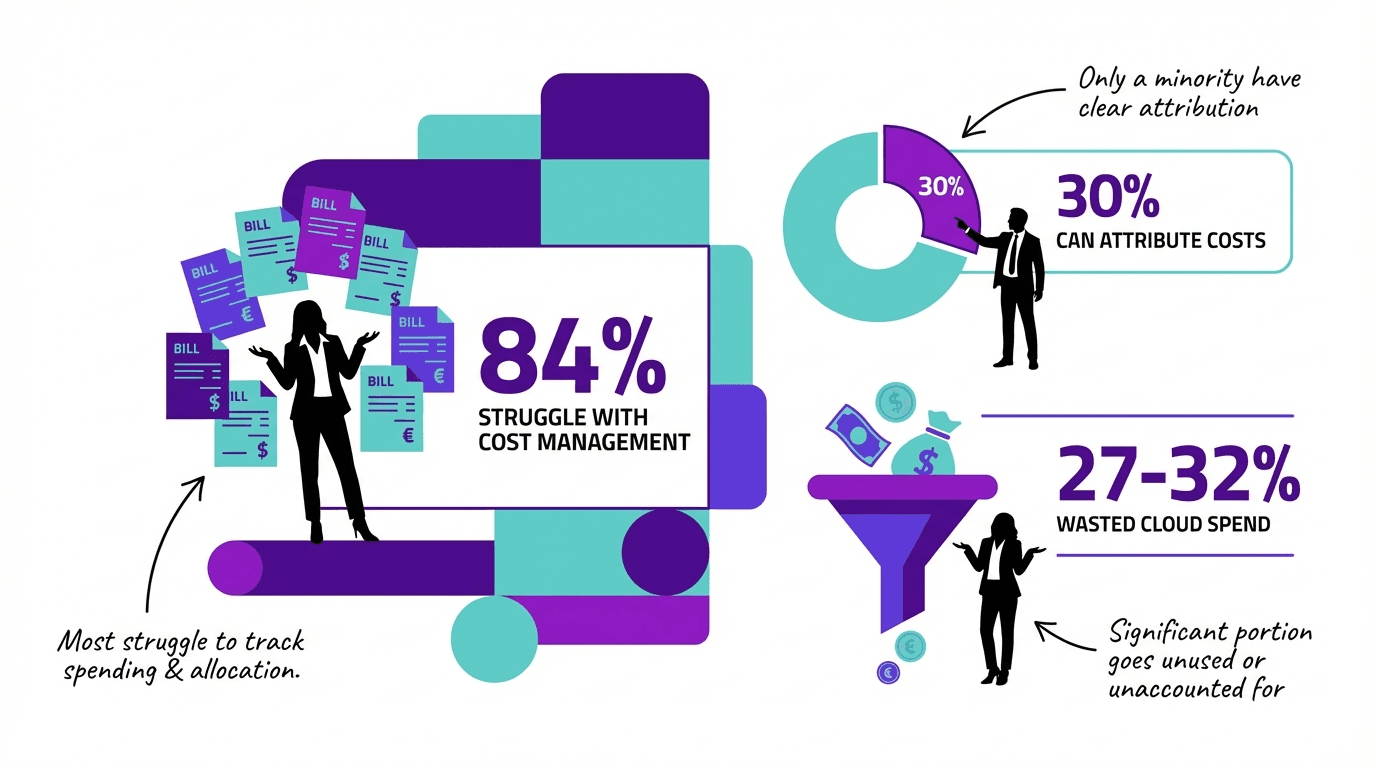
84% of companies say cloud cost management is their biggest cloud challenge.
(Flexera State of the Cloud 2025)
Not security. Not performance. Not compliance. Cost.
And it gets worse:
$44.5 billion in cloud waste projected for 2025. Globally. Infrastructure only.
That is not the total cost. That is the part that is wasted. Idle VMs. Oversized instances. Forgotten snapshots. Resources nobody needs anymore, but everyone is still paying for.
27-32% of cloud budgets are wasted.
For every CHF 100'000 you spend on cloud, CHF 27'000 to 32'000 disappear into nothing.
Why Nobody Knows What They Are Paying For
This is where it gets interesting.
Only 30% of companies can accurately allocate their cloud costs.
That means 70% have no idea which team, which project, which application costs what.
The bill comes in. It gets paid. Nobody asks why.
54% of cloud waste is caused by a lack of cost transparency.
That is no surprise. If you cannot see what you are consuming, you will not optimize it either. Why would you? You do not even know there is a problem.
The Usual Suspects
When we analyze cloud costs, we always find the same patterns. Always.
Dev/Test Environments That Never Sleep
A developer needs a test environment. Makes sense. They provision it with the same specs as production. Makes less sense, but understandable. The environment runs 24/7. Even on weekends. Even at night. Even during vacation.
No one set up automatic scheduling. No one thought of it.
At one client: 40% of Dev/Test costs were for hours when nobody was working.
Snapshots That Keep Piling Up
Backups are important. So snapshots are created. Daily. For every server. Every service. Every database.
The snapshot policy? "Create."
The retention policy? "..."
After two years, one client had more snapshot storage than active data. The storage budget was three times higher than necessary.
The "Temporary" Resources
"We just need a bit more capacity for the project."
The project has been finished for 18 months. The capacity is still running.
48% of companies do not track idle resources.
What is not tracked is not stopped.
On-Demand, Even Though There Is Another Way
58% do not use Reserved Instances or Savings Plans.
That is like buying single-day tickets every day even though you need an annual pass. AWS and Azure offer 30-60% discounts for commitments. Most pay full on-demand prices.
The Real Problem
Here is the uncomfortable truth:
55% of developers say cloud purchases are based on estimates.
Not on data. Not on analyses. On estimates.
"How much do we need?" "No idea. Let us take this."
That does not work. It never has. But without visibility there is no better option.
52% say the disconnect between FinOps and Development leads to wasted cloud costs.
Developers do not know what things cost. Finance only sees the total bill. Nobody connects the dots.
The Path to Transparency
The good news: the problem can be solved. And the solution does not have to be complicated.
Step 1: Take Tagging Seriously
Every resource needs tags. Project. Team. Environment. Cost center.
Sounds trivial. Still not done. Or not consistently.
Without tags, no allocation. Without allocation, no accountability. Without accountability, no optimization.
Step 2: Create Visibility
AWS Cost Explorer. Azure Cost Management. Or a third-party tool.
No matter which one - the main thing is that someone looks at it. Regularly. Not once a year at the budget review.
Continuous Monitoring increases forecast accuracy by 35%.
Step 3: Establish Accountability
Who is responsible for cloud costs? Not "IT". Not "everyone". A specific person or a specific team.
In 70% of large companies, there are now dedicated FinOps teams. In SMEs, that does not have to be full-time - but it has to be someone.
Step 4: Implement Quick Wins
Stop idle resources. If there has been no CPU load for 30 days, nobody probably needs it.
Dev/Test scheduling. Off at 18:00, on at 08:00. Off on weekends. That alone often saves 60% of Dev/Test costs.
Snapshot retention. 90 days is usually enough. 365 is almost never necessary.
Rightsizing. If the instance is consistently running below 20% CPU, it is too large.
Step 5: Evaluate Savings Plans
Once you have visibility, you know which workloads run stably. Those are worth commitments.
30-60% discount compared to on-demand. That is not marginal. That is substantial.
What FinOps Can Deliver
FinOps adoption grew by 46% in 2025. Because it works.
Companies that implement FinOps save 25-40% of their cloud costs.
That is not theory. It is measurable.
But FinOps is not software you buy. It is a discipline. A way of working. A culture of cost accountability.
80% organizational, 20% technical. No dashboard replaces someone accountable for the bill.
The Numbers That Count
84% struggle with cloud cost management. You are not alone.
27-32% are wasted. Probably in your case too.
30% can allocate what they pay for. Do you belong to them?
54% of the waste comes from a lack of visibility. The solution is transparency, not a bigger budget.
25-40% savings are possible. With FinOps principles, consistently applied.
The question is not whether you are paying too much for cloud. The question is how much.
If You Need Help
We do cloud cost assessments. Not to sell tools - to create transparency.
Cost Visibility: Where is the money going?
Waste Identification: What part of it is avoidable?
Quick Wins: What can you stop tomorrow?
Savings Plan Optimization: Where do commitments pay off?
Related articles:
Sources: