
Franco T.,
Too Long; Didn't Read
Technical Debt is not an IT excuse. It is a real financial burden that costs the average large enterprise over 370 million dollars per year. Like a real mortgage: quick fixes today mean interest payments tomorrow. The difference: this debt does not appear on your balance sheet, even though it can account for 20-40% of your technology portfolio value. The solution is not "clean up later" – but strategic debt management at the C-level.

The Mortgage No One Sees
Your company likely has a mortgage you are unaware of.
It doesn't appear on the balance sheet. It doesn't show up in any annual report. But it costs you millions.
We are talking about Technical Debt – technical debts that have accumulated over the years in your IT systems. And like any real mortgage, ignoring it just makes it more expensive.
What is Technical Debt?
The term comes from Ward Cunningham, one of the fathers of agile software development. The metaphor is precise:
When you borrow money, you can move forward faster. But you have to pay it back – with interest.
In IT, it's the same. Every quick fix, every workaround, every "we'll do it right later" is a debt. You reach your goal faster. But you pay interest – in the form of higher maintenance costs, slower development, and missed opportunities.
The problem: With financial debt, you know exactly how much you owe. With Technical Debt, few have an overview.
The Numbers Your CFO Should Know
If Technical Debt were just a technical issue, it would remain at the IT level. But it's not.
$370 million per year – that's how much Technical Debt costs the average global large enterprise. This is not a theoretical number but the result of a study by Pega, which surveyed over 1,000 IT decision-makers in 2025.
(Source: Pega Global Survey 2025)
In the US, this adds up to $2.41 trillion annually – equivalent to 11% of the entire US technology budget.
(Source: Accenture Tech Debt Report)
But the direct costs are just the tip of the iceberg.
The Real Price
91% of CTOs say Technical Debt is their biggest challenge.
70% of IT leaders report that Tech Debt massively restricts their ability to innovate.
80% of companies had critical projects delayed or stopped due to Tech Debt.
(Sources: STX Next CTO Survey 2024, Protiviti Tech Leaders Survey 2025, Unqork/Morning Consult 2024)
Then there's the portfolio value: According to McKinsey analysis, 20-40% of the entire technology portfolio value consists of Technical Debt.
Imagine if 20-40% of your real estate were mortgaged without you knowing.
How Does Technical Debt Arise?
Technical Debt doesn't arise from malice. It's the result of rational decisions under time pressure:
"We need to be live by Friday."
So the quick solution is chosen. With the promise to do it right later.
"The budget only covers the core functions."
So shortcuts are taken. Documentation comes later. So do tests.
"The developer who built it is no longer here."
So no one understands why certain things were done. No one dares to touch it.
"The system works, doesn't it?"
So it's not modernized. Until it no longer works – or no one knows how to maintain it.
The insidious part: Each of these decisions can be right at the moment. Getting to market quickly has value. Budgets are genuinely limited. People change jobs.
The problem arises when no one repays the debt. Then they accumulate with compound interest.
The Hidden Costs
If you ask your IT manager what Technical Debt costs, you'll likely hear about maintenance effort. But the real costs are subtler – and higher.
1. Productivity Loss
Your developers spend 2-5 workdays per month on Tech Debt-related tasks. That's 25% of their capacity. Not for new features. Not for innovation. But for fixing and bypassing legacy issues.
(Source: JetBrains Developer Ecosystem Survey 2025)
2. Maintenance Budgets vs. Innovation Budgets
30% of IT budgets go into maintaining existing systems instead of new developments. This is not a bug – it's the direct result of accumulated debts.
3. Project Risks
80% of IT decision-makers report critical projects delayed or completely stopped due to Tech Debt. Not because of lack of budget or wrong strategy – but because the technical foundation couldn't support the new requirements.
4. Innovation Blockade
70% of IT leaders say Technical Debt massively restricts their ability to innovate. Want to introduce AI? Your legacy systems can't deliver the data. Want to move to the Cloud? Your applications aren't cloud-ready.
5. Security Risks
Outdated systems have known vulnerabilities. Every unpatched framework, every old library is an open gate. But no one dares to change anything – because no one knows what might break.
6. Talent Exodus
The best developers don't want to work with legacy systems. If your teams spend 25% of their time on debt management instead of exciting code, they'll look for a new job.
Why "Clean Up Later" Doesn't Work
The standard promise with Technical Debt: "We'll clean it up later."
But "later" never comes.
Because Technical Debt grows like real debt – with compound interest. The longer you wait, the more expensive the repayment becomes.
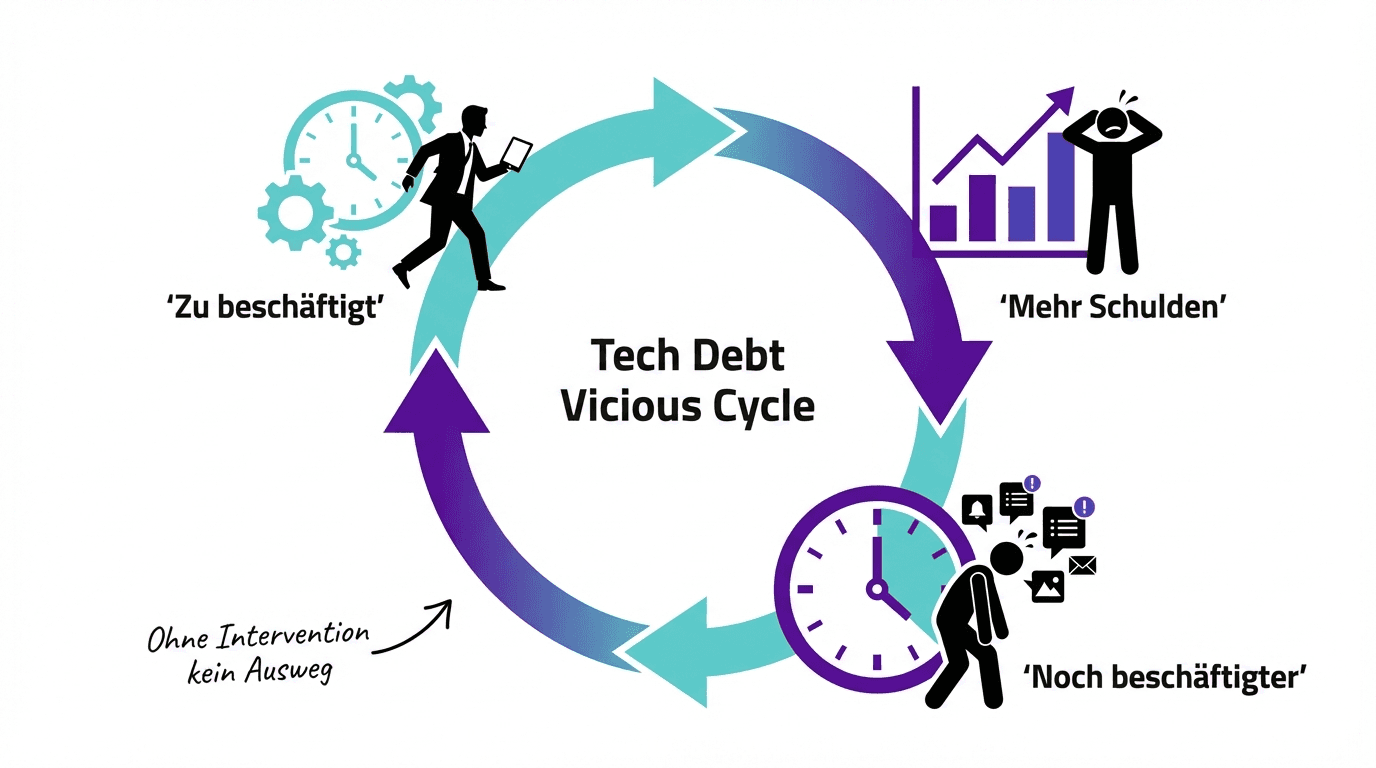
The vicious cycle:
The team is too busy with maintenance to clean up
Because no cleanup is done, maintenance costs rise
As maintenance costs rise, the team gets even busier
Back to point 1
McKinsey calls it the "Vicious Cycle of Tech Debt." And without active intervention, it won't break on its own.
At the same time, the problem is exacerbated by management decisions: Two-thirds of CEOs raid long-term IT projects for short-term business goals.
The modernization budget is cut because a sales project is more urgent. The planned refactoring phase is skipped because a new feature was promised. Every time, the debt burden increases.
Strategic Debt Management
The good news: Technical Debt can be managed. Like financial debt.
The first step is the hardest: Accepting it as a strategic decision – not a technical detail.
The 15% Rule
Accenture recommends setting aside 15% of the IT budget specifically for reducing Tech Debt. Not as a nice-to-have, but as a firm allocation.
It sounds like a lot. But consider: If you spend 30% on maintenance today and the debt continues to grow, it will be 35% tomorrow. The 15% investment today saves the 35% cost tomorrow.
Making Debt Visible
You can't manage what you don't measure. The first step is a Tech Debt inventory:
Which systems have the highest maintenance costs?
Where are the known vulnerabilities?
What legacy issues are blocking strategic projects?
What is the business impact of each debt category?
Prioritizing by Business Impact
Not all debts are equal. A legacy system with 5 users is less critical than one that supports your core business processes.
The prioritization must be based on business impact – not technical elegance.
Tech Debt as a CEO/CFO/CIO Decision
Technical Debt belongs at the executive level. Because the decisions that create debt are made there:
When do we go live – even if the system isn't finished?
How much budget is there for modernization?
Which projects have priority – features or stability?
These decisions have financial consequences. They should not be delegated to the IT department.
For Decision-Makers: The Action Framework
If you are a CEO, CFO, or CIO, here is a pragmatic approach:
1. Create Visibility
Have your Tech Debt quantified – with a business impact assessment, not just a technical analysis. What does each debt cost in terms of productivity, risk, and missed opportunities?
2. Allocate a Dedicated Budget
15% of the IT budget for debt reduction. Non-negotiable. Not to be repurposed for new features.
3. Establish Governance
New debts are deliberately incurred, not accidental. Every project must document what debts it incurs and when they will be repaid.
4. C-Level Ownership
Technical Debt is not an IT topic. It's a business risk. It belongs in the leadership dialogue.
The Short Version
$370 million – that's how much Tech Debt costs the average large enterprise annually
91% of CTOs see it as their biggest challenge
70% say it blocks innovation
80% had projects that failed because of it
The Solution: Strategic debt management at C-level – not "clean up later"
Next Step
Technical Debt doesn't disappear on its own. But it can be managed – if you know how much you owe and what it costs.
We help quantify and strategically reduce Technical Debt.
Not the technical analysis – others can do that. We focus on the business perspective: What does the debt burden cost you? Where is the biggest leverage? How do you integrate debt reduction into your IT strategy?
Related Articles:
Sources: