The scenario currently unfolding in your company
Imagine you spend 10,000 Swiss francs on software every month. Of that, 3,000 Swiss francs go straight into the trash.
Not because someone is cheating you. Not because your teams are careless. But because the SaaS ecosystem is inherently chaotic.
The best part? Most companies treat this 30% as a normal operating expense. "That happens everywhere," they say.
(Yes. But it doesn’t have to.)
Why SaaS gets out of control
The problem starts here: SaaS is damn cheap to buy.
Each tool costs between 10 and 500 Swiss francs per month. For an individual manager, that is practically free. "Let me quickly get Zapier." "The project management tool only costs 25 Swiss francs per person."
Individually, these are tiny amounts. In total, it becomes a disaster.
The average mid-sized company uses between 50 and 150 different SaaS tools. Each tool has a different billing cycle, a different cancellation period, and a different admin.
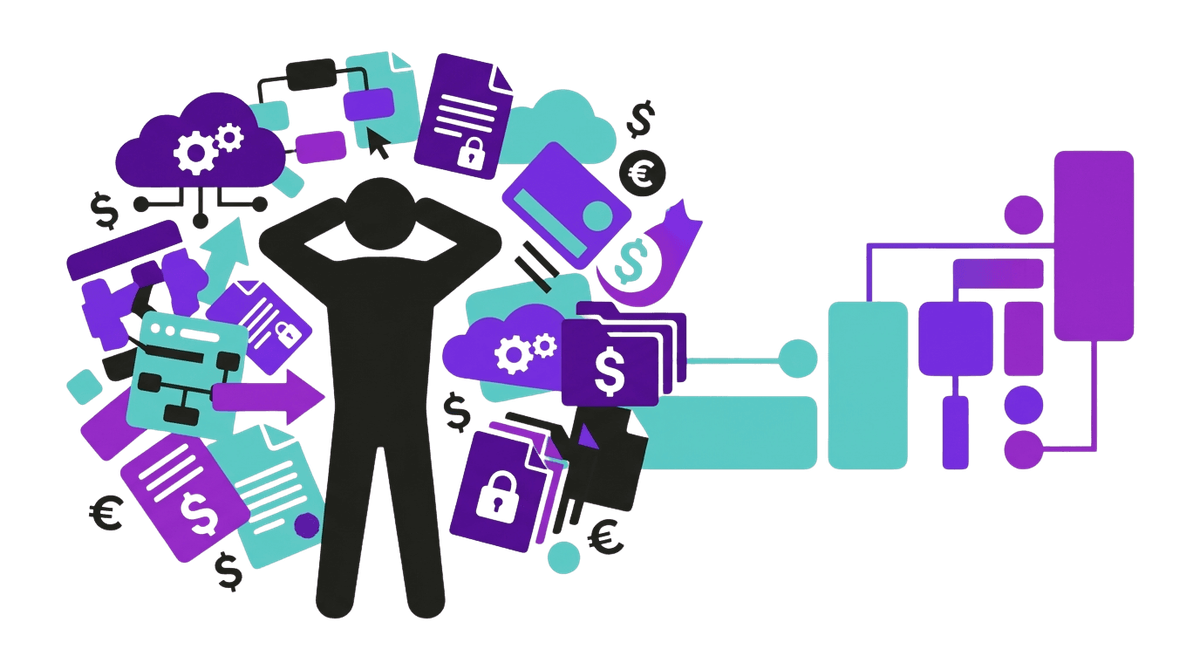
And then there are decentralized decisions: Marketing buys a design tool. Finance activates a reporting feature. Sales signs up for an add-on. No one has the full picture.
The result: 30% waste almost by itself.
The seven waste patterns
1. Ghost users
An employee leaves the company. The license is not canceled. It just keeps running.
Multiply that by your annual employee turnover, typically 15–20% of all licenses are inactive.
What you can do: Review all active users monthly. Exit process: when someone leaves, immediately check all licenses.
2. Wrong tiers
You have the right license, but the wrong plan.
Every SaaS tool has different tiers. Basic for 29 Swiss francs. Pro for 79 Swiss francs. Enterprise for even more. Most people choose the "safe option", the most expensive plan.
The problem: 40% of users in higher tiers use less than 20% of the features.
What you can do: Review with each tool owner quarterly: "Which features are we actually using?" Not all users need Premium.
3. Duplicate tools
You have Tool A. You need Function B. Tool C also offers Function B. So you buy Tool C.
The result: You pay twice for the same functionality.
Two different project management tools. Multiple analytics platforms. Different CRM solutions across departments.
What you can do: Functional audit: "What can we do with Tool A?" Establish one as primary and shut the other down.
4. Auto-renewals without review
You bought a tool two years ago. The invoice arrives automatically. No one asks anymore whether you still use it.
This is one of the biggest waste patterns. It is automated. It is invisible. It becomes a habit.
One company had a stock photo tool for 200 Swiss francs per month that had not been used in months. For four years.
What you can do: List all subscriptions with automatic renewals. Maintain a cancellation calendar. Quarterly review: usage vs. costs.
5. No usage tracking
You don’t know who uses what.
You have 100 licenses for one tool. But who actually uses it? Most SaaS providers do not give you this data proactively.
What you can do: Enable analytics. Monthly: review the "top 20 inactive users." Set notifications when users are inactive for 30 days.
6. Shadow IT
Your teams use tools you don’t know about.
The developer has their code tool. Designers use another design tool. Finance bought a budgeting tool that IT doesn’t know about.
A company with 500 employees could use 100+ SaaS tools, of which IT only knows 50.
What you can do: "Which SaaS subscriptions run through your credit card?" Establish an approval process for new tools.
7. Poor negotiations
Here is the dirty secret: Almost everything is negotiable.
Most companies pay the standard price because they do not negotiate. Discounts of 30–40% are possible with most SaaS tools. Multi-year agreements deliver 20–35% savings.
What you can do: Every tool over 10,000 Swiss francs must be negotiated. The threat of cancellation is a negotiation tool: "We are looking at alternatives."
The underlying pattern
If you look at these seven points, you can see a pattern: The problem is not money. It is visibility.
No one has the full picture. No one knows what is being used. No one negotiates. No one reviews.
The waste does not happen out of bad intent. It happens because it is no one’s job to look.
The conclusion
30% SaaS waste is normal, but not inevitable.
Most of it is a lack of visibility and control, not bad intent. If you know what you are paying and what for, you can optimize.
The companies that have their SaaS costs under control are not the ones with the fewest tools. They are the ones that know which tools they have.
That sounds banal. It is. But it makes the difference between 30% waste and 30% savings.
Clean-ups almost always surface orphaned accounts. What to do with them is settled in IT security consulting.
Want to know where your SaaS waste is? We run audits for Swiss companies, and typically identify 25–35% savings potential.Talk to us.