
Yannick H.,
Too Long; Didn't Read
Most AI strategies fail not because of the technology, but because of organizational mistakes made before the first proof of concept. Knowing the five most common patterns can save you months of wasted time and budget that could be invested more effectively. Before you start your next AI project, check whether you are already making one of these mistakes.

You've probably heard it already. Maybe even said it yourself: "We need to invest in AI now."
And then? A vendor demo. A pilot project. Enthusiasm in the steering committee. Six months later: The project is still running somewhere. No one is using it. Someone has a new idea.
This is not an isolated case. It's a pattern.
We have been working for years with Swiss SMEs and mid-market companies on AI projects. And honestly — the technology was rarely the problem. Almost always, the real mistake is made early on, deep in the preparation. Before a single line of code was written.
Here are the five mistakes we see most often. And what works instead.
Mistake 1: Technology without a business goal
"We need AI." We hear this sentence often. What we hear less often: "We have this specific problem, and we believe AI could help."
The difference is crucial.
Many companies start their AI strategy backward. The vendor presents a demo. The tool looks impressive. Then begins the search for use cases that justify the tool. That's like a hammer in search of a nail.
We recently had a case: An industrial company wanted to introduce a large language model for internal knowledge management. The budget was approved. Technically feasible. But when we asked what specific problem was to be solved — silence. "We just want to become more modern."
That's not a business goal. That's a wish.
What works instead: Start with the problem, not the tool. Which process currently costs you how much time? Where are you losing customers because you respond too slowly? Where are there quality issues that frustrate people? If you can't answer these questions with concrete numbers, an AI strategy is still premature.
(Our AI Readiness Check gives you an initial framework for assessing this.)
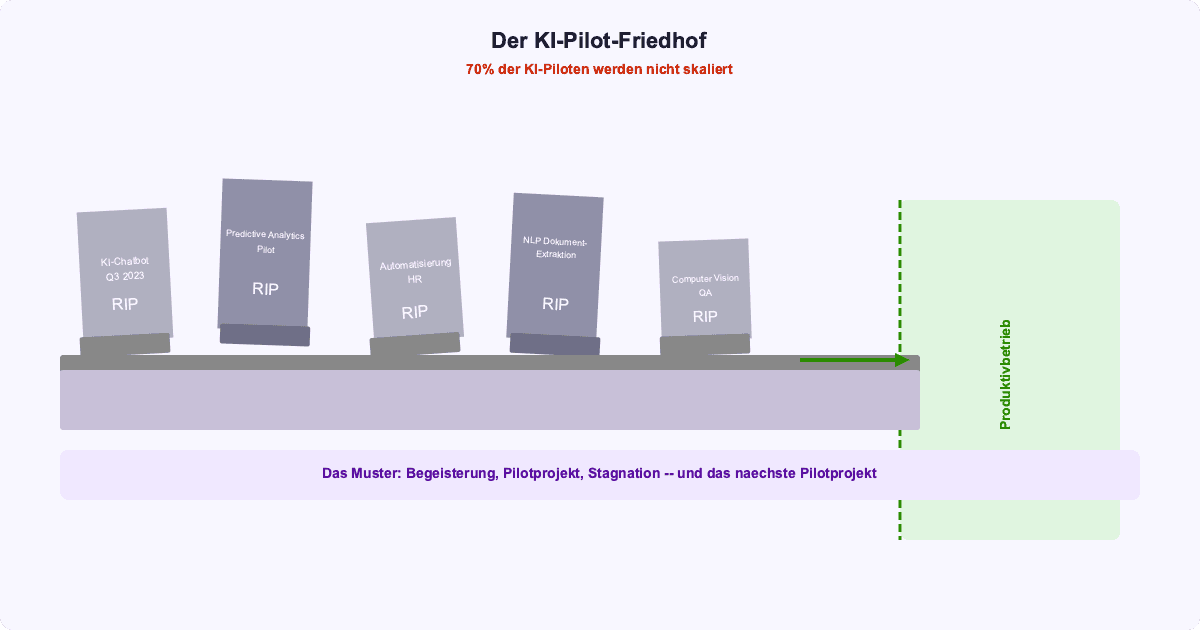
Mistake 2: The pilot project graveyard
Handshakes all around on the home stretch. The pilot project is running. The results are promising. Everyone is excited.
And then... nothing.
Six months later, another pilot project is still running. Then another one. At some point the company has fifteen pilots — and not a single AI use in production. We call that the pilot project graveyard.
This is not just a resource problem. It's a strategic signal: Something breaks between "works in the lab" and "works in operations." Usually several things at once.
What is missing is the scaling plan. No one planned in advance how the system would be integrated into existing processes. How operations works when the model has a bad day. Who is responsible when outputs are wrong. What change management looks like for the teams that are supposed to work with it.
A pilot without a scaling plan is not a strategic investment. It's an expensive experiment.
What works instead: Define from the outset what "success" in production means. Not as a PowerPoint slide, but as concrete conditions: Who uses it? How often? What happens if it fails? Who takes responsibility? If you can't answer these questions, you're starting the pilot too early.
Mistake 3: Lack of a data foundation
AI needs data. Everyone knows that. What many underestimate is how far most companies are from having truly usable data.
For every AI project, we carry out an early data check. The results are regularly sobering. Customer data in three different CRM systems, with no common ID. Production data in Excel files stored locally on employees' laptops. Historical data that exists only as PDFs. Missing timestamps. Inconsistent categorization over years.
This is not a failure — it's the reality for most SMEs. Data was never treated as a strategic asset, but as a byproduct of work.
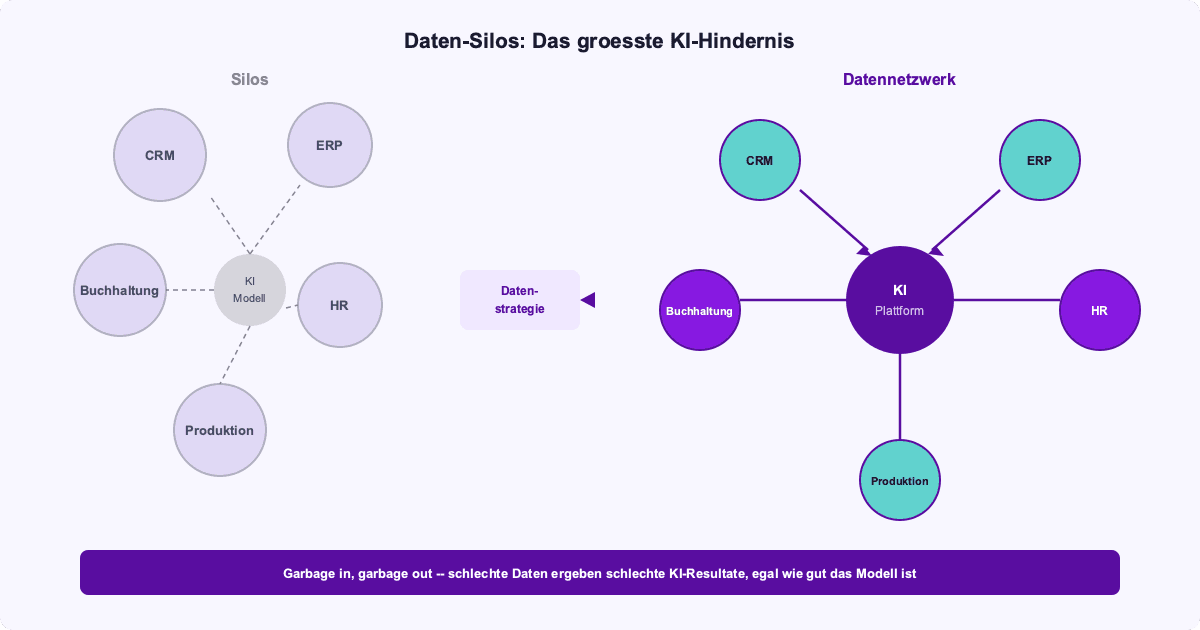
The problem: AI models amplify the quality of the data they receive. Bad data leads to bad results — no matter how good the model is. "Garbage in, garbage out" applies here more than ever.
What works instead: Before you develop an AI strategy, you need an honest assessment of your data situation. Where is the data you would need for your use case located? Is it complete, consistent, accessible? What would need to change for an AI system to work with it?
This is not glamorous work. But it determines success or failure more than any model question ever will.
(You can find more on how AI can be used meaningfully in Swiss SMEs in our post AI in SMEs: between ChatGPT chaos and real business value.)
Mistake 4: No change management
Here is an uncomfortable truth that many AI projects ignore: The tool can be perfect and still fail if the people who are supposed to work with it do not use it.
We have supported implementations where everything was technically sound. The model was well trained. The integration into existing systems worked. The user interface was intuitive. And yet: Three months after go-live, the team was back to using the old processes.
Why? Because no one had brought the team along.
People have legitimate questions when AI systems are introduced. Will I be replaced? Can I trust the outputs? What happens if the system makes a mistake — who is responsible? These questions were not answered, so employees found their own answer: Better to stick with what works.
That is not resistance to change. That's sensible behavior in the face of poor communication.
What works instead: Change management does not begin after implementation, but at problem definition. Involve the teams early. Explain which problem is being solved — and why that is better for them too. Build trust through transparency: What can the system do, what can't it do? Where does it need human oversight?
AI implementation without organizational development is system introduction on hope.
Mistake 5: Everything at once
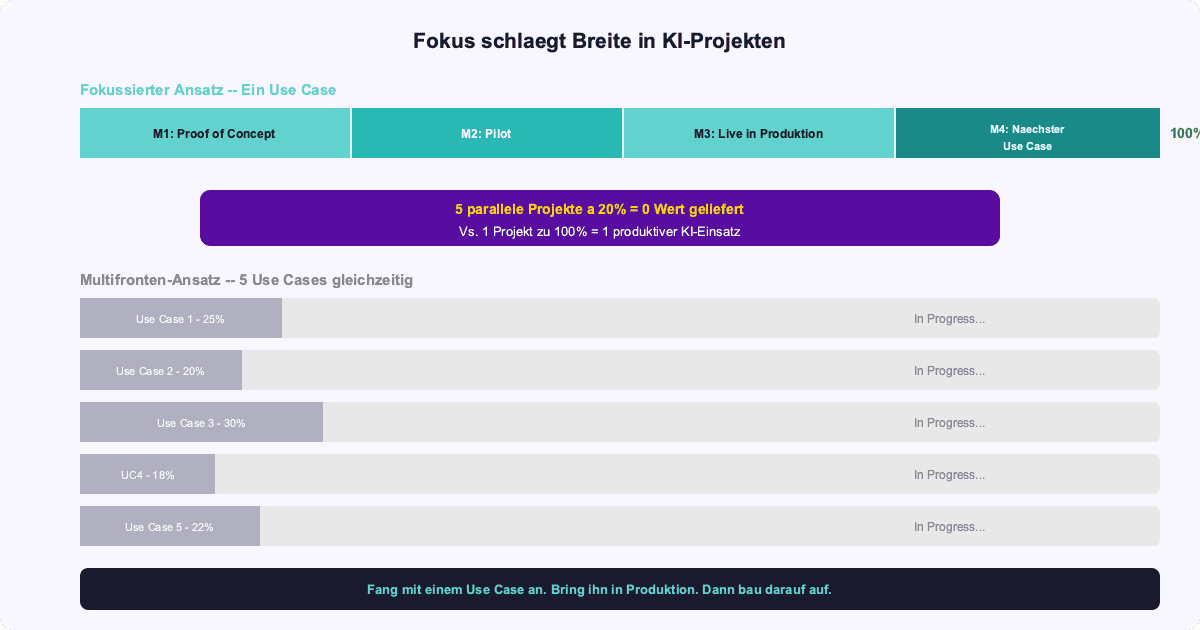
"We're doing AI now" as a company-wide mandate. All departments are supposed to identify use cases at the same time. Five workstreams, three steering committees, one transformation program.
That sounds like ambition. Most of the time, it's paralysis.
Focus is lost. Every department fights for resources and priority. No one has the full picture. The first real success — the one that shows AI actually works — never comes, because everything is half-finished.
There is a simple rule we apply in almost every engagement: Start with one use case. The one where you have a clear problem definition, acceptable data, a team that wants to get on board, and a way to measure success.
Bring that into production. Show that it works. Then build on it.
That is not nitpicking. That is how any technological transformation succeeds sustainably — not through sweeping attacks, but through demonstrable progress.
(We cover in detail how to decide which use case is the right starting point in our pipeline article Prioritizing AI use cases.)
What does this mean for you?
If you take only one thing from this article: AI strategy does not fail in the machine room. It fails in the meetings before that.
Missing business goals. Missing data. Missing scaling plans. Missing involvement of people. Missing focus. These are not technical problems — they are decisions you can control.
The good news: These mistakes can be identified early. Before a budget is approved. Before a vendor contract is signed. Before the pilot fails.
If you are currently developing an AI strategy or evaluating an ongoing project — we help you ask the right questions before you buy the wrong answers.
More on how we approach this: /services/ai