
"We need a penetration test." This is how many of our conversations begin. A managing director has been asked a question by the board of directors, a customer is requesting proof, or the cyber insurance company is pressing for details. The response is almost always the same: we need a pentest.
Sometimes that is correct. Often it is not. Because behind the question of Security Assessment vs. Penetration Test lies a decision that determines several thousand francs and the level of genuine security gain. And this decision is rarely made consciously.
Let's clarify this properly here. No technical jargon, no sales pitches.
What a Penetration Test Really Is
A penetration test is a controlled attack. You hire someone to break into your system, just like a real attacker would try to do. The goal: to find out whether a specific vulnerability is actually exploitable. Not theoretically, but practically.
For example, a good pentester will target your web application, your VPN, or your internal network. They search for a way in, document it, and show you how far they can get. The result is deep and specific. Something like this: "Through this outdated library in the customer portal, I can access the database, and from there, the billing data."
There are different variations. In a black-box test, the tester knows nothing about your system and approaches it from the outside. In a white-box test, they are given access credentials and documentation to look more targetedly. Both have their place, but cost different amounts of time and money.
A pentest is highly effective when you want to secure a specific asset. A new application before going live. An environment that is particularly exposed. A system that has just been remodeled. That is where the depth brings real value.
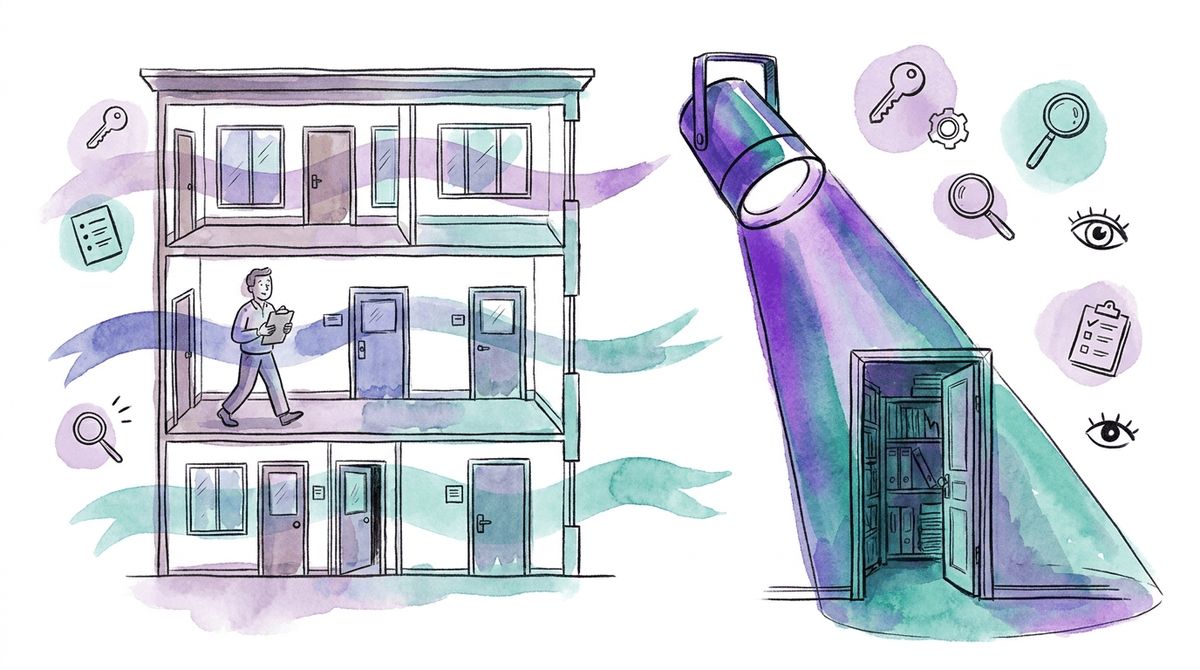
What a pentest does not do: It does not tell you whether your backups work, whether your employees recognize phishing, whether there is an incident response plan, or who is actually responsible for security. It shines a light down a tunnel, not on the whole building.
What a Security Assessment Covers
A security assessment goes in the opposite direction. Instead of going deep into a single system, it looks broadly at your entire security posture. The question is not "Can I get in here?", but "Where do we stand overall, and where are the biggest gaps?".
A good assessment looks at four areas that play together:
- Technology: how systems are configured, patched, and segmented, and where legacy systems are still running.
- Processes: whether incident response, backups, and access management are properly regulated.
- People: whether employees recognize typical attacks and who is responsible for what in an emergency.
- Governance: whether policies, documentation, and clear decision-making processes exist.
In the end, you don't get a single entry path, but a comprehensive picture. And a prioritized one at that: this is urgent, this is important, this can wait. Precisely this overview is what most SMEs lack when we speak with them for the first time.
Specifically, an assessment usually gives you three things. First, an honest baseline assessment, often aligned with a recognized framework like ISO 27001 or the NIST framework, to clarify where the gaps are. Second, a risk overview that translates technical findings into business language, not "Port 3389 open," but "this is how someone gets to your payroll data." And third, an action plan sorted by impact and effort. This allows management to actually make decisions, instead of just nodding along.
The patterns repeat themselves surprisingly often. We have collected what we encounter in almost every assessment in a dedicated article. In short: most of the time it is simple, open doors that allow someone to enter, rather than sophisticated attacks.
The Real Difference: Depth vs. Breadth
Picture a building. A penetration test is like hiring an intruder to test a specific door. Can they get in through the basement window? Good to know. A security assessment is an inspection of the entire building. What doors are there in the first place, which ones are left open, who has a key, and what happens if someone does manage to break in?
Both make sense. But they answer different questions. The pentest provides depth in one area. The assessment provides an overview of all areas.
The point many overlook: without an overview, you don't even know which door you should actually have tested. You are guessing. And guessing is expensive when a test costs several thousand francs.
Which One Do You Need First?
The honest answer for most SMEs: the assessment.
If you have never looked at your security in a structured way, a pentest is like a high-resolution X-ray of a single tooth before anyone even knows your medical history. You get a very detailed result of a tiny section, while the big, obvious issues remain unchecked.
A practical example: A company insisted on a pentest for their website because a customer had requested it. We suggested a one-day assessment first instead. The result: The website was solid. But there were no functional backups, a shared administrator password used by multiple people, and not a single person who would have known what to do in an emergency. The pentest alone would have produced a green checkmark, while the actual risk slept elsewhere.
The rule of thumb we share with customers is simple:
- You don't know your security posture in a structured way? Start with an assessment.
- You have a good overview and want to harden a specific, exposed system? Then a pentest is exactly right.
- A customer or a tender explicitly demands a pentest? Then clarify first what exactly is required. Often a targeted test of one system is enough, rather than a broad sweep across the entire infrastructure.
It is not about talking down pentesting. It is about the order of things. One maps out the territory, the other digs at the marked spot.
"But the customer demands a pentest"
A frequent trigger deserves its own explanation. Increasingly, contracts or tenders state that a supplier must show proof of a penetration test. Sometimes cyber insurance companies ask for it too. It feels like a clear instruction: buy a pentest, check the box, and you're done.
In practice, an intermediate step pays off here. Ask what exactly is required. Often, the wording is vague and a targeted test of the specific system the customer is concerned about is fully sufficient. An assessment beforehand even helps you with this: it shows which system could actually be meant and whether there are still obvious issues that an auditor would otherwise find first. Nothing is more unpleasant than paying a lot of money for a test that gets stuck on a trivial misconfiguration.
And a side effect that many underestimate: a clean assessment report combined with a targeted test is usually more convincing to a customer or insurance company than an isolated pentest report. It shows that you have your security systematically under control. A single green checkmark on one system says very little about that.
When Both Complement Each Other
The two are strongest when combined in the right sequence. A typical path we take with clients looks like this.
First, the assessment to get an overview and close the most urgent gaps. These are often unspectacular things: testing backups, cleaning up admin privileges, enabling multi-factor authentication everywhere, writing down a simple emergency plan. This basic work usually brings the most protection per franc invested.
Afterwards, once the foundation is solid, a targeted penetration test on the system that is most heavily exposed. The customer portal, the web shop, or remote access. Now the test is actually worth something because it no longer fails at the obvious issues and uncovers the deeper risks that nobody would have seen before.
This turns two competing expenses into a structured plan. And you don't spend money on depth while the breadth is still full of holes.
The Costly Mistake We See Time and Again
Now it comes down to a budget question. A pentest is not cheap, and a broad one can quickly cost several times more than a focused assessment. The money is well spent if the test answers the right question. It is wasted if it answers the wrong one.
The classic scenario: An SME buys a broad pentest, receives a 60-page report with dozens of findings, and then nothing happens. Because no one can prioritize, categorize, or implement the findings. The report goes into a folder, the security level remains the same, and the test is repeated the following year. Paid for, but ineffective.
This is exactly the type of expense we like to challenge. Greater security is not achieved through more testing, but through the right test at the right time. Allocating your security budget where it has the greatest impact delivers more protection for less money. An assessment often costs a fraction of a comprehensive pentest and tells you exactly where the depth is worth it in the first place.
Our approach to Security Assessment is therefore deliberately pragmatic. First understand where you stand, then deepen selectively. No reports that don't help anyone, but a handful of actions you can actually tackle. And if a pentest makes sense after that, at least you know exactly which system you are testing and why.
In a Nutshell
Security assessment and penetration testing are not competitors, but rather two tools for two different questions. The assessment shows you the entire map and where the holes are. The pentest digs deep in one spot and proves whether a specific attack works. For most SMEs, the correct order is first the overview, then the depth. Reversing this means paying for precision at one point while the big picture remains out of focus.
If you are currently deciding whether an assessment or a pentest is next for you, have a quick chat with us. In a free initial consultation, we can sort out what you really need in 30 minutes before you spend any money.