Alexis M.,
Too Long; Didn't Read
IT doesn’t have to be a cost center—but most companies treat it exactly that way. Those who see IT as a business advantage make better decisions, spend less, and sleep better at night. This article shows what Business Centric IT means in practical terms: not as a buzzword, but as an operating model.

TLDR
IT doesn’t have to be a cost center — but most companies treat it exactly that way. If you understand IT as a business advantage, you make better decisions, spend less, and sleep more soundly. This article shows what "Business Centric IT" actually means: not as a buzzword, but as an operating model. If, after reading it, you phrase your next IT investment decision differently, it has done its job.
Imagine you’re sitting in your next executive meeting. Sooner or later, the IT agenda item comes up. What happens?
In most companies we know, this is what happens: the IT leadership presents budget requests. The CFO frowns. Someone asks whether it can’t be done more cheaply. Everyone agrees on a number. Move on.
No word about competitive advantage. No word about growth potential. No word about what these IT investments actually enable — or prevent.
That’s the problem. Not the costs. The conversation.
Why IT almost always loses
Over the past few years, we’ve worked with companies of all sizes — from 50-million SMEs to mid-sized corporate groups. And there’s a pattern that repeats itself.
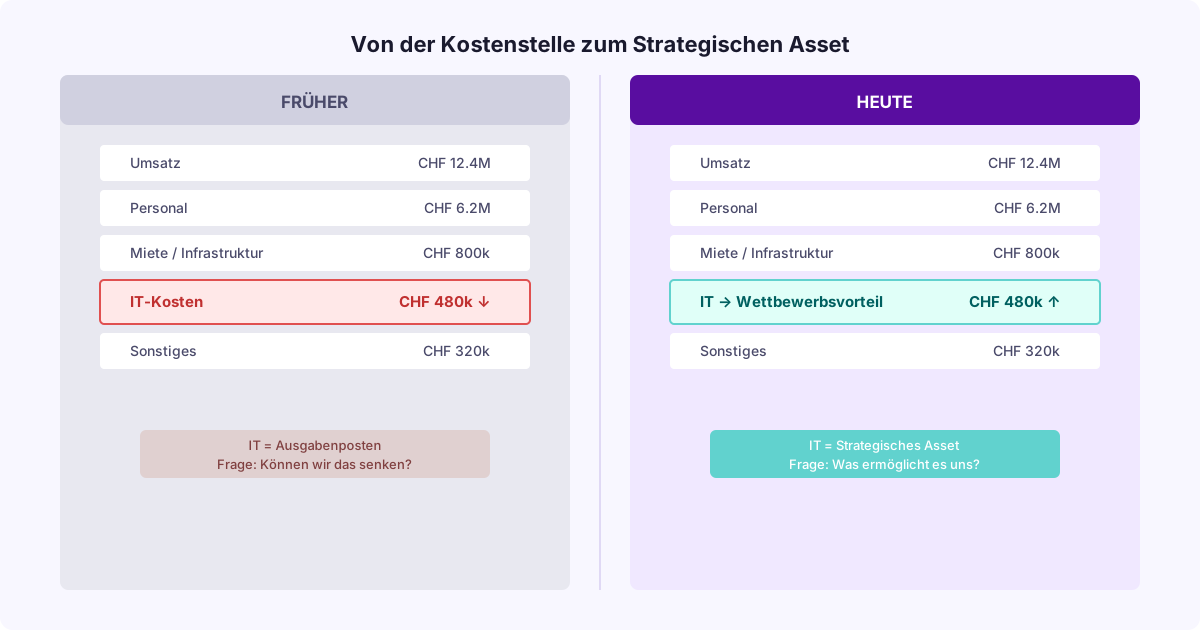
IT reports to the CFO. That sounds reasonable — after all, it’s about costs. But that already sets the frame: IT is an expense item. Not a strategic tool.
The head of IT quickly learns to speak in cost terms. They learn to defend budgets. They learn that their projects are accepted when they say "we save X percent" — not when they say "we enable X". Because nobody asks what IT could enable.
(And honestly? Sometimes it’s the IT leadership itself that doesn’t step outside this frame. Technical metrics are comfortable. Business value is hard to measure and even harder to defend.)
The result: IT becomes reactive. It solves problems left behind by the past. It rarely enables the future the company is aiming for.
Three dimensions of IT as a business advantage
When we work with companies that want to understand IT as a business advantage, we talk about three things at once. Not sequentially — at once.
1. Controllable: IT decisions you understand
Controllable does not mean "more reporting". It means that decisions about IT investments are made based on business objectives — not on technical preferences or vendor proposals.
We regularly see situations like this: a company spends CHF 400,000 on a new platform. Two years later, nobody can say for sure whether it was the right decision. The platform runs. Somehow. But did it increase efficiency? Did it reduce error rates? Did it help sales close deals faster?
Nobody knows, because nobody defined up front what success should look like.
Controllable IT starts with business cases, not technology evaluations. That sounds trivial. It isn’t. It means that before every major IT investment, you can explicitly answer: Which business problem are we solving? How will we measure success in business terms? When was the investment justified?
Those who do this consistently quickly realize that many "urgent" IT projects are not actually that urgent — and that some seemingly optional projects have enormous business value.
(We supported one client in postponing an ERP rollout by 18 months because the business case analysis showed that the real pain point was elsewhere — and could be solved with a third of the budget.)
2. Secure: security as a business enabler, not a box-ticking exercise
This is where I sometimes run into resistance. "Security as an enabler? That sounds like marketing speak."
No. Let me be specific.
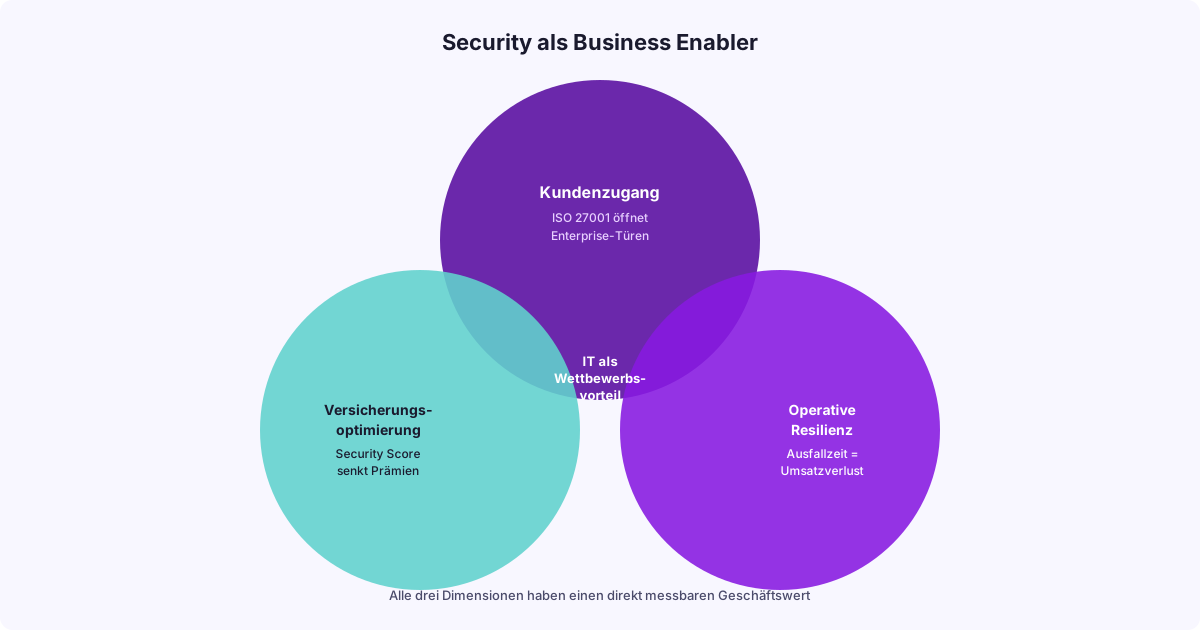
A pharmaceutical company without SOC 2 or ISO 27001 certification loses deals with large U.S. customers that have minimum supplier requirements. That’s not a theoretical risk — it happens, and we’ve seen it. Investment in certification: CHF 80,000. Annual revenue gained through unlocked customer segments: significantly more.
A supplier in the manufacturing industry with demonstrably robust access controls and data segregation wins preferred orders from large enterprises with strict supplier compliance requirements.
An SME that can document resilience against ransomware pays up to 40% lower cyber insurance premiums.
Security is not a cost item. It is a competitive parameter. Anyone who still doesn’t see it that way has either never lost customers because security wasn’t sufficient — or doesn’t know it.
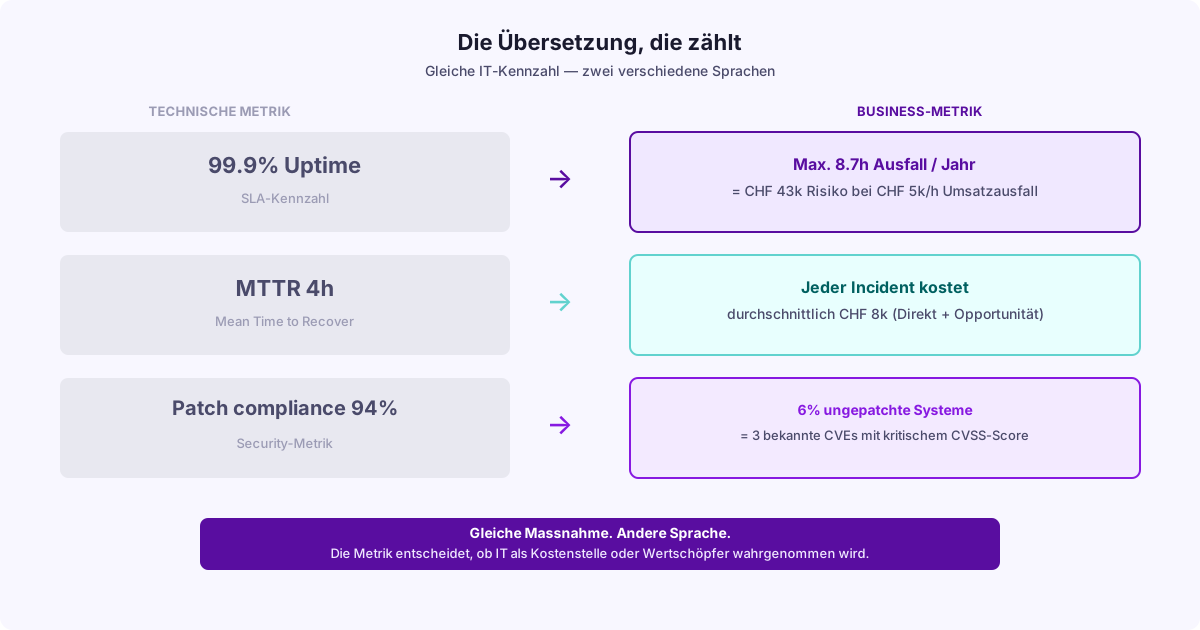
The mistake lies in the framing: "compliance" sounds like bureaucracy. "We secure access to customer groups and reduce insurance costs" sounds like business. Same measure, different language.
(We also wrote a more detailed article about this, why IT excellence belongs in your IT strategy — worth reading if you want to explore this point in more depth.)
3. Cost-efficient: not cheap, but efficient
This is the part where the most nonsense gets said.
"IT costs too much" is almost always the wrong diagnosis. The right question is: What are we paying for, and are we getting the expected value in return?
We’ve seen companies cut IT budgets by 20% — and then have no idea why their development speed declined or why their key people left the company. Costs went down. Value went down too.
And we’ve seen companies increase their IT budget — and improve their margin because automation replaced manual processes that had previously caused hidden costs.
Cost efficiency means: every franc spent has a traceable connection to a business outcome.
That requires transparency. Not just "we spend CHF 2 million on IT," but broken down: how much is operations (keep the lights on), how much is optimization, how much is strategic innovation? These three categories have completely different requirements when it comes to decision-making processes and success metrics.
We explored this in a separate article on IT cost management and transparency. Short version: transparency before savings. If you don’t know what you’re paying for, you also don’t know where you can sensibly save.
The maturity leap: from service center to strategic differentiator
Companies typically move through four stages — if they move at all.
Stage 1 – Cost center: IT keeps the lights on. Every investment is seen as an expense. Nobody asks about business value.
Stage 2 – Service center: IT delivers services at defined costs and SLAs. More transparent, but still reactive. IT speaks in uptime and tickets, not in business impact.
Stage 3 – Business enabler: IT projects have business cases. Investments are prioritized based on their contribution to business goals. IT has a voice in corporate strategy.
Stage 4 – Strategic differentiator: IT capabilities are a competitive advantage. Competitors can copy products or prices, but not the core technological capabilities. IT decisions influence which business models are even possible.
Most companies are stuck at stage 1 or 2. Stage 3 is achievable. Stage 4 is demanding, but decisive in certain industries.
What makes the difference: not more budget. Not better technology. It’s the mindset used to make IT decisions.
What Business Centric IT changes in practice
Here’s the practical test. If your company migrates a platform and the success statement is: "We improved server response time by 40ms" — then you’re at stage 1 or 2.
If the success statement is: "We reduced checkout abandonment by 12%, which corresponds to CHF 400,000 in additional annual revenue at our throughput" — then you’re at stage 3.
Same technical measure. Different success framework. That’s the difference.
(And yes, both statements can be true. But which one do you want to present to your executive team?)
We’ve written more about this — both on why IT projects always become more expensive than planned and on how to communicate IT value internally so that the executive team listens. Both articles complement this one.
What this means for the Swiss reality
Swiss companies have a cultural advantage that they rarely use.
Swiss standards of quality and precision are part of the brand essence — in products, in processes, in customer communication. In IT governance? Often not. Many companies have highly developed operational processes and comparatively immature IT control models.
That is a gap. And at the same time, an opportunity.
The first company in its industry to build a truly controllable, secure, and efficient IT operating model gains an edge that competitors cannot simply copy — because it is not a matter of budget, but of discipline and mindset. Exactly the kind of thing Swiss companies do well when they want to.
The path there is not glamorous. It starts with an honest assessment: where are we making IT decisions based on technology rather than business? Where are our business cases missing? Where do we lack a link between IT spending and measurable value?
The answer to these questions is usually uncomfortable. But it is the starting point for real change.
The honest question
If you look at your IT budget today: what share of the spending has a direct, traceable connection to a business outcome — revenue, cost savings, risk reduction, customer satisfaction?
30 percent? 50 percent?
Your answer determines whether IT in your company is a cost center — or a business advantage you are not yet fully using.
If you want to know what Business Centric IT looks like in your specific context, take a look at our IT strategy consulting. No standard solution, no buzzwords — just honest work on the questions that really matter.