If you search for ISO 27001 cost, you mostly get a number for the certification audit. That is about as helpful as budgeting only the building permit when you build a house. In our experience, the audit is the smallest and most predictable item in the whole undertaking. ISO 27001 gets expensive elsewhere: in your internal time, and even more often in things the standard does not ask of you at all.
The four items that make up the ISO 27001 cost
Let's start with the invoices. There are four positions, and they behave very differently.
The certification audit is the item everyone googles, and the most boring one. An accredited certification body reviews your management system in two stages, followed by annual surveillance audits and recertification after three years. The effort depends on the size and scope of your organization, and the quotes from different bodies sit surprisingly close together. For a typical SME, this is a manageable, well-plannable amount across the whole three-year cycle. This is not where you go broke.
External support is the largest visible variable. Everything from "we coach your internal owner a few days per month" to "we build the complete ISMS for you" is on the market, and the price range in between is enormous. Which variant fits depends less on budget than on who is supposed to run the system afterwards. An ISMS that a consultancy builds for you and that nobody understands internally produces fresh costs every year, because you have to buy someone in for every adjustment.
Tools are the item with the worst value for money. A sober sentence is worth stating here: ISO 27001 does not require a single tool. No GRC portal, no compliance platform, no special software. The standard requires a working management system, and for an SME that fits comfortably into the tools you already pay for. The platforms can become useful later, once the system runs and grows. As a starting investment, they are mostly bought reassurance.
And then there is internal time. The largest item, and the only one that appears in no quote. Risk analysis, interviews, describing processes, implementing measures, training, the internal audit: your people do all of this, next to their day jobs. In our experience, this effort clearly exceeds the external costs, and it is the reason ISO projects rarely fail for lack of money and often for lack of air.
What tends to get forgotten: the paying does not stop with the certificate. An ISMS keeps running like your bookkeeping, quietly and permanently. Every year brings the surveillance audit, the internal audit, the management review and the upkeep of the documents. If you budget only the first year, the second year holds a surprise, and it arrives exactly when the project momentum is gone and the system has to show it breathes without consultants. Include years two and three from the start, otherwise you are comparing quotes for half the truth.
The cost driver that appears in no quote
All four items hang on a single decision that is made right at the beginning and that hardly anyone talks about: the scope.
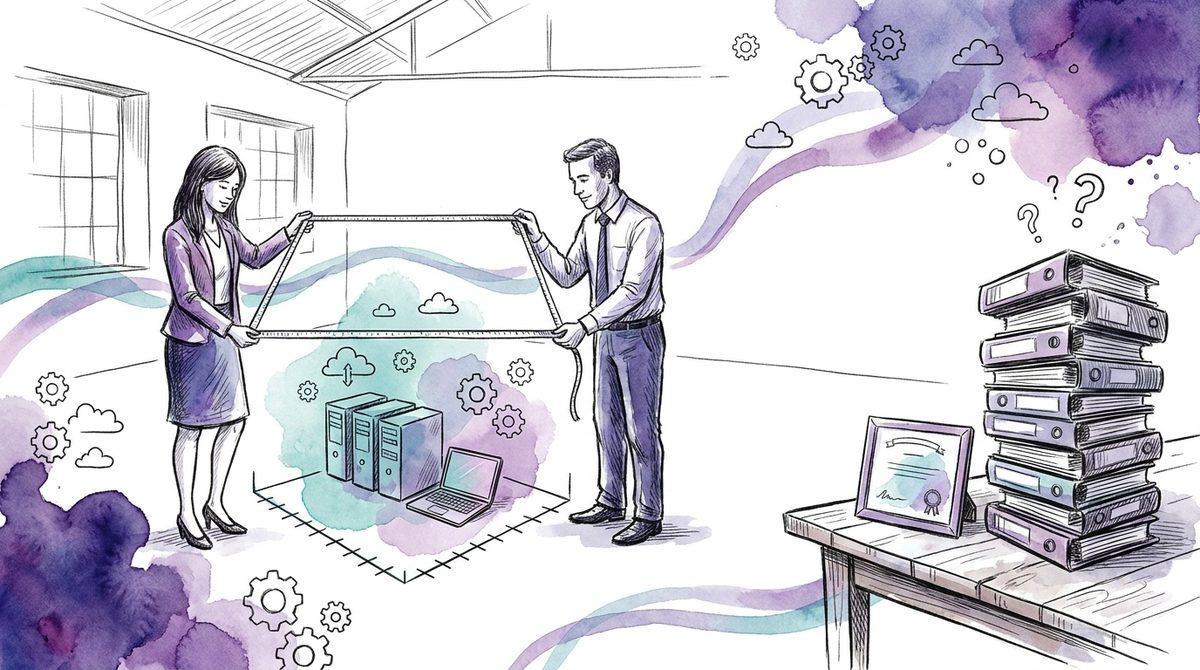
ISO 27001 does not force you to certify the whole company. You define which part of the organization belongs to the management system. This cut determines how many processes you describe, how many risks you assess, how many people get trained and how many audit days the certification body charges. The scope is the lever every single cost position hangs on.
A sensible cut follows the reason you want the certificate. If an enterprise customer demands proof for the services you deliver to them, then exactly those services belong in the scope, not the carpentry shop in the building next door. That is not gaming the system, it is the point of the exercise. A small, honest scope that covers what your customers care about is worth more than a large one where half of it lives only on paper.
A typical picture from practice: a software company wants the certificate because a bank is asking for it as a customer. What needs to be certified is the operation of the platform holding the bank's data, including the people and processes behind it. The internal bookkeeping, the marketing team and the showroom can stay outside. The difference between these two cuts is no detail. It decides how many people get trained, how many processes get described and how many audit days get charged, and the ISO 27001 cost scales almost linearly with it.
Let's be honest: very few oversized ISMS projects exist because someone decided it that way. They exist because nobody asked the question.
Where the money evaporates
The standard is not expensive. What is expensive is what companies build on top because it looks like security.
It starts with the templates. Anyone who buys a policy package from the enterprise world quickly owns a folder of several hundred pages that fit their own company about as well as someone else's tailored suit. Someone has to adapt, approve, train and maintain these documents every year. Every page nobody reads still costs money every year. A document that describes on two pages what you do in reality passes every audit better than twenty pages of wishful thinking.
It continues with the controls. Annex A of the current standard lists 93 measures, and the reflex of many projects is to implement all of them as completely as possible. Yet the statement of applicability exists precisely so that you do not: you justify which measures are relevant for your risks and which are not. An auditor who knows the trade wants to see that justification, not a completeness show. Whoever builds all 93 controls at maximum level pays for protection their risk profile never asked for.
And it ends with the sequence. Buying the platform first and building the system into it afterwards is the most expensive variant we know. It leads to an ISMS shaped by the software instead of by the company. The cheap sequence is unspectacular: first understand what you protect and from what, then document what you already do anyway, and only then decide whether a tool is missing. We described what such a build looks like, without everyone despairing over it, in a separate article on the pragmatic ISMS.
The pattern behind all three points is the same one we see in security budgets in general: spending does not grow with the risk, it grows with the fear of missing something. In an ISMS, this fear has a built-in counterweight, you only have to use it. It is called risk analysis.
When the price is worth it
Which leaves the question of why you should pay for any of this at all.
The most honest answer is rarely "for the security". An SME can work very securely without ever seeing a certificate. The investment pays off where the proof itself earns money or fulfils obligations.
The most common case is sales. If your customers are corporations, banks or public-sector buyers, their procurement often decides based on the paperwork, and without a certificate you never make the shortlist. These deals show up in no loss statement, because you never saw them. Against this invisible filter effect, the certificate is a door opener with a measurable return.
The second case is regulation. For operators of critical infrastructure there is no way around an ISMS anymore, and the pressure travels down the supply chains to their vendors. We took apart who the obligation binds directly and who only indirectly in our article on the ISG ISMS obligation by the end of 2026.
If neither case applies to you, the cheapest variant is sometimes not to certify at all: to run a lean management system along the logic of the standard without paying for the audit cycle. That too is a legitimate answer to the cost question, only hardly any provider who lives off the project will say it out loud.
The number you should demand before you start
If you have quotes for an ISO 27001 project on your desk, each one carries a price for external services. The number that is missing is almost always the same: how many hours your own people will invest, and whose hours those are.
Exactly this number separates serious providers from salespeople. Whoever has understood your environment can estimate it and will discuss it with you, including the uncomfortable follow-up question of who takes work off that person's plate. Whoever quotes only their own days is selling you a project whose largest item you carry yourself, without ever having seen it.
Our role in such projects is usually that of a translator between the standard and everyday operations: cutting the scope, keeping the statement of applicability honest, and preventing a management system from turning into a document graveyard. How we approach this is on our ISMS page. And if you are comparing quotes right now and want an independent second opinion before you sign, an initial consultation is the cheapest part of the whole project.
By the way, one single answer tells you faster than any quote how expensive your project will get: would you know today which part of your company belongs in the scope, and which one deliberately does not?