The Dilemma No One Wants to Solve
Your oldest system is probably between 10 and 20 years old. It works. But every update takes longer. Experts are becoming scarce. Operating costs rise every year.
At the same time, everyone knows: touching this system is extremely risky. It is interconnected with hundreds of processes. If something goes wrong, the business stops.
That is the legacy dilemma: Expensive maintenance or expensive and uncertain change.
(Most companies choose option three: close their eyes and hope. It works. Until it doesn’t.)
What Legacy Systems Really Cost
Most companies dramatically underestimate the costs. They look at the IT budget and think: "CHF 500,000 per year for a critical system - that’s fine."
That is not the whole truth.
The direct costs
Hardware support for old systems. Expensive licenses for proprietary platforms. Backup and recovery that require specialized knowledge.
The hidden costs
Developers who know old technologies like COBOL earn 30-50% more than average. Troubleshooting takes longer because fewer people understand the system. Documentation that is either outdated or nonexistent.
The opportunity costs
This is the biggest item, and it is usually overlooked.
Your development team spends 60% of its time keeping the legacy system running. That means 60% less time for new features.
When a new requirement comes in, integration takes three months. On a modern system, it would take three weeks.
Junior developers do not want to work on COBOL. Your recruiting becomes more difficult.
Add it all up: your legacy system does not cost you CHF 500,000 per year. It probably costs you over a million.
We explore this topic in Digital Transformation Beyond Buzzwords: The 5 Dimensions of Successful Digitalization.
The Three Options
There are exactly three strategic paths. None is universally right. All have advantages and disadvantages.
Option 1: Migration
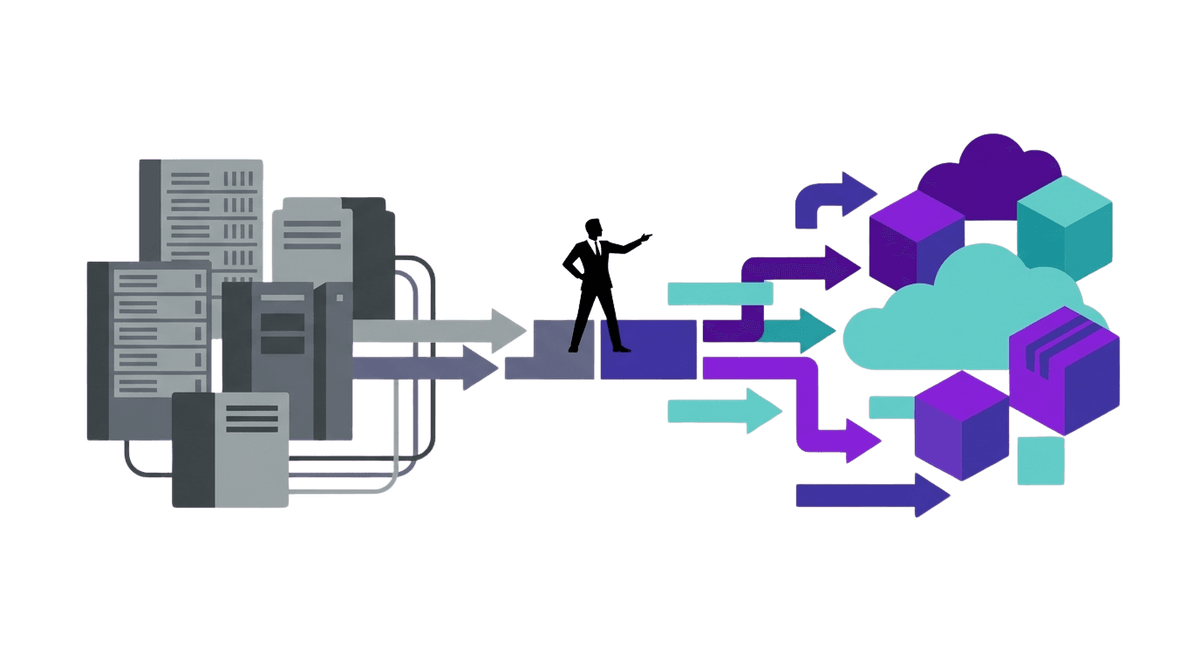
You take the system as it is and move it to a new platform. From on-premise to cloud. From old hardware to modern infrastructure. The business logic stays the same - only the underlying technology changes.
When this makes sense: The system is technologically outdated, but the architecture is solid. You want to reduce operating costs without rewriting everything.
Cost: Typically 30-50% of what a rebuild would cost. Timeframe: 6-18 months.
Option 2: Replacement
The old system is completely replaced. Either by a purchased standard solution (SAP, Salesforce) or by a complete rebuild.
When this makes sense: The architecture is broken. Your business processes have changed fundamentally. You need new capabilities the old system cannot provide.
Cost: The most expensive option. Timeframe: 18-36 months for a rebuild.
Option 3: Retention
You keep the system, but make it less painful. Optimization, better monitoring, security patches. Maybe you hide it behind modern APIs so new systems can communicate with it.
When this makes sense: The system is stable. There are no major requirements for expansion. You do not have the budget for migration or a rebuild.
Cost: The cheapest option in the short term. But the opportunity costs remain.
How to Decide
The question is not: What is the best option? The question is: What is the best option for you?
Four questions to ask yourself:
How critical is the system? If it fails, does the business stop? Then you are risk-averse - migration is better than a rebuild.
What is the architecture like? A solid foundation, just old technology? Migration. A broken architecture with a hundred patches? More likely replacement.
How often do you need new features? Frequent new requirements? Then the innovation backlog is expensive. Stable requirements that change rarely? Retention can work.
What does your budget look like? Large investment budget? Replacement is realistic. Small budget, but high pain? Migration is the compromise.
The Most Common Mistake
The biggest mistake we see: doing nothing and hoping.
"But the system still runs. Why should we touch it?"
The problem: time is working against you.
With each year, operating costs rise. With each year, fewer developers find the technology interesting. With each year, security becomes more questionable.
At some point, your best expert retires. Or changes jobs. And suddenly, no one understands how the system really works anymore.
That is when it becomes expensive. Really expensive.
The second biggest mistake: replacing the entire system when migration would have been enough. Rebuilds are risky, expensive, and take a long time. If the architecture is solid, migration is almost always the better path.
When Things Go Wrong
Legacy modernization is risky. But risks are manageable if you identify them early.
The biggest problems we see:
Hidden dependencies. The system depends on a hundred small things that nobody documented. Solution: dependency mapping early in the project. Who uses which data? Which systems depend on what?
Performance degradation. The new system is slower than the old one. Solution: baseline measurements before migration. Performance tests under load before going live.
Data loss. Data is lost or corrupted during migration. Solution: several dry runs. Data validation after each migration.
Scope creep. At first it was a migration, now it is turning into a rebuild. Solution: strict scope definition. Migration only, no new features. Changes must be approved.
The Bottom Line
Legacy systems are not bad by definition. They are often reliable, stable, and proven. The problem is: they become more expensive while the world around them changes.
There is no universal answer. Some systems should be migrated. Some should be replaced. Some should be kept - for the time being, with smart management.
The worst thing you can do is nothing. The second worst is replacing the entire system when migration would have been enough.
The right decision? The one that fits your situation. Not some generic best practice.
The first step is always the same: an honest conversation. What does this really cost us? What are our options? And how long can we wait?
After that, it gets concrete.
For the time until replacement you need protection that does not slow the business down. We plan it in IT security consulting.
Do you have a legacy system that is giving you headaches? We conduct assessments for Swiss companies - honest, pragmatic, with clear recommendations.Talk to us.