Yannick H.,
Too Long; Didn't Read
Resilience Engineering shifts the focus from "How do we restore System X?" to "How do we maintain business operations no matter what happens?" The framework consists of five dimensions: Business Impact, Process Resilience, Technical Architecture, Organizational Capability, and Compliance & Governance. The order is crucial—always start with the business, never with IT. We will show you how to approach these dimensions systematically.
What differentiates companies that are operational again after a cyber attack in 48 hours from those that struggle for weeks?
It is not the budget. Nor is it the number of security tools.
It is the way they think about resilience.
In recent years, we have seen both types of companies. Some have perfect disaster recovery documentation and still fail. Others may have less paperwork, but they have something more important: a systematic ability to function under pressure.
Today we are showing you the framework that makes this difference.
Why Most Resilience Approaches Fail
Most IT departments start with technology. That is their comfort zone.
"We need backups. Failover servers. Multi-cloud. More redundancy."
The problem? Without business context, this leads to perfectly secured systems that no one needs – and unprotected systems that are critical to the business.
An example: An industrial company invested six figures in highly redundant IT infrastructure. Perfect availability. Then, when their main supplier failed due to a cyber attack, production still came to a halt. The IT was working perfectly – but without components from the supplier, no one could work.
The misconception: Resilience does not mean "IT systems always run". Resilience means "business processes always run – or at least well enough".
The Framework: 5 Dimensions of Operational Resilience
Operational resilience requires a systematic approach across five dimensions. Each builds on the previous one. And the order is not negotiable.
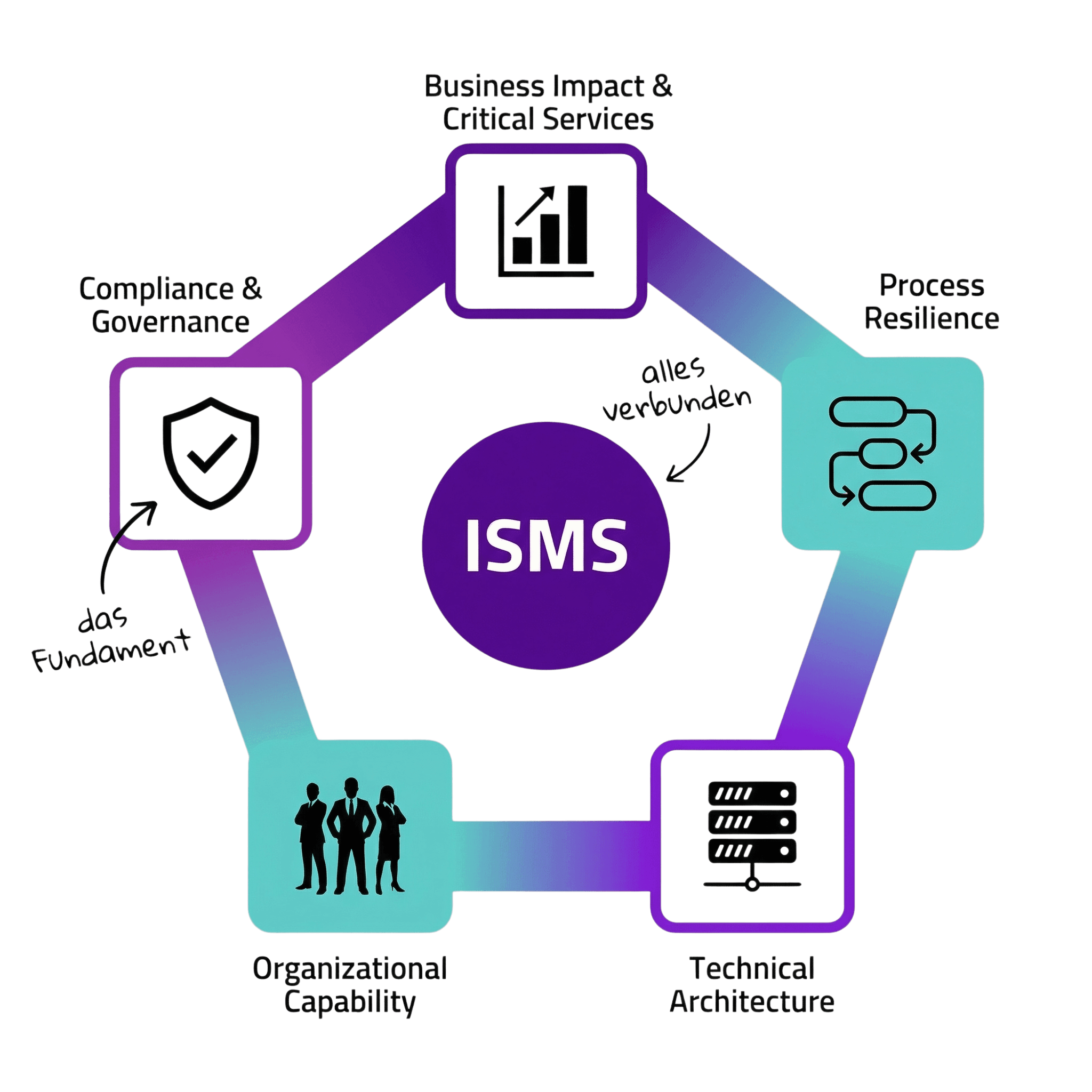
The 5 dimensions build on each other – always start with business impact, never with technology.
Dimension 1: Business Impact & Critical Services
The key question: Where is your revenue? Which processes must run?
Before you even consider a single line of IT architecture, you must understand which business processes are truly critical. Not "somehow important" – critical in the sense that if they don't run, you will lose money or customers or both.
What you need to identify:
Revenue-Critical Processes – processes that directly generate revenue
Regulatory-Critical Processes – processes whose failure has regulatory consequences
Dependencies – what does each process need to run? (IT, suppliers, personnel)
Maximum tolerable downtime – how long can we go without this process?
Practical tip: Work with your business units, not the IT department. They know what really brings in money.
If you already have a Business Impact Analysis – check if it is up-to-date and if it answers these questions.
Dimension 2: Process Resilience
The key question: How do you continue working when critical systems or suppliers fail?
Now it gets concrete: For every critical process from Dimension 1, you need answers to:
Fallback Options: What is Plan B? Can the process run manually? Are there alternative suppliers?
Minimum Viable Operations (MVO): With what reduced capacity can we continue while solving the problem?
Activation time: How quickly can we switch to Plan B?
The 70% rule: Perfect redundancy is unaffordable. But 70% capacity within 30 minutes protects more revenue than 100% capacity after 48 hours.
Practical example:
An e-commerce company has defined:
Normal: 500 orders/day via the online shop
MVO (70%): 350 orders/day via phone + manual entry
If AWS fails, an emergency hotline is active within 30 minutes. Not perfect, but the revenue continues to flow.
Dimension 3: Technical Architecture
The key question: Which IT systems support your critical processes? Where are the single points of failure?
Only now – in Dimension 3 – do we look at IT. But not in isolation, always in relation to business processes.
What you need to analyze:
IT-System-to-Business Mapping: Which systems support which critical processes?
Current vs. needed availability: Does the current SLA suffice?
Single Points of Failure: What lacks redundancy? No failover?
SPOF mitigation: How do you eliminate or mitigate these vulnerabilities?
A common mistake: Companies often have highly redundant systems for non-critical processes – and single points of failure for critical ones. Because no one systematically analyzed the connection between IT and business.
Dimension 4: Organizational Capability
The key question: Can your teams make clear decisions under stress? Who is responsible?
Technology alone is not enough. The best fallback infrastructure is useless if no one knows who is allowed to activate it.
What you need:
Clear decision structures: Who can decide what? With what time limit?
RACI Matrix for crises: Responsible, Accountable, Consulted, Informed – for each critical decision
Substitution rules: What happens if the decision-maker is not reachable?
Trained teams: Hands-on exercises, not PowerPoint presentations
An important realization: In a crisis, an 80% correct decision in 15 minutes is more valuable than a 100% correct decision in 4 hours.
Define clear escalation paths with time limits. If the decision-maker is unreachable after 15 minutes, the decision automatically goes to the deputy.
Dimension 5: Compliance & Governance
The key question: How do you use regulatory requirements as a structure for your resilience?
NIS2, FINMA, GDPR – many see them as bureaucracy. But smart companies use these requirements as a checklist.
What regulation gives you:
Structure for your documentation
Prioritization through regulatory significance
External validation of your measures
Legal certainty in a crisis
Practical approach: Map regulatory requirements to your resilience dimensions. You will find: What NIS2 and FINMA demand is mostly what you need anyway. Regulation just provides the structure.
Why Order Matters
The framework is not a buffet where you can choose where to start.
If you start with technology, you solve the wrong problem.
Wrong approach (common):
IT buys more backup capacity
IT implements multi-cloud
Eventually someone asks "Do we actually need this?"
No one knows exactly
Right approach (rare):
Business defines critical processes and maximum downtimes
Process owners develop fallback options
IT implements technical support for this
Organization trains the processes
Compliance validates the whole
The difference: In the first case, you have expensive IT infrastructure that might protect the wrong things. In the second case, you have an organization that knows how to function when it matters.
How to Start
No panic. You don't have to do everything at once.
Quick Wins (4-6 weeks):
Business Impact Analysis for the top 10 business processes
Dependency mapping for the 3 most critical processes
Define and test a fallback scenario
Phase 2 (3-6 months):
Minimum viable operations for all critical processes
RACI matrix for crisis decision-making
First quarterly drill with the leadership team
Full Resilience Architecture (12 months):
All 5 dimensions systematically implemented
ISMS integrated with resilience framework
Continuous improvement based on tests and real incidents
The Short Version
5 Dimensions build on each other: Business Impact → Process Resilience → Technical Architecture → Organizational Capability → Compliance
Order is non-negotiable – always start with business
Dimension 1 is the key – without understanding critical processes, everything else is guesswork
The 70% rule – fast degraded operations beat perfect late recovery
Compliance as structure – use NIS2/FINMA as a checklist, not a burden
What Next?
Start with an honest question: Which 3 business processes generate 80% of our revenue?
If you can answer that, you have the starting point for Dimension 1. If not, you have your first task.
(And if you find that you need support to systematically implement the framework – that's exactly what we are here for.)
Further Reading
Business Impact Analysis: Identifying Critical Business Processes – The first step to Dimension 1
Crown Jewel Analysis: Focus on What Truly Matters – A related approach
CISO as a Service – How mid-sized companies leverage security expertise