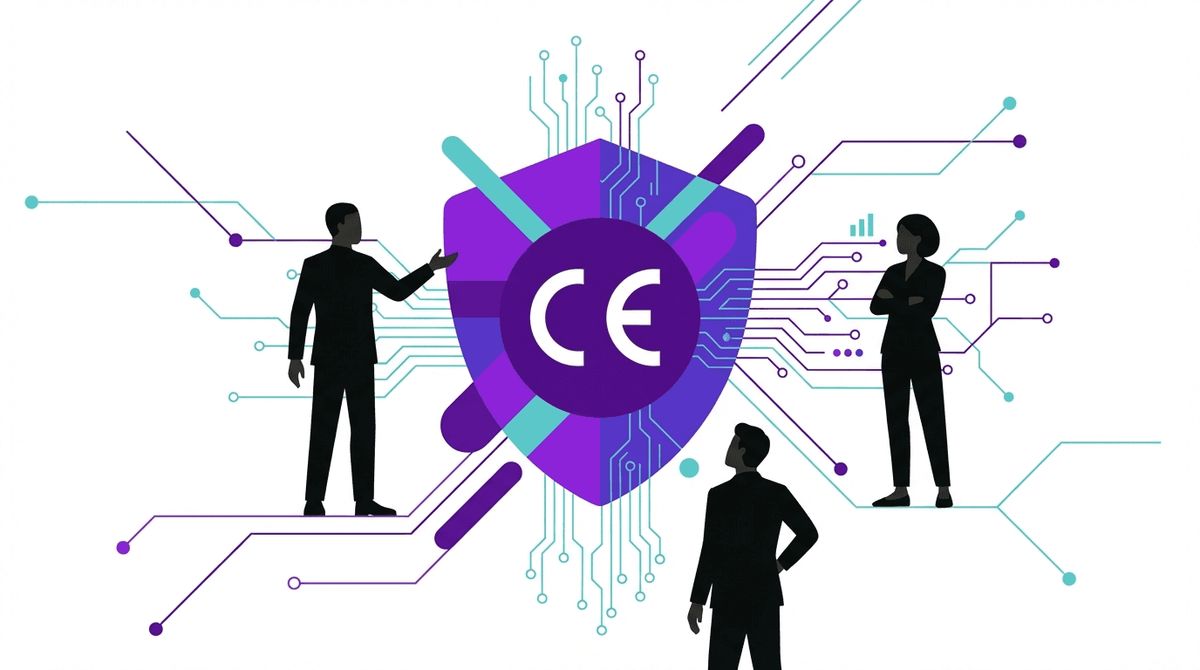
From December 2027, a new reality will apply in the EU for digital products: no software update, no IoT device, and no connected product may be placed on the market without a CE marking. No documented patch process? No SBOM? No market access.
The EU Cyber Resilience Act, Regulation (EU) 2024/2847, published in November 2024, is not abstract talk about the future. The Regulation has been in force since December 2024. The clock is ticking.
And yes, this also affects Swiss companies. Directly.
What the Cyber Resilience Act requires
For the first time, the CRA systematically regulates the cybersecurity of products with digital elements. Until now, most software products had no mandatory security requirements before entering the market. That is changing fundamentally.
The core requirements can be reduced to four pillars:
Security by Design. Products must be developed securely from the outset. No known exploitable vulnerabilities at the time of market launch. Secure default configurations. Protection of data confidentiality and integrity. Minimal data processing. This is not new as a principle, but it is new as a legal obligation.
Vulnerability management throughout the entire lifecycle. Manufacturers must identify, document, and remediate vulnerabilities for the full support period. Security updates must be provided free of charge. Actively exploited vulnerabilities must be reported to ENISA within 24 hours (early warning), with a full report within 72 hours.
SBOM, Software Bill of Materials. Every manufacturer must create a machine-readable SBOM that identifies at least the top-level dependencies. This must be updated at market launch and with every security update. It does not have to be public, but it must be made available to authorities upon request.
CE marking and conformity assessment. Digital products will in future require a CE mark confirming CRA compliance. This requires technical documentation, an EU declaration of conformity, and depending on the product category, a self-assessment or third-party assessment.
Who it affects, and when
Not every product is treated the same. The CRA divides digital products into categories with different conformity requirements:
The Standard category covers the majority of products: photo software, smart speakers, games, simple IoT devices. Here, a self-assessment is sufficient, provided harmonized standards are available.
Important Class I applies to products with elevated risk: VPNs, identity management systems, network management, SIEM solutions, routers, and modems. Self-assessment is possible if harmonized standards are available; otherwise, a third-party assessment is required.
Important Class II applies to high-risk products: operating systems, hypervisors, firewalls, intrusion detection systems, industrial control systems. Here, a third-party conformity assessment is mandatory.
And then there are critical products such as hardware security modules, smart cards, and secure elements, which require European cybersecurity certification.
The deadlines are staggered:
- September 2026: the reporting obligation for actively exploited vulnerabilities enters into force
- December 2027: all CRA requirements become fully applicable
That sounds far away. But conformity assessments, SBOM tooling, process documentation, and third-party audits take time. Anyone starting in autumn 2027 is already too late.
What this means for Swiss companies
This is where it becomes unexpected for many: Switzerland is not an EU member, but the CRA still affects Swiss companies on several levels.
As a software manufacturer: If you sell digital products in the EU market, you must meet all CRA requirements as a manufacturer. There is no Swiss special privilege. Your EU importer or authorized representative is responsible for ensuring that your product is compliant, but the work is yours to do.
As an importer/distributor: Swiss companies that bring digital products from the EU into Switzerland do not (yet) have CRA obligations there. But anyone redistributing products in the EU takes on verification obligations.
As an IT buyer: Even without your own manufacturer obligations, things are changing. If your software suppliers must be CRA-compliant, that becomes a procurement criterion. You can request SBOM data. You can review vulnerability management processes. And you should, because it helps you assess your own security posture.
So far, Switzerland has not announced its own legislation equivalent to the CRA. But for any company with a presence in the EU market, the question is not whether implementation must start, but when.
The open-source elephant in the room
One topic that is causing a lot of discussion: how does the CRA affect open-source software?
The short answer: open source developed outside commercial activity is exempt. But the definition of "commercial activity" is broader than many think. Paid support, use as a component in commercial products, or the processing of personal data can bring open source into the CRA scope.
For this, the CRA introduces a new role: the Open Source Software Steward, organizations such as foundations that coordinate the development of commercially used open source. They have lighter obligations (security policy, cooperation with authorities, vulnerability reporting), but they are not outside the scope.
For manufacturers that use open-source components in their products, the level of responsibility changes. You are responsible for the CRA compliance of your entire product, including all integrated open-source libraries. The SBOM requirement of course also applies here.
Fines risk: impossible to ignore
If the regulatory requirements alone are not convincing: the fine ranges are significant.
Violations of the essential cybersecurity requirements can cost up to EUR 15 million or 2.5% of global annual turnover, whichever is higher. Violations of other CRA obligations can cost up to EUR 10 million or 2%. Misleading statements to authorities can cost up to EUR 5 million or 1%.
That is GDPR-level. And as with the GDPR, enforcement is unlikely to start on day one. But it will come, and market surveillance authorities will be able to remove non-compliant products from the market.
What to do now: concretely
The deadline is December 2027. What can you already tackle now?
Take stock. Which of your products fall under the CRA? In which category (Standard, Class I, Class II)? That determines the effort required for conformity assessment.
Use what you already have. Do you already have ISO 27001? NIS2 measures? An ISMS? Many CRA requirements overlap with existing standards. Security by design, vulnerability management, documentation, this does not have to be built from scratch. We regularly see with our clients that 40-60% of the requirements are already covered by existing compliance programs.
Introduce SBOM tooling. If you are not generating an SBOM yet, start now. The tooling landscape is mature (CycloneDX, SPDX). The biggest effort is not the tool itself, but integrating it into the build process.
Formalize the vulnerability process. A 24-hour reporting obligation to ENISA for exploited vulnerabilities applies from September 2026. For that, you need a process, not just a tool. Who responds? Who reports? Who patches?
Adjust procurement criteria. As an IT buyer: require SBOM data and documented vulnerability processes from your suppliers. That is not micromanagement; it is forward-looking supply chain risk management.
The next step
December 2027 will come. The question is whether you arrive with a structured plan or in panic mode.
If you take one thing from this article, let it be this: do the inventory. Which products, which category, which gaps relative to the CRA requirements. That is an afternoon’s work, and it determines everything that follows.
(We support Swiss companies in implementing cybersecurity compliance pragmatically, without consultant theater and without panic. If you want to know where you stand, get in touch.)