
Yannick H.,
Too Long; Didn't Read
80% of your employees use shadow IT. Despite policies. Despite training. Despite monitoring tools. The problem is growing because you're fighting the wrong battle. Shadow IT is not the disease—it's a symptom of an IT organization that fails to deliver what the business needs. 38% use shadow IT because IT responds too slowly. 54% just want to work more productively. The solution is not more control—it's IT transformation: from gatekeeper to enabler.
The Numbers You Don’t Want to Hear
Let’s start with the facts:
80% of your employees use shadow IT. Not just a few rebels in the marketing department. Four out of five.
(Source: Gartner/NinjaOne Research 2024)
And it’s not getting better. 52–65% of all SaaS applications in companies are not approved by IT. The average company uses more than 130 SaaS apps—and IT only knows a fraction of them.
(Source: Productiv SaaS Intelligence)
You might be thinking: "It’s different at our company. We have policies. We provide training. We have this under control."
Here is the next uncomfortable number: 67% of employees know your IT policies. They deliberately ignore them.
So they know what is allowed. And they do it differently anyway. The question is: Why?
Why Your Employees Work Around IT
The standard explanation is: employees are uninformed, careless, or—worse—malicious.
Reality is more uncomfortable:
38% of employees use shadow IT because IT responds too slowly to their requests.
(Source: Gartner IT Response Survey)
They have a problem. They need a tool. IT says: "Submit a ticket. We’ll review it. In six weeks, we can give you an assessment."
The business does not wait six weeks.
54% install unauthorized software to work more productively. Not to steal data. Not to create chaos. But to get their work done.
(Source: Enterprise Software Survey)
Here is the number that should keep IT leaders up at night: Only 12% of IT departments can keep up with new technology requests.
88% cannot.
Employees are not the problem. The IT organization is the patient.
The Security Risk Is Real—But Blocking Is Not the Solution
Don’t get me wrong: the risks of shadow IT are real.
$4.2 million—that is the average cost of a security breach caused by shadow IT.
(Source: Ponemon Institute/IBM)
Unknown apps mean: uncontrolled data flows. Missing security updates. Compliance violations. Attack vectors that no one monitors.
The obvious response: block more. Stricter policies. Tighter monitoring.
That doesn’t work.
The more you block, the more creative the workarounds become:
You block Dropbox? Employees use personal Google Drive accounts.
You block cloud storage altogether? Files are sent by email to private addresses.
You tighten monitoring? Shadow IT goes mobile—on private devices, via private hotspots.
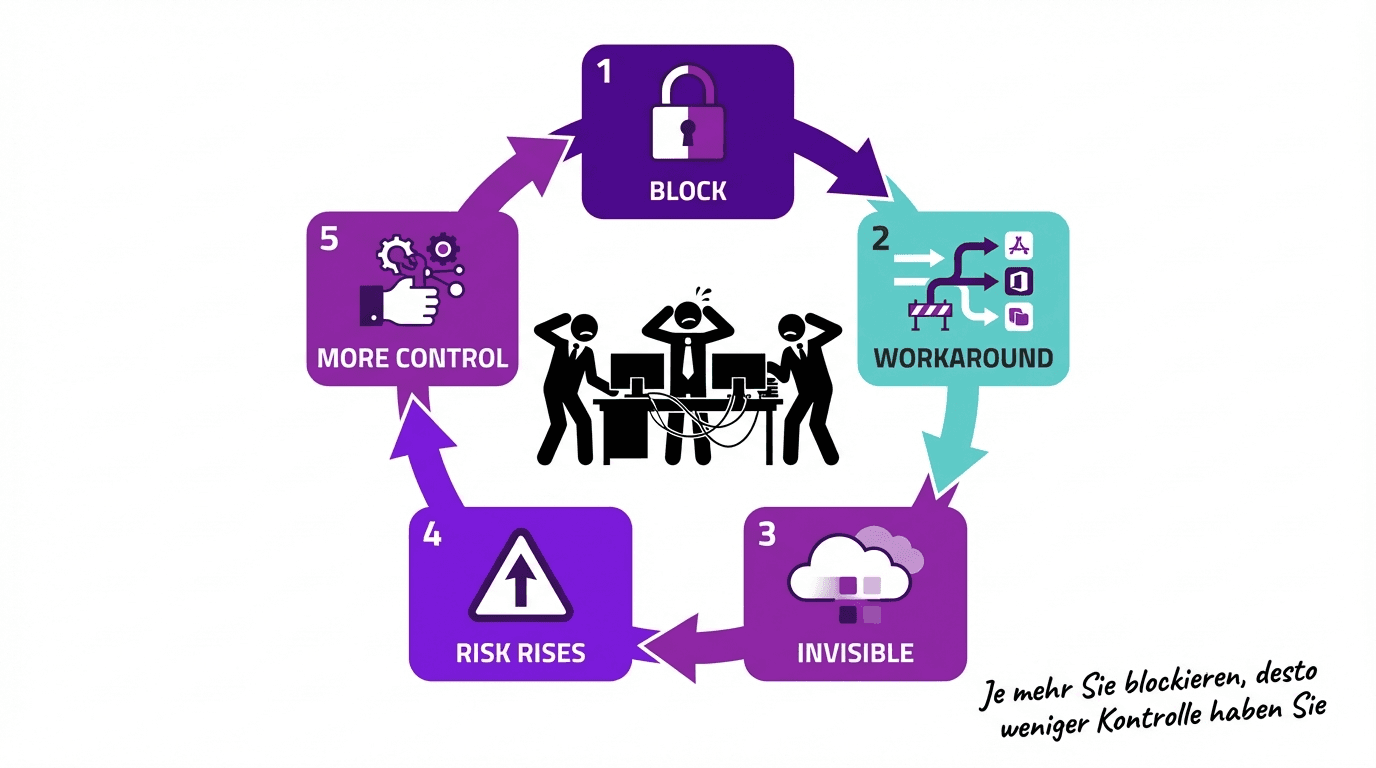
The result: you don’t have less shadow IT. You have less visibility. The risks have not become smaller—just more invisible.
Our article Why IT Excellence Belongs in Your IT Strategy offers a deeper look.
The Gartner Forecast: You Will Lose
If you were still hoping the problem would solve itself:
By 2027, 75% of employees will use technology outside IT control.
Three quarters. Not despite your efforts—but regardless of them.
The current driver: generative AI. ChatGPT, Claude, Midjourney, Copilot—employees discovered these tools long ago. Some companies blocked them. Employees still use them, on private devices, during lunch breaks, at home.
The question is no longer: "How do we prevent shadow IT?"
The question is: "How do we deal with the fact that a large portion of our employees works around IT?"
Why Traditional Countermeasures Fail
The typical IT response to shadow IT follows a predictable pattern:
Measure 1: More policies → Result: 67% know them and ignore them anyway.
Measure 2: More training → Result: Effective in the short term. After three months, old patterns return.
Measure 3: More monitoring → Result: Shadow IT becomes less visible. Risk increases.
Measure 4: More blocking → Result: More creative workarounds. More frustrated employees. Greater distance from IT.
The pattern: every measure reinforces the underlying problem.
IT is perceived as an obstacle. Trust declines. Employees search even more actively for alternatives. IT blocks even more. A vicious cycle.
The Uncomfortable Truth: You Are the Problem
Shadow IT is not the disease. It is the symptom.
A symptom of what?
An IT organization that is too slow. When requests take weeks while the business must deliver tomorrow.
An IT organization that does not understand what the business needs. When IT tools do not meet requirements.
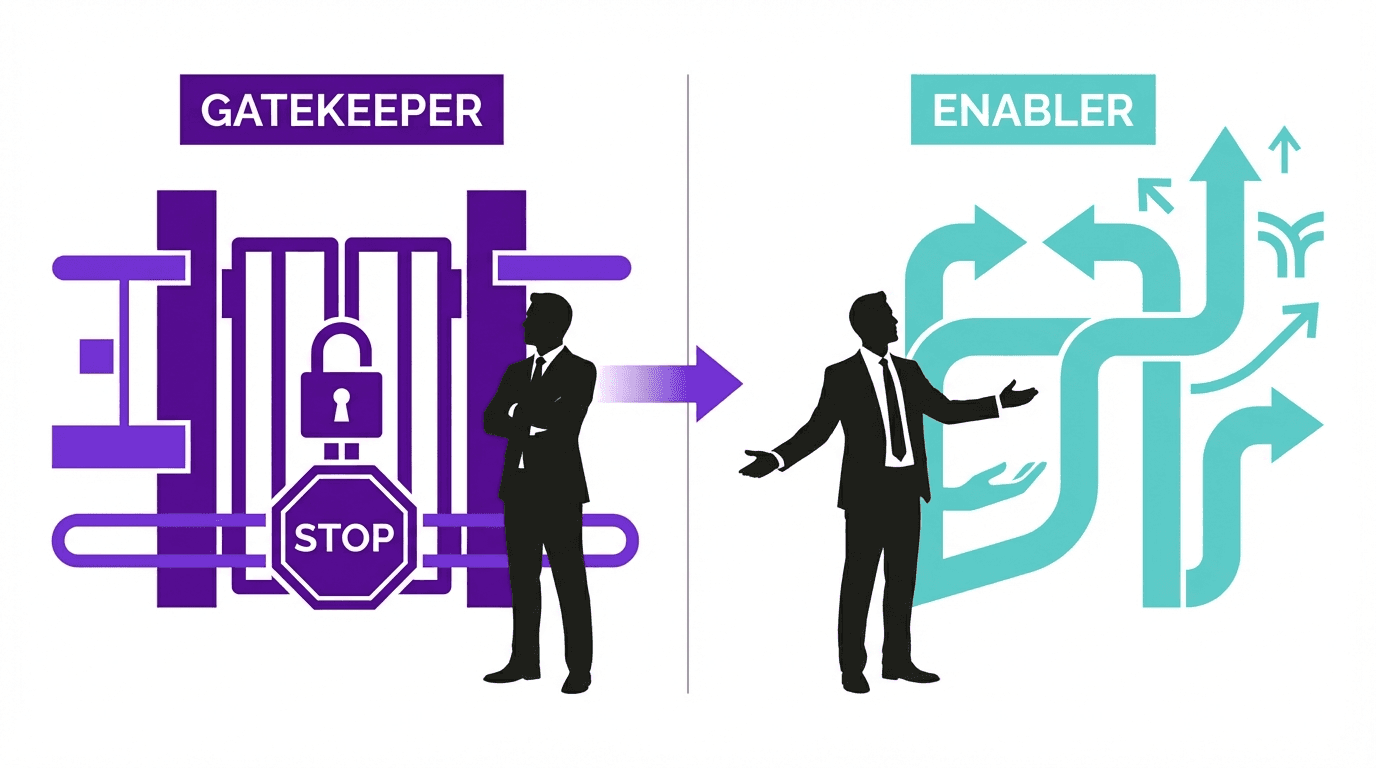
An IT organization that acts as a gatekeeper. When "No" is easier than "Yes—and this is how we do it securely."
An IT organization that puts compliance above productivity. When employees feel they are working against IT.
38% use shadow IT because IT is too slow. 54% use shadow IT to be more productive. Only 12% of IT departments can keep up.
As long as these three numbers remain unchanged, shadow IT will grow. No matter how many policies you write.
What Actually Helps: From Gatekeeper to Enabler
The solution is not more control. The solution is transformation.
1. Faster response times
Days instead of weeks. When employees know IT responds quickly, they have less reason to look for alternatives.
That means:
Clear SLAs for tool requests
Fast-track processes for standard tools
Decision-making authority at lower levels
38% of the shadow IT problem can be directly addressed through speed.
2. Self-service options
Provide pre-curated, secure alternatives. An "app store" with vetted tools that employees can activate themselves.
Need a collaboration tool? Here are three secure options.
Need file sharing? These are approved.
Want an AI tool? Here is our enterprise license.
When IT makes secure alternatives quickly available, the need for workarounds decreases.
3. Business-IT partnership
IT must understand what the business really needs. Not only technically, but in context.
That means:
IT staff in business meetings
Joint prioritization instead of one-sided backlogs
User experience as an evaluation criterion
When IT and business are partners, there is no reason to bypass IT.
4. Legitimated innovation
Instead of a total ban: controlled spaces for experimentation.
Sandbox environments for new tools
Pilot programs with clear rules
Transparent evaluation processes
Channel innovation instead of blocking it.
The Question You Should Ask Yourself
Why do your employees use shadow IT?
Not the official answer ("They don’t understand the risks"). The honest answer.
Does your IT respond quickly enough to requests?
Does your IT understand what the business really needs?
Is your IT perceived as a partner—or as an obstacle?
67% of your employees know the policies. They ignore them anyway.
This is not a question of awareness. This is a question of IT organization.
What the Numbers Really Say
80% use shadow IT. Not because they are rebelling—because they want to work.
38% do it because IT is too slow. This is not an awareness problem. This is a delivery problem.
67% know your policies. They ignore them anyway. Not out of ignorance—out of necessity.
75% will use technology outside IT control by 2027. You will not win this fight.
The solution is not more control. The solution is an IT organization that delivers faster than the workarounds.
Next Step
We help IT organizations transform.
Not through more policies or better training. But through structural change: from gatekeeper to enabler. From brake to business partner.
This is not easy. But it is the only way to truly address shadow IT.
Sources: