
Yannick H.,
Too Long; Didn't Read
More security tools do not mean more security. 65% of companies have too many, and 74% of ransomware victims say the same. The problem: 53% cannot integrate their tools, 40% of alerts are never investigated. The solution is counterintuitive: consolidation. Companies with fewer, better-integrated tools achieve a 4x higher ROI, detect threats 74 days faster, and save 15-25% on security costs.
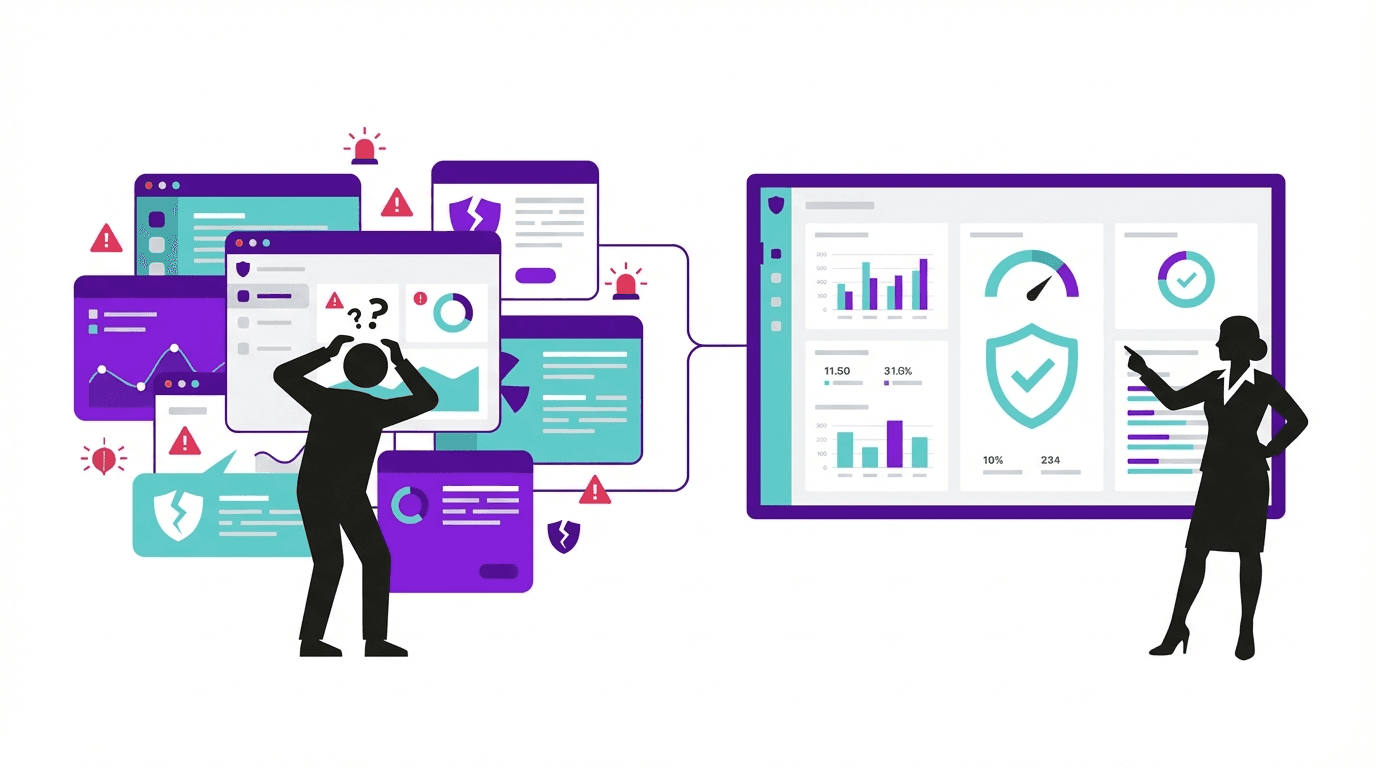
The Security Tool Paradox
Here is the situation in most SMEs:
You have an antivirus. A firewall. A SIEM. Endpoint detection. Email security. Cloud Security Posture Management. Maybe a few specialized tools for compliance.
That sounds like good security. But often it is not.
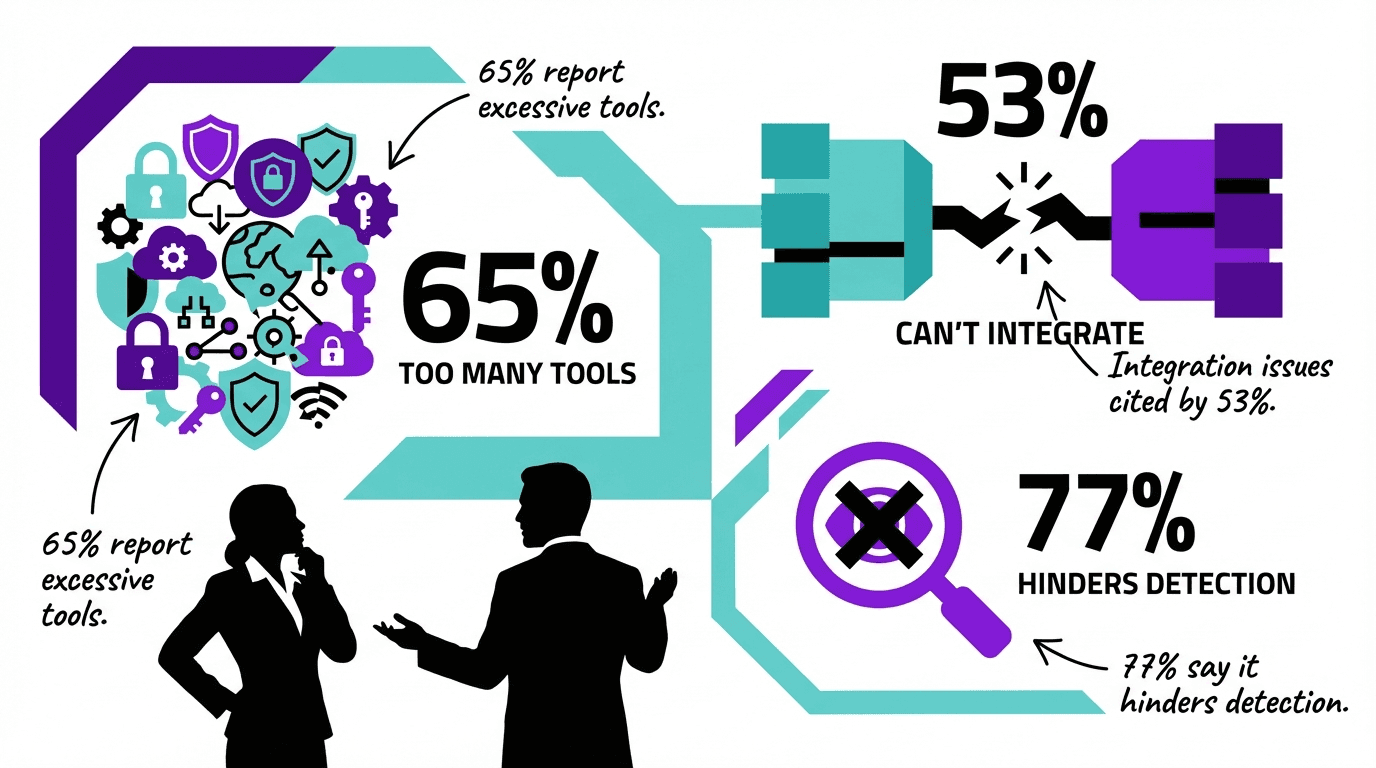
65% of companies believe they have too many security tools.
This is not an outsider's opinion. This is the majority.
The Uncomfortable Numbers
74% of companies affected by multiple ransomware attacks say: "We are juggling too many security tools."
This is not a correlation. This is a pattern. More tools, poorer outcomes.
Why?
53% of the tools cannot be integrated. Every vendor promises "Single Pane of Glass". None really delivers it.
77% say: Tool chaos hinders detection. More dashboards mean more places where something can be overlooked.
Only 10-20% of features are used. You're paying for enterprise features and using basic ones.
Alert Fatigue: The Silent Killer
This is where it gets really problematic.
On average, 960 security alerts per day. From about 28 different tools.
(AI SOC Market Landscape 2025)
No one can process 960 alerts per day effectively. So the inevitable happens:
40% of alerts are never investigated.
61% of teams have ignored alerts that later turned out to be critical.
70% of SOC teams feel emotionally overwhelmed.
(SOC Alert Fatigue Research 2025)
This means: You pay for tools that generate alarms nobody reads. And somewhere in this noise, the real attack is hiding.
The SME Dilemma
Large enterprises have SOC teams with 20+ analysts. They can afford tool sprawl - at least partially.
SMEs do not.
83% of SMEs are not prepared to recover from the financial damage of a cyberattack.
Only 14% consider their cybersecurity to be highly effective.
The problem is not a lack of budget for more tools. The problem is: more tools do not solve the problem.
What Works: Consolidation
The numbers are clear.
75% of companies are actively consolidating their security tools. In 2020, it was only 29%.
This is not a cost-saving exercise. This is a security strategy.
The Results of Consolidators:
4x higher ROI. Consolidated platforms: 101% ROI. Fragmented stacks: 28%.
74 days faster detection. Because one platform correlates faster than 20 dashboards.
84 days faster response. Because orchestration works automatically, manual coordination does not.
15-25% less security expenses. Fewer licenses, less integration effort, less management overhead.
The Pragmatic Security Strategy
Here is what we recommend for SMEs:
1. Take Inventory
List all security tools. All of them. Even the "free" browser plugins and the Excel sheets for compliance tracking.
Most are surprised at how many there are.
2. Check Usage
For each tool: Who uses it? How often? Which features?
Ernst & Young says: Most use 10-20% of what they pay for. Our experience confirms this.
3. Identify Overlaps
Three different endpoint solutions? Two SIEM approaches? Cloud security from the cloud provider AND a third-party tool?
This is not defense-in-depth. This is tool sprawl.
4. Consolidate, Don't Accumulate
The goal: 5-7 tools covering 95% of threats. Properly configured. Properly integrated. Monitored by someone who knows what they're doing.
Better than 20 tools that never investigate 40% of alerts.
The CISO Question
Most SMEs do not have a CISO. And do not need a full-time CISO.
What they need: Someone responsible for the security strategy. Who makes tool decisions. Who prioritizes the alerts that are important.
This can be an external CISO-as-a-Service. This can be an IT leader with a security focus. This can be a managed security provider.
What it cannot be: Nobody.
61% of teams have ignored critical alerts. Not out of incompetence - out of overload.
Someone has to make the decisions. Someone has to have the overview. Someone has to be able to say no when the next vendor comes with the next "indispensable" tool.
The Next Step
Tomorrow morning: Count your security tools.
Not the ones you know about. All of them. Ask your team. Check the credit card statements. Look into the cloud subscriptions.
If the number is higher than you thought - and it almost always is - then consolidation is not an option. It is a necessity.
Fewer tools. Better integrated. Properly monitored.
That is pragmatic cybersecurity.
If You Need Help
We conduct security assessments for SMEs. Not to sell more tools - to identify the right ones.
Security Assessment: What do you have? What do you really need?
Tool Consolidation: From 20 to 7 - without security gaps
CISO-as-a-Service: Strategy and oversight without full-time costs
Managed Detection: Alerts that someone actually reads
Sources: